































Συμπληρώματα Biohacking 2026: Τι υποστηρίζεται από την έρευνα, τι είναι η διαφημιστική εκστρατεία
Τα συμπληρώματα βιολογικού χάκερ σχηματίζουν μια παγκόσμια βιομηχανία που εκτιμάται σε δεκάδες δισεκατομμύρια δολάρια το 2026, μεγάλο μέρος της οποίας θα είναι θόρυβος. Η κατηγορία αυτή πουλάει τα πάντα, από κρεατίνη (δεκαετίες αδιάσειστων στοιχείων) έως ενέσιμα πεπτίδια (χωρίς έγκριση από τον FDA, προσφορά από την γκρίζα αγορά). Αυτή η ανασκόπηση διαχωρίζει αυτό που γενικά υποστηρίζει η έρευνα από ομότιμους από αυτό που ισοδυναμεί με μάρκετινγκ που βασίζεται σε μελέτες τρωκτικών, μαρτυρίες μεμονωμένων διασημοτήτων ή βιοχημεία που δεν έχει μεταφραστεί στους ανθρώπους.
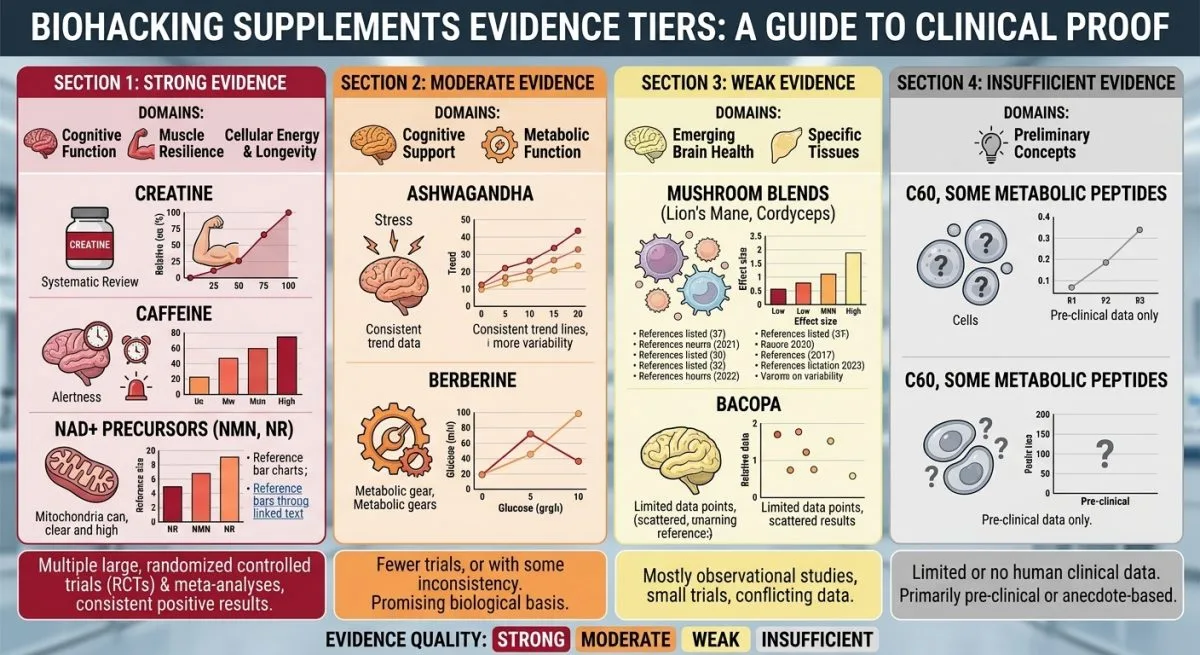
Το πλαίσιο είναι απλό. ΙΣΧΥΡΑ στοιχεία σημαίνουν πολλαπλές δοκιμές σε ανθρώπους με αξιολόγηση από ομοτίμους, συχνά με μετα-αναλύσεις ή συστηματικές ανασκοπήσεις. ΜΕΤΡΙΑ σημαίνει αρκετές θετικές τυχαιοποιημένες ελεγχόμενες δοκιμές (RCT) με επιφυλάξεις σχετικά με τη γενίκευση ή το μέγεθος του αποτελέσματος. ΑΔΥΝΑΜΙΚΗ ή ΑΝΑΔΥΟΜΕΝΗ σημαίνει μικρές μελέτες, δεδομένα μόνο σε ζώα ή μικτά κλινικά αποτελέσματα. ΑΝΕΠΑΡΚΗΣ σημαίνει εκτεταμένοι ισχυρισμοί μάρκετινγκ χωρίς ισχυρά κλινικά στοιχεία από τον Ιούνιο του 2026.
Αυτή η ανασκόπηση βασίζεται σε γενική βιβλιογραφία διατροφής και κλινικής έρευνας που καλύπτει την κρεατίνη, τα ωμέγα-3, τους προδρόμους NAD+ και σχετικές ενώσεις. Όπου αναφέρονται πρόσφατες επώνυμες μελέτες στο μάρκετινγκ συμπληρωμάτων, το άρθρο αυτό χρησιμοποιεί σκόπιμα γενικευμένες αναφορές αντί για συγκεκριμένες αναφορές συγγραφέα-έτος-DOI, επειδή αρκετές από τις συγκεκριμένες αναφορές που κυκλοφορούν στο περιεχόμενο biohacking 2024-2026 δεν επαληθεύτηκαν με σαφήνεια σε πηγές αξιολογημένες από ομότιμους κατά τη στιγμή της σύνταξης. Επαληθευμένα κανονιστικά στοιχεία, όπως η αναταξινόμηση της NMN από τον FDA των ΗΠΑ τον Οκτώβριο του 2022 από την κατηγορία των συμπληρωμάτων διατροφής, αναφέρονται με τις συγκεκριμένες ημερομηνίες τους.
Αξιολόγηση Αποδεικτικών Στοιχείων με μια Ματιά: 14 Συμπληρώματα Βιοχακινγκ
Πίνακας γρήγορης αναφοράς που καλύπτει τα πιο συνηθισμένα συμπληρώματα βιολογικής χακάρισης το 2026. Διαβάστε πρώτα αυτό. Ακολουθεί λεπτομερής ανάλυση ανά επίπεδο αποδεικτικών στοιχείων. Όλες οι αξιολογήσεις αντικατοπτρίζουν τη γενική κατάσταση της έρευνας σε ανθρώπους που έχει αξιολογηθεί από ομότιμους τον Ιούνιο του 2026.
| Συμπλήρωμα | Ανθρώπινες δοκιμές | Αξιολόγηση Αποδεικτικών Στοιχείων | Τυπική δόση | Μηνιαίο κόστος (USD) |
|---|---|---|---|---|
| Μονοϋδρική κρεατίνη | Εκατοντάδες (θέση ISSN περίπτερο) | ΙΣΧΥΡΟΣ | 3-5 γρ. ημερησίως | $10-20 |
| Ωμέγα-3 (EPA + DHA) | Εκατοντάδες, πολλαπλές μετα-αναλύσεις | ΙΣΧΥΡΟΣ | 1-3 γρ. EPA+DHA ημερησίως | $15-40 |
| Μαγνήσιο (γλυκινικό ή κιτρικό) | Πολλαπλές δημοσιευμένες κριτικές | ΔΥΝΑΤΟ (αν είναι ελλιπές) | 300-400 mg ημερησίως | $8-20 |
| Βιταμίνη D3 | Εκατοντάδες (ανάλογα με την ανεπάρκεια) | ΔΥΝΑΤΟ (υπό όρους) | 1.000-4.000 IU ανά δοκιμή | $5-15 |
| Πρωτεΐνη (ορός γάλακτος, καζεΐνη, τρόφιμα) | Δεδομένα αθλητικής διατροφής δεκαετιών | ΙΣΧΥΡΟΣ | 1,6-2,2 g/kg σωματικού βάρους | $20-60 |
| Ασβαγκάντα (KSM-66) | Πολλαπλές τυχαιοποιημένες ελεγχόμενες δοκιμές, μέτριες επιδράσεις | ΜΕΤΡΙΟΣ | 300-600 mg ημερησίως | $15-30 |
| L-Θεανίνη | τυχαιοποιημένες ελεγχόμενες δοκιμές (RCTs) για το άγχος και την εστίαση | ΜΕΤΡΙΟΣ | 100-200 mg ημερησίως | $10-20 |
| ΝΜΝ | Πολλαπλές τυχαιοποιημένες ελεγχόμενες δοκιμές σε ανθρώπους που αναφέρθηκαν το 2024-2025 | ΜΕΤΡΙΑ (βιοχημική) / ΑΝΕΠΑΡΚΗΣ (κλινική) | 250-500 mg ημερησίως | $40-90 |
| NR (νικοτιναμίδιο ριβοζίδιο) | Χρηματοδοτούμενες από το NIH τυχαιοποιημένες ελεγχόμενες δοκιμές (RCTs), κατάσταση GRAS | ΜΕΤΡΙΑ (βιοχημική) / ΑΝΕΠΑΡΚΗΣ (κλινική) | 250-500 mg ημερησίως | $35-80 |
| Φισετίνη (σενολυτική) | Περιορισμένος άνθρωπος, δυνατό ζώο | ΑΔΥΝΑΜΟΣ / ΑΝΑΔΥΟΜΕΝΟΣ | 100-500 mg κυκλικής | $25-60 |
| AKG (άλφα-κετογλουταρικό) | Λίγες ανθρώπινες δοκιμές | ΑΔΥΝΑΜΟΣ / ΑΝΑΔΥΟΜΕΝΟΣ | 1-2 γρ. ημερησίως | $30-60 |
| Ρεσβερατρόλη | Οι δοκιμές σε ανθρώπους για τα αποτελέσματα μακροζωίας απέτυχαν | ΑΔΥΝΑΜΟΣ (μόνο για τρωκτικά) | 150-500 mg ημερησίως | $15-40 |
| Πεπτίδια (TB-500, BPC-157) | Δεν έχει εγκριθεί από τον FDA. Περιορισμένα δεδομένα για την ασφάλεια στον άνθρωπο. | ΑΝΕΠΑΡΚΗΣ | δ/υ (μη εγκεκριμένο συμπλήρωμα) | $50-300+ (γκρίζα αγορά) |
| Μείγματα μανιταριών ‘μακροζωίας’ | Ισχυρισμοί μάρκετινγκ· δεν υπάρχουν αυστηρές δοκιμές μακροζωίας | ΑΝΕΠΑΡΚΗΣ | Ποικίλλει | $30-100 |
ΙΣΧΥΡΗ: πολλαπλές μετα-αναλύσεις ή μεγάλες τυχαιοποιημένες ελεγχόμενες δοκιμές (RCT) με σταθερά θετικά αποτελέσματα. ΜΕΤΡΙΑ: αρκετές θετικές δοκιμές με επιφυλάξεις ή ασαφή κλινική ερμηνεία. ΑΔΥΝΑΜΗ / ΑΝΑΔΥΟΜΕΝΗ: περιορισμένα δεδομένα για ανθρώπους, κυρίως στοιχεία από ζώα ή μικτά κλινικά αποτελέσματα. ΑΝΕΠΑΡΚΗΣ: ισχυρισμοί μάρκετινγκ χωρίς ισχυρά στοιχεία· σε ορισμένες περιπτώσεις, κανονιστικά ζητήματα (π.χ., αφαίρεση NMN από τη λίστα συμπληρωμάτων του FDA τον Οκτώβριο του 2022, πεπτίδια ως μη εγκεκριμένα φάρμακα).
Τι είναι τα συμπληρώματα βιο-χακινγκ; (Γρήγορο πλαίσιο)
Τα συμπληρώματα βιο-χάκινγκ είναι ενώσεις που χρησιμοποιούνται για τη βελτιστοποίηση της σωματικής ή γνωστικής λειτουργίας πέρα από την αντιμετώπιση των διατροφικών ελλείψεων. Η κατηγορία αυτή συμπίπτει με την αθλητική διατροφή (κρεατίνη, πρωτεΐνη), με την έρευνα για τη μακροζωία (NMN, NR) και με τη γνωστική ενίσχυση (νοοτροπικά συμπληρώματα). Αυτό που διακρίνει το βιο-χάκινγκ από τη συμβατική χρήση συμπληρωμάτων είναι η νοοτροπία βελτιστοποίησης: όχι μόνο η διόρθωση ενός ελλείμματος, αλλά και η αύξηση της απόδοσης, της διάρκειας ζωής ή της γνωστικής λειτουργίας πάνω από την αρχική τιμή.
Η βιομηχανία επεκτάθηκε ραγδαία τα τελευταία πέντε χρόνια χάρη σε διάσημους βιοχάκερ όπως ο Μπράιαν Τζόνσον και ο Ντέιβ Άσπρεϊ, στην κουλτούρα των podcast και στο ευρύτερο ενδιαφέρον για την έρευνα για τη μακροζωία. Οι εκτιμήσεις της βιομηχανίας για το μέγεθος της παγκόσμιας αγοράς το 2026 ανέρχονται σε δεκάδες δισεκατομμύρια δολάρια σε όλες τις κατηγορίες συμπληρωμάτων μακροζωίας, νοοτροπικών και προσαρμογόνων. Το μεγαλύτερο μέρος αυτών των εσόδων δεν αντιστοιχεί σε ενώσεις που βασίζονται σε στοιχεία. Αυτό που είναι το βιοχάκερ στην πράξη για πολλούς καταναλωτές είναι η πληρωμή για ελπίδα και καινοτομία, όχι για μετρήσιμα αποτελέσματα. Αυτή η ανασκόπηση επικεντρώνεται σε ενώσεις όπου η αναλογία στοιχείων προς κόστος δικαιολογεί στην πραγματικότητα την συμπερίληψη σε μια στοίβα.
ΙΣΧΥΡΗ ΑΠΟΔΕΙΞΗ: Οι Πέντε Βασικοί Πυρήνες (Συμπληρώματα Βιοχακινγκ Θεμελιωδών Δράσεων)
Πέντε συμπληρώματα έχουν δεκαετίες αδιάσειστης ανθρώπινης εμπειρίας και αποτελούν τη βάση οποιασδήποτε ορθολογικής στοίβας. Κανένα δεν είναι εξωτικό. Όλα κοστίζουν κάτω από $20 το μήνα το καθένα. Μαζί, γενικά ξεπερνούν τα περισσότερα πρωτόκολλα υψηλής ποιότητας διασημοτήτων σε μετρήσιμους δείκτες υγείας, όπως ο δείκτης ωμέγα-3, η κατάσταση της βιταμίνης D, η επάρκεια μαγνησίου και η άλιπη σωματική μάζα.
Μονοϋδρική κρεατίνη (Πέρα από τους μύες)
Η κρεατίνη είναι το καλύτερα μελετημένο συμπλήρωμα στην αθλητική διατροφή, με εκατοντάδες τυχαιοποιημένες ελεγχόμενες δοκιμές (RCT) να υποστηρίζουν οφέλη για τους μύες, τη δύναμη και την απόδοση. Η Διεθνής Εταιρεία Αθλητικής Διατροφής διατηρεί μια επίσημη θέση σχετικά με την κρεατίνη που συνοψίζει αυτήν τη βάση δεδομένων. Αυτό που έχει αλλάξει τα τελευταία χρόνια είναι η γνωστική ιστορία: πολλαπλές μετα-αναλύσεις και συστηματικές ανασκοπήσεις τυχαιοποιημένων ελεγχόμενων δοκιμών (RCT) για την κρεατίνη έχουν αναφέρει γνωστικά οφέλη, ιδιαίτερα σε άτομα που έχουν στερηθεί ύπνου, ηλικιωμένους και χορτοφάγους. Τα μεγέθη των αποτελεσμάτων είναι μέτρια αλλά αρκετά σταθερά ώστε η κρεατίνη να έχει γίνει ένας λογικός υποψήφιος ως συμπλήρωμα κρεατίνης για τη λειτουργία των μυών και του εγκεφάλου. Τυπική δόση: 3-5 g ημερησίως. Κόστος: 10-20 USD ανά μήνα. Συμβουλευτείτε τον πάροχο υγειονομικής περίθαλψης πριν ξεκινήσετε, ειδικά εάν έχετε νεφρικά προβλήματα.
Ωμέγα-3 λιπαρά οξέα (υποδοσολογημένα σε όλη τη βιομηχανία)
Τα στοιχεία για τη μακροζωία των ωμέγα-3 είναι από τα πιο ισχυρά από οποιαδήποτε άλλη κατηγορία συμπληρωμάτων. Εκατοντάδες δοκιμές και πολλαπλές μετα-αναλύσεις υποστηρίζουν τα καρδιαγγειακά και γνωστικά οφέλη. Η βιβλιογραφία για τη μακροζωία των ωμέγα-3 είναι επίσης μια από τις πιο συνεπείς όσον αφορά τη στόχευση: ένας Δείκτης Ωμέγα-3 8% ή υψηλότερος στα ερυθρά αιμοσφαίρια είναι ένας συχνά αναφερόμενος στόχος στη βιβλιογραφία. Πολλοί Αμερικανοί έχουν ως στόχο 4-5%. Τυπική δόση EPA + DHA: 1-3 g ημερησίως. Κόστος: 15-40 USD ανά μήνα για μάρκες που έχουν δοκιμαστεί από τρίτους. Το ζήτημα της δοσολογίας είναι πραγματικό: πολλά προϊόντα που διατίθενται χωρίς ιατρική συνταγή περιέχουν 200-400 mg ανά κάψουλα, απαιτώντας αρκετές κάψουλες για να επιτευχθούν οι τυπικές θεραπευτικές δόσεις. Συμβουλευτείτε έναν πάροχο υγειονομικής περίθαλψης πριν συνδυάσετε υψηλή δόση ωμέγα-3 με φάρμακα αραίωσης του αίματος.
Μαγνήσιο (Γλυκινικό ή Κιτρικό)
Ένα σημαντικό μέρος των ενηλίκων στις ΗΠΑ δεν λαμβάνει τη συνιστώμενη πρόσληψη μαγνησίου σύμφωνα με διατροφικές έρευνες. Το γλυκινικό μαγνήσιο (απορροφάται καλά, είναι ήπιο για την πέψη) και το κιτρικό μαγνήσιο (αποτελεσματικό, ελαφρώς καθαρτικό) είναι οι πρακτικές μορφές. Τα στοιχεία υποστηρίζουν τα οφέλη για τον ύπνο, την αρτηριακή πίεση και τη ρύθμιση της γλυκόζης. Πολλαπλές δημοσιευμένες κριτικές τοποθετούν το μαγνήσιο στη βάση οποιασδήποτε στοίβας μακροζωίας που βασίζεται σε στοιχεία. Τυπική δόση: 300-400 mg στοιχειακού μαγνησίου ημερησίως. Κόστος: 8-20 δολάρια ΗΠΑ ανά μήνα. Συμβουλευτείτε έναν πάροχο υγειονομικής περίθαλψης πριν από τη λήψη συμπληρώματος εάν έχετε νεφρική νόσο ή λαμβάνετε φάρμακα που επηρεάζονται από την κατάσταση του μαγνησίου.
Βιταμίνη D3 (Ισχυρή υπό όρους απόδειξη)
Τα στοιχεία για τα συμπληρώματα βιταμίνης D είναι ΙΣΧΥΡΑ μόνο εάν έχετε ανεπάρκεια. Πολλοί ηλικιωμένοι και άτομα με περιορισμένη έκθεση στον ήλιο έχουν. Κάντε έλεγχο πριν από τη λήψη συμπληρώματος: Οι στόχοι της 25-υδροξυβιταμίνης D αναφέρονται συνήθως γύρω στα 40-60 ng/mL για τη γενική υγεία, αν και τα κλινικά όρια ποικίλλουν ανάλογα με τον πάροχο και τις οδηγίες. Οι δόσεις κυμαίνονται συνήθως από 1.000 IU ημερησίως για ήπια ανεπάρκεια έως 4.000 IU για σοβαρή ανεπάρκεια, προσαρμοσμένες με εξετάσεις παρακολούθησης υπό την επίβλεψη του παρόχου. Κόστος: 5-15 USD ανά μήνα. Μην λαμβάνετε άσκοπα υψηλές δόσεις χωρίς έλεγχο, επειδή η βιταμίνη D είναι λιποδιαλυτή και η τοξικότητα είναι πιθανή σε παρατεταμένη υψηλή πρόσληψη. Συμβουλευτείτε έναν πάροχο υγειονομικής περίθαλψης πριν από τη λήψη συμπληρώματος πάνω από την τυπική πρόσληψη αναφοράς.
Πρωτεΐνη (συχνά παραβλεπόμενη)
Η πρωτεΐνη είναι το πιο τεκμηριωμένο συμπλήρωμα για τους μύες και τη γήρανση, το οποίο συχνά παραλείπεται στις συζητήσεις για το biohacking επειδή δεν είναι χάπι. Οι ενεργοί ενήλικες γενικά επωφελούνται από 1,6 έως 2,2 γραμμάρια ανά κιλό σωματικού βάρους ημερησίως για τη συντήρηση των μυών και την πρόληψη της σαρκοπενίας, σύμφωνα με τις καθιερωμένες οδηγίες αθλητικής διατροφής. Το όριο λευκίνης, που συνήθως αναφέρεται ως 2,5-3 γραμμάρια ανά γεύμα, φαίνεται σημαντικό για τη σύνθεση πρωτεϊνών σε ηλικιωμένους ενήλικες. Η πρωτεΐνη ορού γάλακτος, η καζεΐνη ή οι πηγές τροφίμων λειτουργούν. Κόστος: 20-60 δολάρια ΗΠΑ ανά μήνα για σκόνη πρωτεΐνης βαθμού συμπληρώματος, συχνά $0 από την τροφή εάν η διατροφή είναι επαρκής. Συμβουλευτείτε έναν πάροχο υγειονομικής περίθαλψης εάν έχετε νεφρική νόσο πριν αυξήσετε σημαντικά την πρόσληψη πρωτεΐνης.
ΜΕΤΡΙΑ ΑΠΟΔΕΙΞΗ: Πολλά υποσχόμενα αλλά μη αποδεδειγμένα συμπληρώματα βιο-χακώματος
Πέντε κατηγορίες ενώσεων παρουσιάζουν σημαντικά στοιχεία, αλλά με επιφυλάξεις. Η βιοχημεία είναι σαφής. Η κλινική μετάφραση είναι μερική. Αυτές ανήκουν σε καλά οργανωμένες στοίβες για χρήστες που αποδέχονται τον πειραματικό χαρακτήρα, όχι σε συμπληρώματα βάσης. Συμβουλευτείτε έναν πάροχο υγειονομικής περίθαλψης πριν προσθέσετε οποιαδήποτε από αυτές, ειδικά εάν λαμβάνετε συνταγογραφούμενα φάρμακα.
NMN και NR (Πρόδρομοι NAD+)
Το συμπλήρωμα NMN και το NR (νικοτιναμίδιο ριβοζίδιο) αυξάνουν αξιόπιστα τα επίπεδα NAD+ στο αίμα σε δοκιμές σε ανθρώπους. Αυτή η βιοχημική αλληλεπίδραση επιβεβαιώνεται σε πολλαπλές δημοσιευμένες τυχαιοποιημένες ελεγχόμενες μελέτες. Πρόσφατες ανασκοπήσεις του NMN και του NR αναφέρουν γενικά συνεπείς βιοχημικές επιδράσεις, αλλά ασυνεπή κλινική ερμηνεία για μετρήσιμα αποτελέσματα για την υγεία. Οι συστηματικές ανασκοπήσεις των προδρόμων NAD+ του 2025 κάλυψαν δεδομένα τόσο για ανθρώπους όσο και για τρωκτικά σε περίπου εκατό μελέτες και κατέληξαν σε παρόμοια ανάμεικτα συμπεράσματα. Η διάκριση nmn έναντι nr έχει μεγαλύτερη νομική σημασία παρά βιοχημική το 2026: Το NR διατηρεί την κατάσταση GRAS στον FDA, ενώ το NMN αφαιρέθηκε από τον κατάλογο των συμπληρωμάτων διατροφής τον Οκτώβριο του 2022 (μια επαληθευμένη ρυθμιστική δράση του FDA) και παρέμεινε σε καθεστώς έρευνας φαρμάκων κατά τη στιγμή της σύνταξης του παρόντος. Διεθνώς, και οι δύο ενώσεις αποστέλλονται ελεύθερα. στις ΗΠΑ, οι πωλήσεις NMN λειτουργούν σε κανονιστική αβεβαιότητα. Δόσεις που αναφέρονται στη βιβλιογραφία: 250-500 mg ημερησίως. Κόστος: 35-90 USD ανά μήνα η καθεμία. Συμβουλευτείτε έναν πάροχο υγειονομικής περίθαλψης πριν από τη χρήση.
Φισετίνη, AKG (άλφα-κετογλουταρικό), Γλυκίνη
Αυτά τα τρία ανήκουν στις κατηγορίες γερονλυτικής και μιτοχονδριακής υποστήριξης με ισχυρά δεδομένα σε ζώα και περιορισμένες δοκιμές σε ανθρώπους. Η φισετίνη παρουσιάζει ενδιαφέρουσα γερονλυτική δράση σε ποντίκια. Οι δοκιμές σε ανθρώπους είναι πρώιμες και μικρές. Η συμπλήρωση AKG παρατείνει τη διάρκεια ζωής σε ποντίκια, αλλά τα αποτελέσματα για τη μακροζωία σε ανθρώπους δεν έχουν μελετηθεί. Η γλυκίνη έχει ορισμένα δεδομένα δεικτών ύπνου και μακροζωίας, αλλά δεν διαθέτει μεγάλες τυχαιοποιημένες ελεγχόμενες δοκιμές (RCT). Αυτές οι ενώσεις εμφανίζονται σε γνωστές στοίβες (για παράδειγμα, NOVOS Core), συχνά συνδυασμένες μεταξύ τους. Είναι λογικές προσθήκες για χρήστες που αποδέχονται την πειραματική κατάσταση. Δεν είναι συμπληρώματα βάσης. Συμβουλευτείτε έναν πάροχο υγειονομικής περίθαλψης πριν προσθέσετε γερονολυτικές ενώσεις, ιδιαίτερα εάν λαμβάνετε ανοσοτροποποιητικά φάρμακα.
Προσαρμογόνα: Ashwagandha και L-Theanine (Νοοτροπικά Συμπληρώματα)
Η Ashwagandha (ιδιαίτερα το εκχύλισμα KSM-66) έχει πολλαπλές τυχαιοποιημένες ελεγχόμενες δοκιμές που υποστηρίζουν μέτρια μείωση της κορτιζόλης και του στρες. Η L-Θεανίνη έχει αξιοσημείωτες ενδείξεις για τη μείωση του στρες και την εστίαση της προσοχής, ιδιαίτερα σε συνδυασμό με την καφεΐνη. Και τα δύο χαρακτηρίζονται ως νοοτροπικά συμπληρώματα με ΜΕΤΡΙΕΣ ενδείξεις. Τα αποτελέσματα είναι πραγματικά αλλά μέτρια σε μέγεθος. Μην περιμένετε δραματικές μεταμορφώσεις. Τυπικές δόσεις: ashwagandha 300-600 mg ημερησίως, L-θεανίνη 100-200 mg. Κόστος: 10-30 δολάρια ΗΠΑ ανά μήνα η καθεμία. Συμβουλευτείτε έναν πάροχο υγειονομικής περίθαλψης πριν από τη χρήση, ιδιαίτερα για την ashwagandha εάν έχετε παθήσεις του θυρεοειδούς ή λαμβάνετε ανοσοκατασταλτικά.
ΑΔΥΝΑΜΑ Ή ΑΝΕΠΑΡΚΗ ΑΠΟΔΕΙΞΗ: Η λίστα με τις υπερβολικές προσδοκίες
Η λίστα με τα συμπληρώματα βιο-χακάρισμα για τα οποία υπάρχουν αδύναμα ανθρώπινα στοιχεία σε σχέση με τον προϋπολογισμό μάρκετινγκ τους είναι μεγάλη. Τα περισσότερα ανήκουν στην κατηγορία αποφυγής μέχρι να βελτιωθούν τα στοιχεία.
- Ρεσβερατρόλη: μελέτες σε τρωκτικά έδειξαν παράταση της διάρκειας ζωής. οι δοκιμές σε ανθρώπους δεν έχουν αναπαράγει σημαντικά αποτελέσματα μακροζωίας. Η εμπορία συμπληρωμάτων ρεσβερατρόλης ξεπερνά κατά πολύ τα ανθρώπινα στοιχεία. ΑΔΥΝΑΜΗ βαθμολογία.
- Κλασικά νοοτροπικά (πιρακετάμη, ανιρακετάμη): τα περισσότερα στοιχεία είναι κακής ποιότητας. Οι ισχυρισμοί για γνωστική βελτίωση δεν υποστηρίζονται σε μεγάλο βαθμό σε υγιείς ενήλικες.
- Πεπτίδια βιο-χακάροντας (TB-500, BPC-157): δεν έχουν εγκριθεί από τον FDA ως συμπληρώματα. Οι πηγές της γκρίζας αγοράς ενέχουν πραγματικούς κινδύνους μόλυνσης και δοσολογίας. Περιορισμένα δεδομένα ασφάλειας για τον άνθρωπο. ΑΝΕΠΑΡΚΕΣ.
- Συμπληρώματα αποτοξίνωσης: δεν υπάρχουν κλινικά στοιχεία ότι τα συμπληρώματα αποτοξινώνουν τον οργανισμό. Το ήπαρ και τα νεφρά χειρίζονται βιολογικά αυτή τη λειτουργία. Κατηγορία μόνο για μάρκετινγκ.
- Σύμπλοκα μανιταριών ‘μακροζωίας’ (χαίτη λιονταριού, reishi, cordyceps σε ιδιόκτητα μείγματα): ορισμένα γνωστικά στοιχεία για τη χαίτη λιονταριού σε μικρές δοκιμές. Οι γενικοί ισχυρισμοί για τη μακροζωία δεν υποστηρίζονται.
- Ιδιόκτητα μείγματα χωρίς αποκαλυφθείσα δοσολογία: οποιοδήποτε προϊόν που κρύβει μεμονωμένες ποσότητες συστατικών πίσω από μια ετικέτα ‘ιδιόκτητου μείγματος’ δεν είναι μελετήσιμο, ανεξάρτητα από την εμπορία του.
- Ενδοφλέβιες σταγόνες για ευεξία: ακριβές, χωρίς αυστηρά στοιχεία για υγιείς ενήλικες, πραγματικοί κίνδυνοι για λοιμώξεις και ηλεκτρολύτες.
- Η ραπαμυκίνη πωλείται ως συμπλήρωμα: η ραπαμυκίνη είναι φάρμακο που χορηγείται με ιατρική συνταγή, όχι συμπλήρωμα. Η χρήση εκτός ενδείξεων ενέχει πραγματικούς κινδύνους ανοσοκαταστολής. Η έρευνα για τη μακροζωία της ραπαμυκίνης είναι ενδιαφέρουσα, αλλά απαιτεί ιατρική επίβλεψη.
Κόστος Biohacking Stack: Ειλικρινή Μηνιαία Μαθηματικά
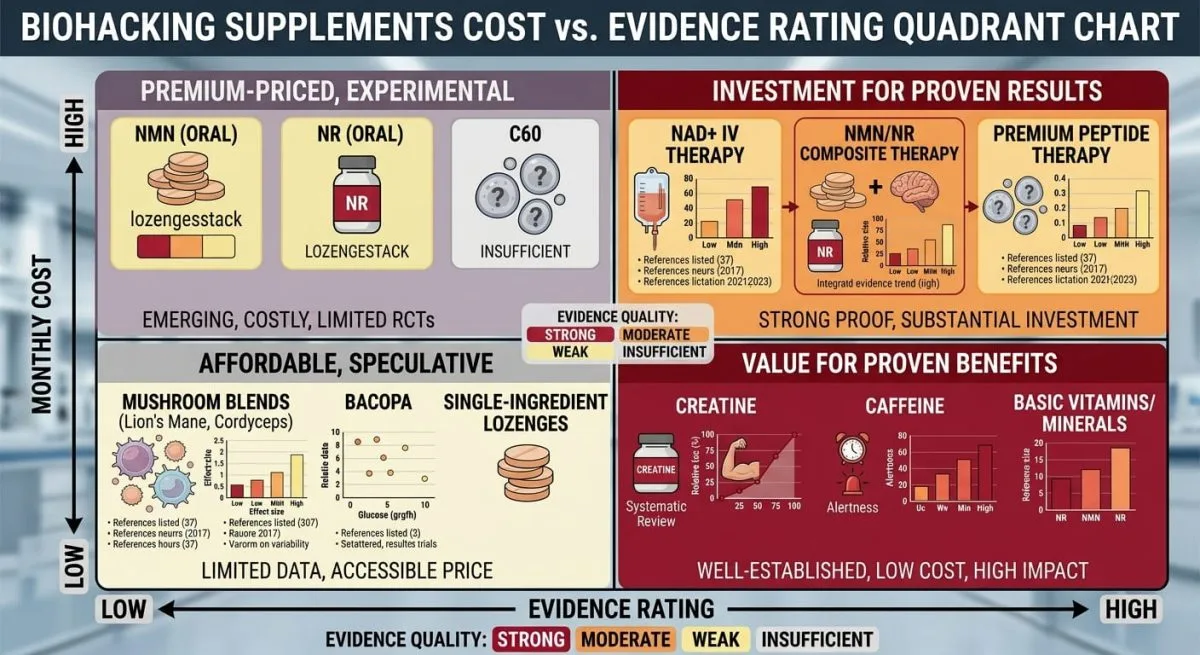
Το πιο μετρήσιμο όφελος από τα συμπληρώματα βιολογικής χάκερ προέρχεται από τα πρώτα $50-80 ανά μήνα. Οι μειούμενες αποδόσεις ξεπέρασαν γρήγορα τα $150 ανά μήνα. Η βαθμίδα Bryan Johnson ($1.000+ μηνιαίως) περιλαμβάνει πολλές πειραματικές ενώσεις όπου η αναλογία αποδεικτικών στοιχείων προς κόστος είναι χαμηλή.
| Κερκίδα | Σύνθεση στοίβας | Μηνιαίο κόστος (USD) |
|---|---|---|
| Ελάχιστη Θεμελίωση | Κρεατίνη + ωμέγα-3 + μαγνήσιο + βιταμίνη D + πρωτεΐνη από τρόφιμα | $30-50 |
| Πλήρες Ίδρυμα | Οι ίδιες πέντε + δοκιμασμένες από τρίτους μάρκες + επαρκείς δόσεις | $80-150 |
| NAD+ Enthusiast | Foundation + NMN ή NR + ashwagandha | $150-300 |
| Μπράιαν Τζόνσον Τάιερ | Πολλαπλές πειραματικές ενώσεις + συχνές δοκιμές + προηγμένα πεπτίδια | $1,000-2,000+ |
Η διαβάθμιση κόστους-αποδεικτικών στοιχείων είναι απότομη. Το Minimal Foundation καταγράφει περίπου 80% μετρήσιμου οφέλους από το συμπλήρωμα βιο-χακώματος με 5% κόστους premium. Η προσθήκη προδρόμων NAD+ προσθέτει βιοχημικές επιδράσεις με ασαφή κλινική ερμηνεία. Το επίπεδο Bryan Johnson προσθέτει πολλές ενώσεις με ΑΝΕΠΑΡΚΕΙΣ ή ΑΔΥΝΑΜΕΣ αξιολογήσεις. Η δαπάνη αφορά σε μεγάλο βαθμό την πληρωμή ελπίδας και υποδομών προσωπικών δοκιμών, όχι αποτελεσμάτων που υποστηρίζονται από αποδεικτικά στοιχεία.
Ασφάλεια, Αλληλεπιδράσεις και Ποιότητα (Τι πραγματικά μετράει)
Τα συμπληρώματα βιοχημικής απορρόφησης (κρεατίνη, ωμέγα-3, μαγνήσιο, βιταμίνη D, πρωτεΐνη) έχουν εξαιρετικά προφίλ ασφάλειας με δεκαετίες δεδομένων σε εκατομμύρια χρήστες. Οι πρόδρομες ουσίες NAD+ (NMN, NR) φαίνονται ασφαλείς σε βραχυπρόθεσμες δοκιμές. Η μακροπρόθεσμη ασφάλεια παραμένει μη χαρακτηρισμένη στη δημοσιευμένη βιβλιογραφία. Τα ενέσιμα πεπτίδια (TB-500, BPC-157, κ.λπ.) δεν έχουν εγκριθεί από τον FDA και ενέχουν πραγματικούς κινδύνους από μόλυνση, σφάλματα δοσολογίας και άγνωστες μακροπρόθεσμες επιπτώσεις.
Η ποιότητα έχει μεγαλύτερη σημασία από την επωνυμία. Η πιστοποίηση τρίτων από την USP, την NSF ή την Informed Sport υποδεικνύει την ακρίβεια της ετικέτας και τις δοκιμές μόλυνσης. Οι καταχωρίσεις γενόσημων προϊόντων χωρίς πιστοποίηση ενέχουν σημαντικό κίνδυνο μόλυνσης. Πολλαπλές δημοσιευμένες έρευνες έχουν διαπιστώσει ότι συμπληρώματα περιέχουν αδήλωτα συστατικά ή λιγότερη δραστική ουσία από την αναγραφόμενη στην ετικέτα. Η κατηγορία των συμπληρωμάτων μακροζωίας έχει επηρεαστεί ιδιαίτερα επειδή η ζήτηση ξεπέρασε την υποδομή ποιότητας.
Οι αλληλεπιδράσεις φαρμάκων έχουν σημασία. Στατίνες και CoQ10 (συχνά περιγράφονται ως ένας ευεργετικός συνδυασμός, αλλά συμβουλευτείτε τον γιατρό). Αραιωτικά αίματος και ωμέγα-3 σε υψηλές δόσεις (προσθετική δράση· συντονισμός με τον γιατρό). Ανοσοκατασταλτικά και τα περισσότερα προσαρμογόνα (πιθανές αλληλεπιδράσεις). Εγκυμοσύνη: τα περισσότερα συμπληρώματα βιολογικής χάκερ αντενδείκνυνται ή δεν έχουν μελετηθεί· τα βασικά συμπληρώματα όπως οι προγεννητικές βιταμίνες, τα ωμέγα-3, η βιταμίνη D και η επαρκής πρωτεΐνη παραμένουν κατάλληλα υπό την επίβλεψη του γιατρού.
Κανονιστική σημείωση που αξίζει να επαναληφθεί: ο FDA αφαίρεσε το NMN από τη λίστα συμπληρωμάτων διατροφής τον Οκτώβριο του 2022, μετά από υποβολή έρευνας φαρμάκου από τον κατασκευαστή. Πρόκειται για μια τεκμηριωμένη, επαληθευμένη κανονιστική ενέργεια. Οι πωλήσεις συμπληρωμάτων NMN συνεχίζονται στις ΗΠΑ εν μέσω κανονιστικής αβεβαιότητας. Ορισμένοι μεγάλοι λιανοπωλητές στις ΗΠΑ περιορίζουν τις πωλήσεις NMN από το 2026. Οι διεθνείς πωλήσεις συνεχίζονται ελεύθερα. Το NR διατηρεί το καθεστώς GRAS του FDA ως ρυθμιζόμενου συμπληρώματος, ένα επίσης επαληθευμένο κανονιστικό γεγονός.
Πώς τα συμπληρώματα βιο-χακινγκ ταιριάζουν σε μια ευρύτερη προσέγγιση
Τα συμπληρώματα από μόνα τους δεν παράγουν τα αποτελέσματα που ισχυρίζεται το μάρκετινγκ της κοινότητας του biohacking. Η δίαιτα biohacking, η βελτιστοποίηση του ύπνου, το φορτίο προπόνησης και ο εξοπλισμός αποκατάστασης συνήθως οδηγούν σε μεγαλύτερες μετρήσιμες βελτιώσεις από τα στοίβα συμπληρωμάτων ίσης αξίας. Το biohacking για γυναίκες προσθέτει συγκεκριμένες παραμέτρους σχετικά με τους ορμονικούς κύκλους, τον σίδηρο και τον χρόνο που σχετίζεται με την εγκυμοσύνη. Μια ολοκληρωμένη προσέγγιση στοίβας biohacking περιλαμβάνει τη διατροφή, την προπόνηση, τον ύπνο, την αποκατάσταση και επιλεκτικά επιλεγμένα συμπληρώματα, με αυτή τη σειρά επίδρασης για τους περισσότερους χρήστες.
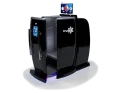
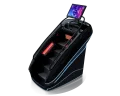
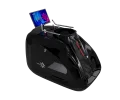
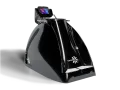
Ο εξοπλισμός αποκατάστασης παίζει ρόλο εδώ. Οι θάλαμοι κρυοθεραπείας, εξοπλισμός θεραπείας με κόκκινο φως, εξοπλισμός body rolling και σάουνες υπέρυθρης ακτινοβολίας παρέχουν μετρήσιμα οφέλη που μπορούν να συνδυαστούν με συμπληρώματα διατροφής. Κάψουλα μακροζωίας HaloX Συνδυάζει διάφορες μεθόδους ευεξίας (κόκκινο φως, υπέρυθρες ακτίνες, αρωματοθεραπεία) σε μία μονάδα και συχνά αναπτύσσεται σε κέντρα ευεξίας που δημιουργούν μενού υπηρεσιών με γνώμονα το βιοχάκερ. Σημειώστε ξεκάθαρα: το HaloX είναι εξοπλισμός ευεξίας, όχι συμπλήρωμα και όχι υποκατάστατο των παραπάνω βασικών ενώσεων.
Συχνές ερωτήσεις
Ε1. Ποια είναι τα καλύτερα συμπληρώματα βιολογικής χάκερ με πραγματικά στοιχεία;
Τα συμπληρώματα με τα ισχυρότερα στοιχεία είναι απλούστερα από ό,τι υποδηλώνει η διαφημιστική εκστρατεία: μονοϋδρική κρεατίνη (αποδεδειγμένα οφέλη για τη γνωστική λειτουργία και τους μύες), ωμέγα-3 λιπαρά οξέα (τα πιο υποδοσολογημένα στη μακροζωία), γλυκινικό ή κιτρικό μαγνήσιο (για τον ύπνο, την αρτηριακή πίεση, τη γλυκόζη), βιταμίνη D3 (εάν υπάρχει έλλειψη στις δοκιμές) και επαρκής πρωτεΐνη (1,6-2,2 g/kg σωματικού βάρους). Αυτά τα πέντε αποτελούν τη βάση που υποστηρίζεται από στοιχεία. Όλα τα υπόλοιπα είναι είτε ΜΕΤΡΙΑ στοιχεία (NMN, NR, AKG, ashwagandha) είτε ΑΝΕΠΑΡΚΗ. Συζητήστε τις ατομικές επιλογές με τον πάροχο υγειονομικής περίθαλψης.
Ε2. Λειτουργούν πράγματι τα συμπληρώματα NMN;
Το NMN αυξάνει αξιόπιστα τα επίπεδα NAD+ στο ανθρώπινο αίμα. Ο βιοχημικός μηχανισμός επιβεβαιώνεται σε πολλαπλές δημοσιευμένες τυχαιοποιημένες ελεγχόμενες δοκιμές (RCT). Αυτό που δεν είναι σαφές είναι εάν αυτό μεταφράζεται σε σημαντικά οφέλη για τη μακροζωία ή την υγεία στους ανθρώπους. Πρόσφατες συστηματικές ανασκοπήσεις των προδρόμων του NAD+ αναφέρουν γενικά συνεπή βιοχημική αλληλεπίδραση αλλά ασυνεπή κλινικά αποτελέσματα. Σημαντικό επαληθευμένο κανονιστικό πλαίσιο: ο FDA αφαίρεσε το NMN από τον κατάλογο των συμπληρωμάτων διατροφής τον Οκτώβριο του 2022, δημιουργώντας κανονιστική αβεβαιότητα στην αγορά των ΗΠΑ.
Ε3. Ποια είναι η διαφορά μεταξύ NMN και NR;
Τόσο το NMN (μονονουκλεοτίδιο νικοτιναμιδίου) όσο και το NR (ριβοζίδιο νικοτιναμιδίου) είναι πρόδρομες ουσίες NAD+ που αυξάνουν αποτελεσματικά τα επίπεδα NAD+ στο αίμα. Το NR έχει καθεστώς GRAS από τον FDA. Η κατάσταση συμπληρώματος του NMN ανακλήθηκε το 2022 (και τα δύο επαληθεύτηκαν ως κανονιστικά στοιχεία). Πρόσφατες ανασκοπήσεις του NMN και του NR γενικά διαπιστώνουν ότι και οι δύο ενώσεις παράγουν παρόμοιες βιοχημικές επιδράσεις σε δοκιμές σε ανθρώπους. Το NR είναι περισσότερο διαθέσιμο ως ρυθμιζόμενο συμπλήρωμα στις ΗΠΑ. Το NMN πωλείται ευρέως διεθνώς, αλλά βρίσκεται σε κανονιστικό κενό στις Ηνωμένες Πολιτείες από το 2026.
Ε4. Πόσα πρέπει να ξοδεύω σε συμπληρώματα βιολογικής χάκερ μηνιαίως;
Ένα βασικό πακέτο (κρεατίνη, ωμέγα-3, μαγνήσιο, βιταμίνη D, πρωτεΐνη) κοστίζει 30-80 δολάρια ΗΠΑ το μήνα χρησιμοποιώντας δοκιμασμένες μάρκες τρίτων. Η προσθήκη NMN ή NR ανεβάζει το κόστος στα 80-150 δολάρια ΗΠΑ το μήνα. Τα πακέτα Bryan Johnson-tier (1.000+ δολάρια ΗΠΑ μηνιαίως) περιλαμβάνουν πειραματικές ενώσεις με ασθενέστερα στοιχεία. Το πιο μετρήσιμο όφελος προέρχεται από τα πρώτα 50-80 δολάρια ΗΠΑ το μήνα. Οι μειούμενες αποδόσεις φτάνουν γρήγορα πάνω από τα 150 δολάρια ΗΠΑ το μήνα.
Ε5. Είναι ασφαλή τα συμπληρώματα βιο-χακώματος;
Τα βασικά συμπληρώματα (κρεατίνη, ωμέγα-3, μαγνήσιο, βιταμίνη D, πρωτεΐνη) έχουν εξαιρετικά προφίλ ασφάλειας με δεκαετίες δεδομένων. Οι πρόδρομες ουσίες NAD+ (NMN, NR) φαίνονται ασφαλείς σε βραχυπρόθεσμες δοκιμές, αλλά δεν έχουν μακροπρόθεσμα δεδομένα ασφάλειας. Τα ενέσιμα πεπτίδια (TB-500, BPC-157, κ.λπ.) δεν είναι εγκεκριμένα από τον FDA και ενέχουν πραγματικούς κινδύνους. Ελέγχετε πάντα τις αλληλεπιδράσεις φαρμάκων, ειδικά με στατίνες, αραιωτικά αίματος και ανοσοκατασταλτικά. Τα περισσότερα συμπληρώματα βιολογικής χάκερ αντενδείκνυνται ή δεν έχουν μελετηθεί κατά τη διάρκεια της εγκυμοσύνης. Συμβουλευτείτε έναν εξειδικευμένο πάροχο υγειονομικής περίθαλψης πριν ξεκινήσετε.
Ε6. Βοηθάει η κρεατίνη στη λειτουργία του εγκεφάλου;
Πολλαπλές μετα-αναλύσεις τυχαιοποιημένων ελεγχόμενων δοκιμών (RCT) κρεατίνης έχουν αναφέρει γνωστικά οφέλη, ιδιαίτερα σε άτομα που έχουν στερηθεί ύπνου, ηλικιωμένους και χορτοφάγους. Συστηματικές ανασκοπήσεις σε ηλικιωμένους πληθυσμούς έχουν αναφέρει παρόμοια γνωστικά αποτελέσματα. Η τυπική δόση είναι 3-5 γραμμάρια ημερησίως, η ίδια όπως και για τους μύες. Αυτό είναι ένα από τα ΙΣΧΥΡΑ ευρήματα για τη μακροζωία και τη γνωστική λειτουργία της κρεατίνης. Συμβουλευτείτε έναν πάροχο υγειονομικής περίθαλψης πριν ξεκινήσετε, ειδικά εάν έχετε νεφρικά προβλήματα.
Ε7. Ποια συμπληρώματα πρέπει να αποφεύγω επειδή είναι κυρίως διαφημιστική εκστρατεία;
Το 2026, ο κατάλογος με τα ασθενή στοιχεία περιλαμβάνει τη ρεσβερατρόλη (δρά σε τρωκτικά, δεν έχει αναπαραχθεί σε δοκιμές μακροζωίας σε ανθρώπους), κλασικά νοοτροπικά όπως η πιρακετάμη (βάση στοιχείων κακής ποιότητας), ενέσιμα πεπτίδια που πωλούνται στο διαδίκτυο (δεν έχουν εγκριθεί από τον FDA, κίνδυνος μόλυνσης), συμπληρώματα αποτοξίνωσης (δεν υπάρχουν κλινικά στοιχεία), σύμπλοκα μακροζωίας με μανιτάρια (ευρείες αξιώσεις που δεν υποστηρίζονται), ιδιόκτητα μείγματα με μη αποκαλυφθείσα δοσολογία, ενδοφλέβιες σταγόνες για ευεξία και ραπαμυκίνη που πωλείται ως συμπλήρωμα (είναι φάρμακο που χορηγείται με ιατρική συνταγή, όχι συμπλήρωμα).
Ε8. Ποια είναι η καλύτερη στοίβα συμπληρωμάτων για μακροζωία;
Για μακροζωία βασισμένη σε στοιχεία, μια μινιμαλιστική βάση γενικά ξεπερνά σε απόδοση τις σύνθετες στοίβες: κρεατίνη 5 g ημερησίως, ιχθυέλαιο ωμέγα-3 (δοκιμή Δείκτης Ωμέγα-3, συνήθως αναφερόμενος στόχος 8% ή υψηλότερος), γλυκινικό μαγνήσιο 300-400 mg, βιταμίνη D3 (δοκιμή 25-υδροξυ D, συνήθως αναφερόμενος στόχος 40-60 ng/mL) και πρωτεΐνη στα 1,6-2,2 g/kg σωματικού βάρους. Προαιρετικές προσθήκες με ΜΕΤΡΙΑ στοιχεία: NMN ή NR 250-500 mg, ashwagandha για το στρες. Συνολικό μηνιαίο κόστος: 50-130 USD. Εξατομικεύστε τη γνώμη σας με τον πάροχο υγειονομικής περίθαλψης με βάση τα αποτελέσματα των εξετάσεων και τα φάρμακά σας.
Τα συμπληρώματα βιο-χακάρισμα το 2026 χωρίζονται σε επίπεδα με σαφή στοιχεία. Τα πέντε βασικά συστατικά (κρεατίνη, ωμέγα-3, μαγνήσιο, βιταμίνη D, πρωτεΐνη) βρίσκονται στην ΙΣΧΥΡΗ ζώνη με δεκαετίες δεδομένων σε ανθρώπους. Τα NMN, NR, φισετίνη, AKG και προσαρμογόνα όπως η ashwagandha βρίσκονται στην ΜΕΤΡΙΑ ζώνη: πραγματική βιοχημεία, μερική κλινική μετάφραση. Η ρεσβερατρόλη, τα ενέσιμα πεπτίδια, οι φόρμουλες αποτοξίνωσης, τα σύμπλοκα μακροζωίας με μανιτάρια και τα ιδιόκτητα μείγματα βρίσκονται στην ΑΔΥΝΑΜΗ ή ΑΝΕΠΑΡΚΗ ζώνη όπου το μάρκετινγκ έχει ξεπεράσει τα στοιχεία.
Η ειλικρινής περίληψη: το πιο μετρήσιμο όφελος προέρχεται από τα πρώτα 50-80 δολάρια ΗΠΑ ανά μήνα που δαπανώνται σε συμπληρώματα βάσης με επαρκή δοσολογία και ποιοτικούς ελέγχους από τρίτους. Πάνω από 150 δολάρια ΗΠΑ ανά μήνα, η αναλογία αποδεικτικών στοιχείων-κόστους μειώνεται απότομα. Τα συμπληρώματα από μόνα τους δεν παράγουν τα αποτελέσματα που ισχυρίζεται το μάρκετινγκ της κοινότητας του biohacking. Η διατροφή, η προπόνηση, ο ύπνος, ο εξοπλισμός αποκατάστασης και τα επιλεκτικά επιλεγμένα συμπληρώματα μαζί οδηγούν στα πραγματικά αποτελέσματα.
Για ένα ευρύτερο πλαίσιο σχετικά με την προσέγγιση του biohacking, βλ. Τι είναι το Biohacking; Πλήρης οδηγός. Για χρήστες που ενδιαφέρονται για εξοπλισμό που συνδυάζεται με συμπληρώματα foundation, το Longevity Capsule: How HaloX Replaces 5-7 Wellness Devices καλύπτει την πολυτροπική προσέγγιση. Το Biohacking for Women: Hormonal Health and Recovery καλύπτει ζητήματα που αφορούν συγκεκριμένα το φύλο. Πάνω απ 'όλα, να θυμάστε ότι οποιαδήποτε απόφαση για συμπλήρωμα θα πρέπει να εξατομικεύεται με έναν εξειδικευμένο πάροχο υγειονομικής περίθαλψης.


