













Iceberg Electric vs Nitrogen Local Cryotherapy: A Spa Owner’s Choice
Iceberg Electric local cryotherapy reaches -20°C (-4°F) using compressor-based cold air; nitrogen local cryotherapy reaches -110°C to -160°C using liquid nitrogen vapor stream. The two approaches use different mechanisms, produce different treatment depth, and fit different spa business models. This article compares them head to head so a spa or medspa operator can pick the right one for their clientele and service model.
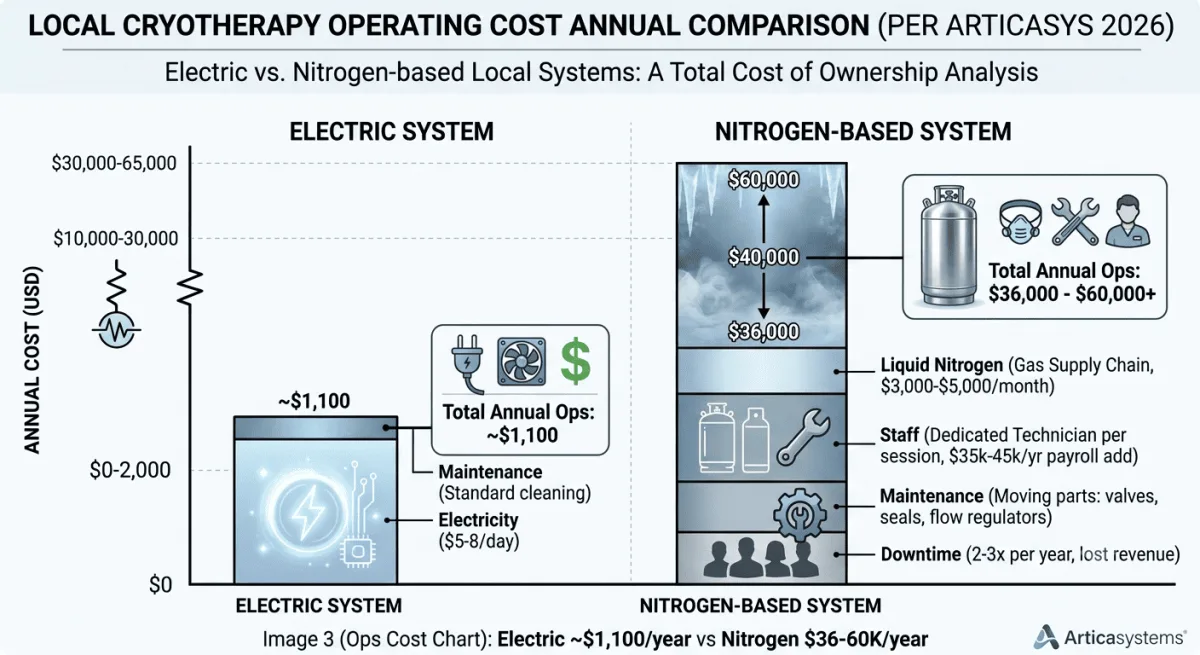
The short version: Iceberg Electric wins on operating cost (roughly $5-$8 per day electricity vs $3,000-$5,000 per month LN2 gas per industry-reported operator data 2025-2026), on portability (standard 110V outlet, no ventilation required), and on baseline safety (no gas hazard, cold breathable air). Nitrogen wins on treatment depth (deeper penetration for sports rehab and elite athlete recovery), on session throughput (8-12 sessions per hour vs 3-5 for compressor recovery), and on clinical pain relief protocols where deeper cooling matters. Neither is universally better; each is optimal for a different application profile.
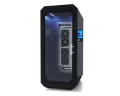
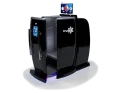
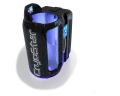
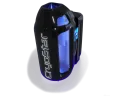
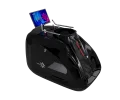
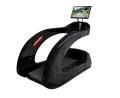
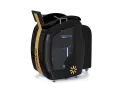
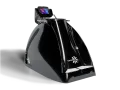
Vacuactivus manufactures both device classes since 2009 (over 15 years). The Iceberg Electric Cryo (compressor-based, -20°C, portable, standard outlet) is our aesthetic/beauty/mobile-therapist device; the Iceberg 25L and 50L are our liquid-nitrogen local devices reaching down to -160°C for clinical and sports-recovery applications. This article is written from the manufacturer side with skin in the game, so it describes each device honestly including where the other type wins. Nothing here is medical or safety-consulting advice; installation, ventilation, staff certification, and client contraindication screening must comply with local health-and-safety regulations before commercial use.
The Three Types of Local Cryotherapy Machines
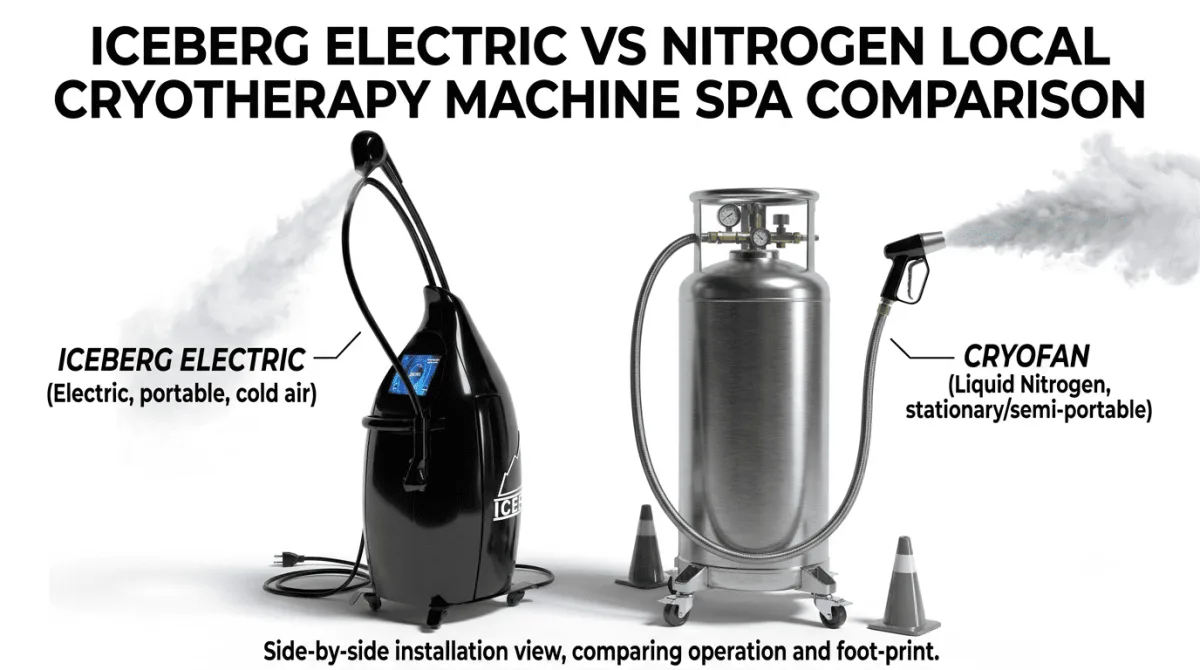
Local cryotherapy splits into three technology types, and knowing the split matters before picking between electric and nitrogen. Type 1 is compressor-based electric (like the Iceberg Electric Cryo), which uses standard refrigeration to cool ambient air and blow it onto the treated area at -20°C (-4°F). Type 2 is CO2-based systems, which use pressurized CO2 for mid-depth surface cooling. Type 3 is liquid nitrogen (LN2) vapor stream, which reaches -110°C to -160°C for deeper penetration and is the standard for clinical sports-recovery applications.
Each type has a different mechanism, a different treatment depth, and a different operating-cost profile. The electric type is the newest of the three and represents the segment growing fastest in aesthetic and mobile-therapist channels because of portability and low operating cost. The nitrogen type is the established clinical standard where treatment depth and session throughput matter more than portability. CO2 sits between the two on both dimensions. This article focuses on the electric-vs-nitrogen comparison since those are the two dominant commercial choices for a spa operator building a local cryotherapy service line. For adjacent context on whole-body cryotherapy (WBC) equipment where the electric-vs-nitrogen tradeoff plays out at a much larger equipment scale, see Nitrogen vs Electric Cryotherapy Chambers: WBC Comparison which walks the parallel WBC decision in detail.
How Iceberg Electric Works: Compressor-Based Cold Air Therapy
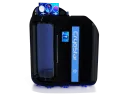
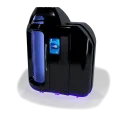
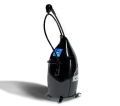
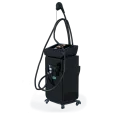
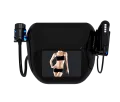
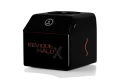
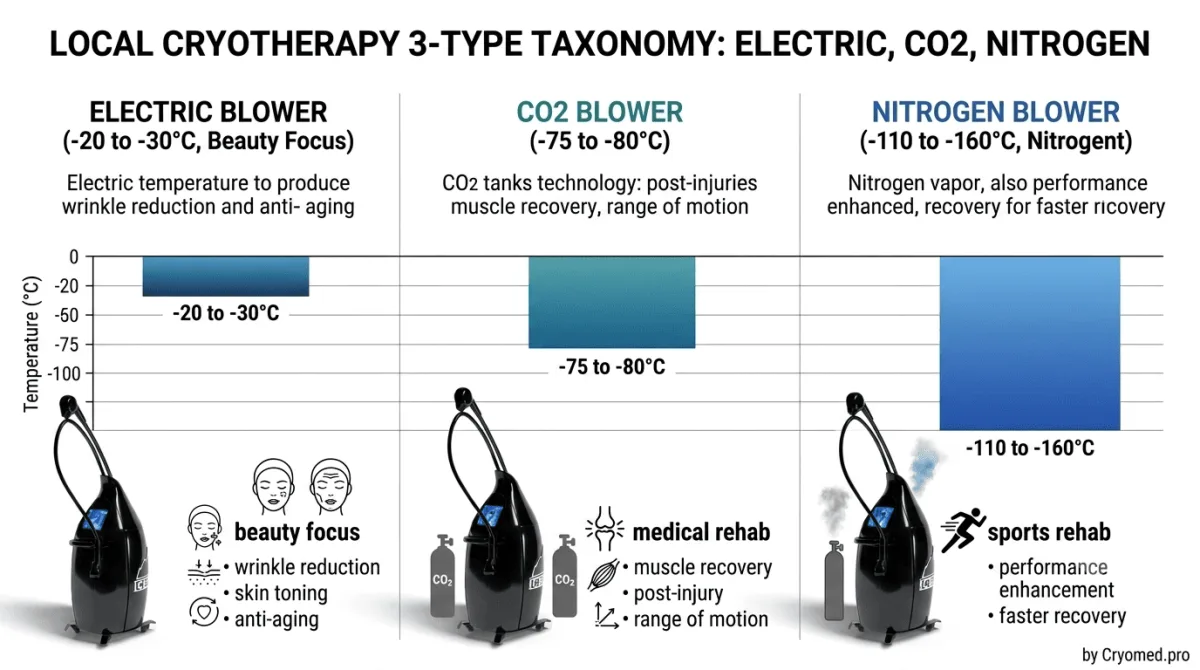
The Iceberg Electric Cryo is a compressor-based local cryotherapy device that cools ambient air and delivers it at -20°C (-4°F) onto the treated area through a directed handpiece. The mechanism is straightforward refrigeration engineering, similar in principle to a commercial air conditioning compressor but optimized for temperature output rather than volume. The client positions the handpiece over the target zone (facial area, joint, muscle group), and the compressor delivers cold air for a session typically lasting 5 to 15 minutes per treated area.
The advantages of the compressor approach compound. No consumable gas cost. No ventilation required. Standard 110V outlet (the unit is a plug-and-play deployment, not a facility-integration project). Portable footprint, meaning a mobile therapist can bring it to client sites and a small spa can wheel it between treatment rooms. Zero cryogenic-handling training requirement (staff onboarding is measured in hours, not certification cycles). The tradeoff is treatment depth, since -20°C surface cooling does not penetrate to the depth that nitrogen achieves at -110°C to -160°C. For aesthetic applications (cryofacial, post-laser cooldown, superficial pain relief) that shallower depth is exactly right; for clinical sports-recovery protocols requiring deep-tissue cooling, nitrogen still wins.
How Nitrogen Local Cryo Works: Liquid Nitrogen Vapor Stream
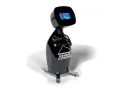
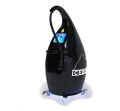
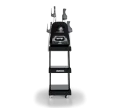
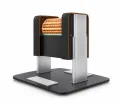
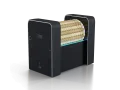
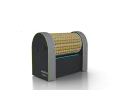
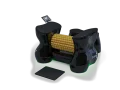
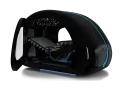
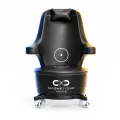
Nitrogen local cryotherapy (represented in the Vacuactivus range by the Iceberg 25L and Iceberg 50L devices) uses liquid nitrogen stored in an insulated tank, released as a controlled vapor stream through a directed handpiece onto the treated area. The vapor stream reaches -110°C to -160°C at the skin surface, which produces deeper tissue cooling than compressor-based electric can achieve. Session length runs 5 to 10 minutes per treated area, slightly faster than electric because of the more intense cooling gradient.
The advantages are deeper penetration (better for deep-tissue clinical pain, sports recovery, elite athlete protocols where the physiological effect is dose-dependent on cooling depth) and higher session throughput (continuous LN2 flow means no compressor recovery cycle between sessions, delivering 8-12 sessions per hour vs 3-5 for compressor-based electric). The tradeoffs are operating cost (LN2 gas is a per-session consumable at industry-reported ranges of roughly $3,000-$5,000 per month for a busy center running 15-20 sessions daily), ventilation requirement (LN2 vapor displaces oxygen and requires facility ventilation), and staff training (cryogenic handling requires certification). For a clinical operation where those tradeoffs make sense the nitrogen device is the right choice; for a beauty spa or mobile therapist those tradeoffs kill the model.
Iceberg Electric vs Nitrogen Local Cryo: Head-to-Head Comparison
The comparison table below distills the head-to-head across the parameters that matter for a spa business decision. It is intentionally opinionated on which side wins each row, and the winner column is per-parameter not per-device (there is no universal winner across all parameters).
| Parameter | Iceberg Electric | Nitrogen Local Cryo (Cryo LC / Cryofan class) | Winner + Note |
|---|---|---|---|
| Temperature range | -20°C (-4°F) surface cooling (compressor) | -110°C to -160°C deeper penetration (LN2 vapor stream) | Nitrogen for depth, Iceberg for aesthetic safety and portability |
| Session length | 5-15 minutes per treated area | 5-10 minutes per treated area | Both similar; nitrogen slightly faster |
| Ops cost per year | ~$1,100/year electricity ($5-$8/day illustrative) | $36,000-$60,000/year LN2 gas at 15-20 sessions daily | Iceberg wins by roughly 35x (industry-reported operator data 2025-2026) |
| First-year investment | Higher upfront (10-20%) vs nitrogen equipment | Lower upfront but recovered in 6-12 months by ops cost | Iceberg wins on 3-year TCO |
| Portability | Fully portable, standard 110V outlet, small footprint | Fixed installation, tank ventilation required | Iceberg wins (mobile therapist use case) |
| Safety profile | Zero gas hazard, cold breathable air, industry-reported zero-incident safety benchmark for compressor systems | Ventilation required, ice burn risk from direct stream, LN2 handling training required | Iceberg wins on baseline hazard |
| Staff training | Minimal (plug in, run, follow session protocols) | Cryogenic handling certification recommended | Iceberg wins (lower staff cost) |
| Maintenance | Compressor service annually | Tank inspection plus weekly LN2 supply chain | Iceberg wins on ongoing operational simplicity |
| Best applications | Aesthetics, cryofacial, post-laser cooldown, routine local pain relief | Sports rehab, elite athlete recovery, deep-tissue clinical pain | Application-dependent split |
| Session throughput | 3-5 sessions per hour (compressor recovery cycle) | 8-12 sessions per hour (continuous LN2 flow) | Nitrogen wins on high-volume clinical use |
The pattern in the table: Iceberg Electric wins on operating economics (ops cost, portability, safety, staff training, maintenance), nitrogen wins on clinical performance (depth, throughput). For a spa business model where the client demand is aesthetic and beauty-focused, the ops-economics side of the table dominates the decision. For a sports-recovery clinical practice where the client demand is deep-tissue pain relief and elite athlete recovery, the clinical-performance side dominates. The head-to-head is designed to make that split explicit.
Spa Owner’s Decision Matrix: Which One for Your Business?
The decision reduces to business model rather than to feature count. A beauty spa or medspa doing cryofacial and post-laser cooldown as the anchor local-cryotherapy service should choose Iceberg Electric: the aesthetic-application depth is a match, the ops cost is compatible with per-session pricing at $50-$150, and the portability supports multi-room and mobile-therapist configurations. A sports-recovery clinic or athlete-focused facility doing deep-tissue pain relief and clinical recovery protocols should choose nitrogen: the deeper cooling drives the client outcome, the higher throughput supports high-volume schedules, and the operating-cost profile is compatible with clinical per-session pricing at $75-$200.
The mixed-model spa (beauty services plus some sports-recovery clientele) has three options. Option one: Iceberg Electric only, positioning the sports-recovery clients toward whole-body cryotherapy for depth (a WBC chamber becomes the clinical anchor and the local Iceberg Electric handles surface applications). Option two: both device types, running Iceberg Electric as the everyday workhorse for the majority-aesthetic client base and nitrogen local as a premium tier for sports clients (this doubles equipment investment but captures both clientele types). Option three: nitrogen only, positioning the aesthetic clients as premium cryofacial at nitrogen-clinic pricing (this works in premium urban markets, but ops cost pressure is significant at lower-throughput aesthetic session volumes). Model the specific mix of clients and their willingness-to-pay before picking. For the full context on how local cryotherapy fits into a broader spa recovery service line, see Local Cryotherapy Machine: When Spot Treatment Outperforms WBC.
When Nitrogen Local Cryo Still Wins: The Honest Limits of Electric
A manufacturer honest about the tradeoffs names them explicitly. The Iceberg Electric approach does not replace nitrogen for every application. Six specific cases where nitrogen still wins. First, deep-tissue clinical pain relief where the treatment depth matters clinically and the -20°C surface cooling does not reach the target tissue. Second, elite athlete recovery protocols where the physiological effect is dose-dependent on cooling intensity and the difference between -20°C and -160°C produces measurable outcome differences. Third, high-volume clinical throughput where 8-12 sessions per hour is required and the 3-5 sessions per hour of compressor-based systems creates a capacity bottleneck.
Fourth, cases where the session protocol specifies nitrogen (some clinical protocols standardize on nitrogen as the reference; substituting electric changes the protocol). Fifth, high-margin premium positioning where the clinical nitrogen equipment itself becomes part of the service story and clients pay for the equipment class (this is a marketing consideration rather than clinical). Sixth, established sports-recovery brands where switching from nitrogen to electric would be perceived as downgrade regardless of clinical equivalence for the actual application. If your business fits any of these, nitrogen local cryo is the right choice and Iceberg Electric is not a substitute. For adjacent aesthetic protocol context (where Iceberg Electric strongly fits), see Facial Cryotherapy: How Cold Boosts Collagen and Reduces Inflammation which walks the cryofacial application in depth.
Iceberg Electric Specific Features + Grand Model with LED
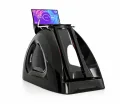
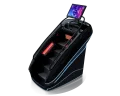
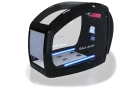
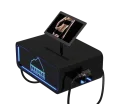
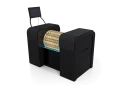
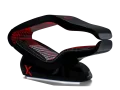
The Iceberg Electric Cryo comes in two configurations. The standard Iceberg Electric Cryo unit is the compressor-based -20°C portable local device suitable for beauty spa, cryofacial, post-laser cooldown, and routine local pain relief applications. The Iceberg Electric Grand adds integrated LED phototherapy in the handpiece, combining cold-air delivery at -20°C with LED wavelengths for combined cryofacial + LED collagen stimulation protocols. Grand is the specific spec for spa operators building an aesthetic-first service line where the combined cryofacial + LED session is a signature offering.
Both configurations share the electric-compressor advantages: standard 110V outlet, no consumable gas cost, no ventilation required, minimal staff training, and compact portable footprint. The Iceberg Electric Grand model with integrated LED adds equipment complexity (LED module maintenance, dual-modality staff protocols) but delivers a differentiated service the base model cannot. For a spa operator’s tier decision, evaluate whether the LED-combined cryofacial service will drive enough incremental pricing to justify the tier upgrade over the base Iceberg Electric Cryo. For product specification and pricing, the Iceberg Electric Cryo product page covers full configuration options, and the broader localized cryotherapy equipment category covers the Iceberg 25L and 50L nitrogen local devices for operators considering nitrogen as an alternative or complement. For the wider whole-body context, Cryotherapy Chambers whole body equipment catalog covers the parallel WBC decision.
Frequently Asked Questions
Q1. What is the difference between electric and nitrogen local cryotherapy?
The mechanism, the temperature, and the operating profile. Electric compressor systems (like Iceberg Electric Cryo) use standard refrigeration to cool ambient air to -20°C (-4°F) delivered through a handpiece; nitrogen systems (like Iceberg 25L or 50L) use liquid nitrogen vapor stream reaching -110°C to -160°C. Electric wins on operating cost (no consumable gas), portability (standard 110V outlet, no ventilation), and safety baseline. Nitrogen wins on treatment depth (deeper tissue cooling), session throughput (8-12 sessions per hour vs 3-5 for compressor recovery), and clinical protocols where cooling depth matters. Beauty spa and cryofacial applications typically fit electric; sports rehab and clinical deep-tissue applications typically fit nitrogen.
Q2. How cold does an electric local cryotherapy machine get?
The Vacuactivus Iceberg Electric Cryo reaches -20°C (-4°F) at the delivered air temperature, produced by compressor-based refrigeration and directed through a handpiece onto the treated area. This is surface cooling suitable for aesthetic applications (cryofacial, post-laser cooldown), routine local pain relief, and beauty spa protocols. For deeper tissue cooling, nitrogen-based local cryotherapy reaches -110°C to -160°C but requires ventilation, LN2 gas supply, and cryogenic handling training. Some competitor electric-compressor units in the industry claim lower temperatures at the compressor output, but the practical delivered temperature at the skin surface with realistic distance and airflow calibration is typically in the -20°C to -25°C range for compressor-based systems. Verify the specific spec (compressor output vs delivered temperature at the treated area) with the manufacturer before comparing units.
Q3. How much does it cost to operate a local cryotherapy machine?
For electric compressor systems the operating cost is essentially electricity, at illustrative $5-$8 per day at typical session volume, translating to roughly $1,100 per year at normal-hours commercial use. For nitrogen systems the operating cost is LN2 gas plus maintenance, at industry-reported ranges of roughly $3,000-$5,000 per month for a busy center running 15-20 sessions daily, translating to $36,000-$60,000 per year. The delta is roughly 30-50x on annual operating cost. Add facility ventilation cost (initial + maintenance) and cryogenic handling training cost for nitrogen; both are near-zero for electric. Verify current supplier pricing before financial modeling, since electricity rates and LN2 supply pricing vary significantly by market and change over time.
Q4. Is electric local cryotherapy as effective as nitrogen?
It depends on the application. For aesthetic applications (cryofacial, post-laser cooldown), electric at -20°C is effective and matches the surface cooling the protocol requires. For sports rehab and deep-tissue clinical pain relief, nitrogen at -110°C to -160°C reaches tissue depth that electric cannot, and clinical protocols standardized on nitrogen typically require nitrogen-level cooling for the specified outcome. For routine local pain relief (mild joint or muscle discomfort), electric is often sufficient. The equivalence question is protocol-specific rather than absolute; a beauty spa cryofacial does not need nitrogen depth, while an elite athlete recovery protocol typically does. Match the equipment to the application rather than assuming one is universally more effective.
Q5. Can I use electric local cryotherapy for cryofacial treatments?
Yes, and cryofacial is one of the strongest use cases for electric compressor systems specifically. The -20°C delivered temperature is well matched to facial-skin cryostimulation without the deep-tissue cooling that nitrogen produces (deeper cooling is not required for the cryofacial application and would create more aggressive skin response than the aesthetic protocol targets). The Iceberg Electric Grand model with integrated LED phototherapy is specifically designed for combined cryofacial + LED collagen stimulation in one session, which is the differentiated service many aesthetic spas build around this equipment tier. Portability and no-ventilation requirements also fit typical beauty spa treatment room configurations better than nitrogen units.
Q6. Which is safer: electric or nitrogen local cryotherapy?
Electric compressor systems have a substantially lower baseline safety hazard profile because they produce cold breathable air with no cryogenic gas involved. Nitrogen systems require facility ventilation (LN2 vapor displaces oxygen in an enclosed space and creates an asphyxiation risk without ventilation) and cryogenic handling training (LN2 skin contact causes immediate cryogenic burn, and improper vapor-stream direction can cause ice burn on the client). Both device types can be safely operated with proper training and protocols, but the training and facility requirements differ significantly. Industry-reported operator safety benchmarks for compressor-based electric systems track very low incident rates because the underlying hazard profile is limited to standard electrical safety. Consult local health-and-safety regulations for specific installation and staff training requirements.
Q7. What is the best local cryotherapy machine for a beauty spa?
For a beauty spa or medspa where the primary applications are cryofacial, post-laser cooldown, and aesthetic surface cryotherapy, the Iceberg Electric Cryo is a strong fit: -20°C compressor-based cold air matches the aesthetic-application depth, portable standard-outlet installation fits multi-room configurations, low operating cost is compatible with per-session pricing in the $50-$150 range, and minimal staff training keeps onboarding fast. The Iceberg Electric Grand model with integrated LED adds combined cryofacial + LED phototherapy as a differentiated signature service. Sports-focused or clinical facilities emphasizing deep-tissue recovery should evaluate nitrogen local cryo instead, since the depth requirement changes the equipment fit.
Q8. How does Iceberg Electric integrate with laser hair removal?
Post-laser cooldown is one of the strongest integration use cases for electric local cryotherapy in a medspa. After a laser hair removal, IPL, or resurfacing procedure, immediate local cryotherapy at -20°C reduces client discomfort, calms erythema, and shortens recovery. The Iceberg Electric Cryo integrates cleanly because it operates on standard 110V outlet in the same treatment room as the laser (no separate installation or ventilation), the compressor cold-air delivery does not conflict with the laser optics or introduce moisture into the treatment area, and the portable footprint allows the same unit to move between laser rooms as scheduling requires. Many medspa operators pair a single Iceberg Electric with 2-3 laser treatment rooms as the shared cooldown resource. Nitrogen local cryo is technically usable in this application but the ventilation requirement and higher operating cost usually make electric the practical choice for post-laser integration.
Conclusion
Iceberg Electric local cryotherapy at -20°C (-4°F) and nitrogen local cryotherapy at -110°C to -160°C are not competing technologies for the same application. They are complementary technologies for different applications. Electric wins on operating cost (approximately 30-50x lower annual ops than nitrogen), portability (standard 110V outlet, no ventilation), safety baseline (no cryogenic gas hazard), and staff training simplicity. Nitrogen wins on treatment depth (deeper penetration for clinical sports-recovery), session throughput (8-12 sessions per hour vs 3-5), and clinical protocol standardization where nitrogen is the reference.
The spa business model determines which fits. Beauty spa, medspa cryofacial, mobile therapist, and post-laser cooldown applications match Iceberg Electric. Sports rehab, elite athlete recovery, deep-tissue clinical pain, and high-volume clinical throughput match nitrogen. Mixed-model operations can run both, prioritizing the majority-application class. Vacuactivus manufactures both device types since 2009 (over 15 years); the Iceberg Electric Cryo and Iceberg Electric Grand cover the compressor-based side, and the Iceberg 25L and 50L cover the nitrogen side. Match the equipment to the actual client mix and revenue model rather than assuming one is universally better.


