











OEM (Original Equipment Manufacturer): What B2B Brands Should Know
An OEM (Original Equipment Manufacturer) is a factory that produces equipment to a buyer’s product design and specification, which the buyer then sells under the buyer’s own brand. The buyer owns the design and the brand; the OEM builds to that design at agreed MOQ, lead time, and unit cost. Behind that simple definition sits a set of contract terms, certification requirements, tooling investments, and vetting steps that separate working OEM partnerships from expensive mistakes.
This article walks the B2B brand owner or private-label buyer through the practical framework: what OEM is (and how it differs from ODM, contract manufacturing, and private label), the IP ownership and contract terms that matter, MOQ and lead-time reality across product categories, certification frameworks (CE, ISO 9001, ISO 13485, FDA registration, UL listing) and the verification requirement that comes with any specific vendor claim, when OEM economics make sense (and when they do not), and the red flags to watch for in OEM partner selection.
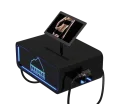
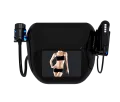
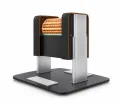
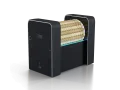
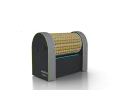
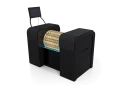
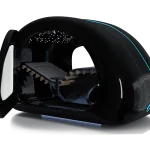
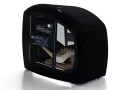
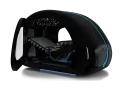
Vacuactivus manufactures specialized wellness equipment (commercial cryotherapy chambers, red light therapy, vacuum infrared fitness, RollShaper wood-roller machines) since 2009 (over 15 years) in Poland (EU market), with OEM and private-label partnerships active across 50+ countries. This article is written from the OEM factory side of the relationship, and nothing here is legal or contract-consulting advice – contract terms should be reviewed by a qualified attorney with international manufacturing contract experience before signing.
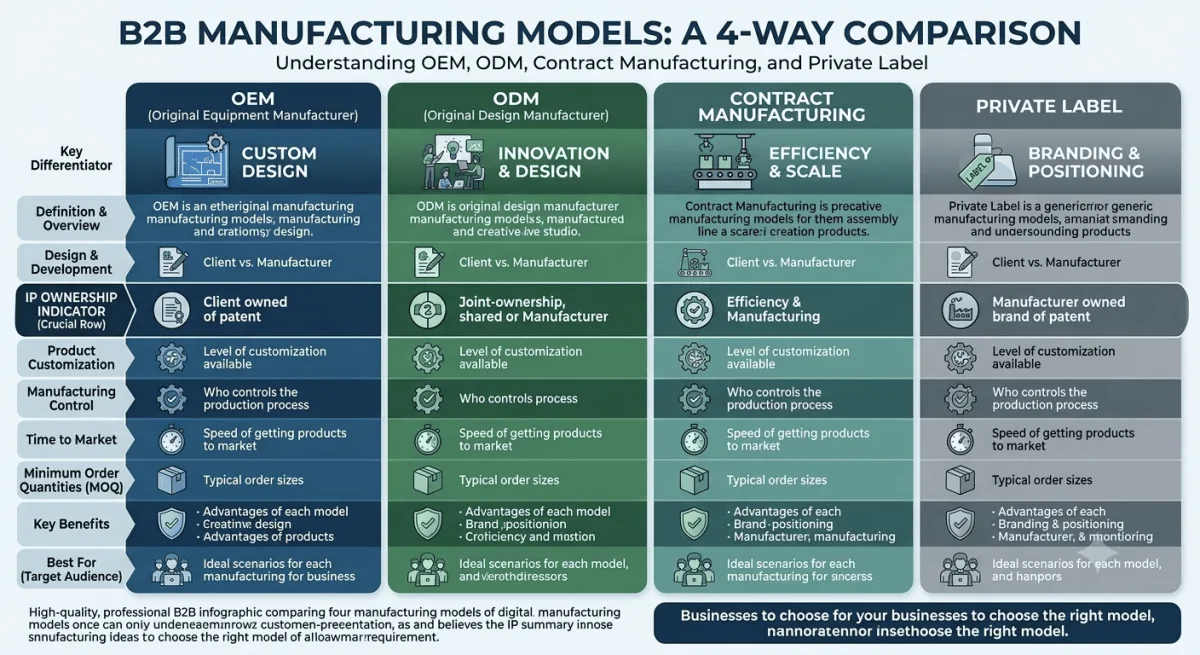
What Is an OEM (Original Equipment Manufacturer)?
An OEM builds finished products to a buyer’s design specification, which the buyer sells under the buyer’s own brand. The buyer holds the product IP and the brand; the OEM contributes production capacity, tooling, quality control, certification workflow where applicable, and delivery logistics. The classic industry pattern is the OEM-VAR relationship – a Value-Added Reseller (VAR) contracts with an OEM to produce equipment sold under the VAR brand, with the canonical example being Apple designing hardware and contracting Foxconn to build it at scale.
The OEM model differs from the alternatives in ownership and design responsibility. An ODM (Original Design Manufacturer) owns the underlying product design and licenses it to buyers who rebrand and customize; a contract manufacturer builds strictly to the buyer’s drawings without owning any product IP; a private-label arrangement rebadges an existing factory product under the buyer’s brand without customization. Each model has a different economics profile and a different fit for different buyer maturity levels. A brand with a differentiated product design and MOQ commitment fits OEM; a brand testing a category without a proven product design often fits private label first.
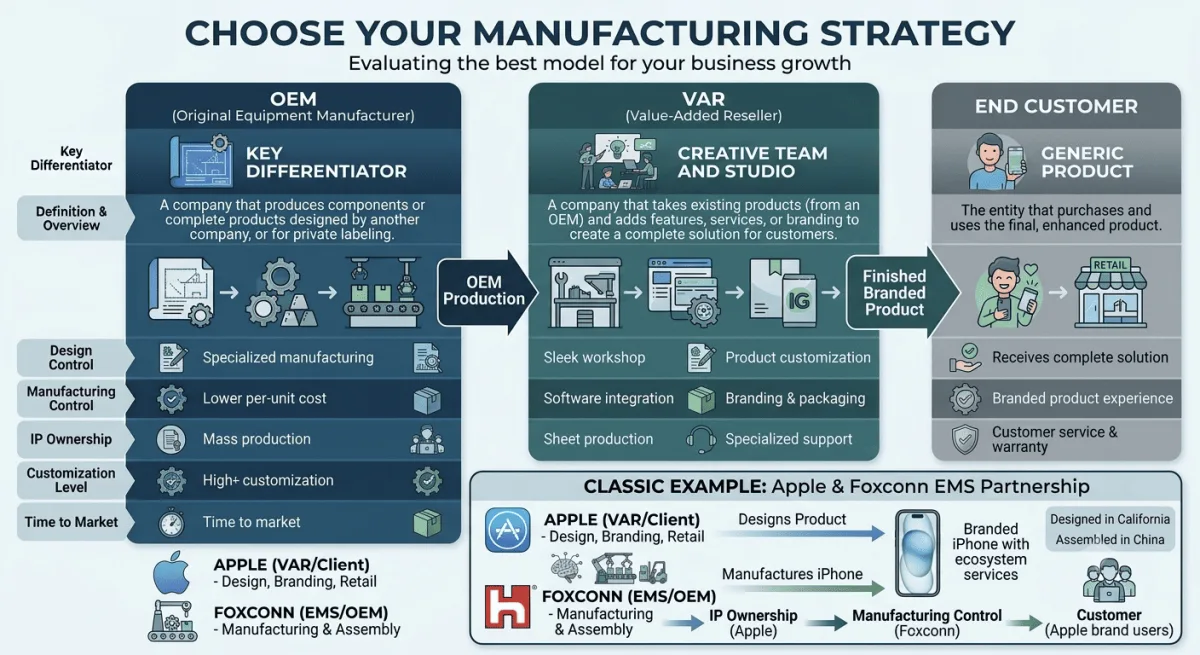
OEM vs ODM vs Contract Manufacturing vs Private Label: The 4-Way Comparison
The four models are frequently confused in casual usage, but the practical differences drive different contract terms, MOQ tiers, and lead-time windows. The comparison table below distills them across the dimensions that matter for procurement decisions.
| Model | Design Ownership | Buyer Branding | MOQ Reality | Lead Time |
|---|---|---|---|---|
| OEM (Original Equipment Manufacturer) | Buyer owns product design and specification; factory builds to buyer’s design | Yes – full buyer branding on product and packaging | 10-1,000+ depending on category (specialized wellness equipment: 10-50 typical) | 14-24 weeks for first runs with certification workflow; 6-12 weeks reorders |
| ODM (Original Design Manufacturer) | Factory owns product design; buyer customizes and rebrands | Yes – buyer branding on factory-designed product | Higher MOQ typical (100-1,000+); factory recouping design investment across buyers | 8-16 weeks typical (design already exists) |
| Contract Manufacturing | No product ownership either side; buyer provides full drawings, factory builds to print | Variable – typically buyer branding but no design distinction | Depends on product complexity; often lower MOQ than OEM | 10-18 weeks build-to-print |
| Private Label | Existing factory product rebadged for buyer brand; no design customization | Yes – buyer label on unmodified factory product | Lower MOQ typical (10-500); factory selling existing catalog | 4-8 weeks typical (product exists, just rebadging) |
The regional dimension layers on top of the model choice. Poland/EU-based production (where Vacuactivus operates) offers CE-native certification, EU market access without additional import duty, and shorter lead time to European buyers, at higher unit cost than Asian equivalents. China offers lower unit cost with higher MOQ, longer lead time, and tariff and shipping exposure for US and EU buyers. Southeast Asia sits between on cost and lead time. US-based OEMs offer the highest unit cost with lowest tariff exposure for US buyers and typically the strongest IP protection framework. The regional decision compounds with the model decision – a specialized wellness equipment OEM buyer prioritizing CE certification and EU market access has a different optimal geography than a consumer electronics private-label buyer prioritizing per-unit cost.
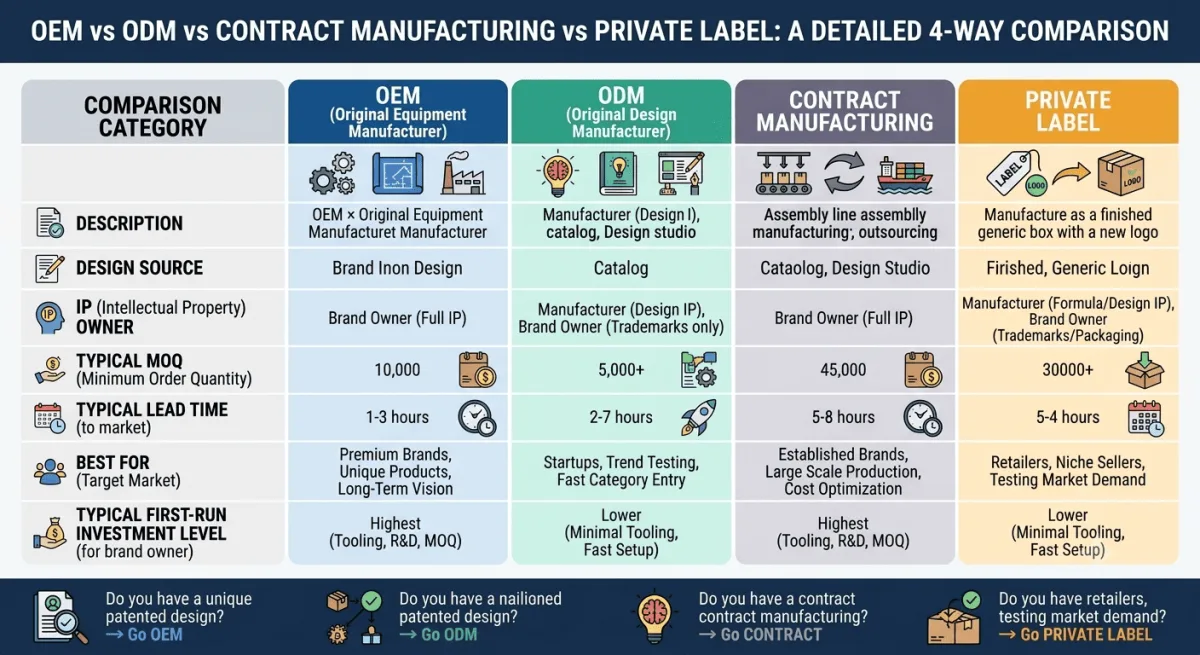
IP Ownership and Contract Terms: The Details That Matter
The single most important OEM contract provision is IP ownership. The default assumption for a buyer is that any product IP contributed to the design (drawings, specifications, brand elements, custom fixtures) transfers or is licensed exclusively to the buyer; the default assumption for an OEM factory may be that residual improvements, tooling designs, or process innovations belong to the factory. The contract should resolve this explicitly, and IP-assignment terms should be reviewed by a qualified attorney with international manufacturing contract experience before signing.
Five provision categories deserve attorney review at contract stage. IP ownership and assignment (who owns product design, custom tooling, process improvements, brand elements). Confidentiality (NDA scope, duration, exceptions for factory operational learning). Indemnification (product liability allocation between OEM and buyer, particularly for regulated categories). Territorial rights (whether the OEM is exclusive to the buyer in a defined territory, whether the OEM is restricted from producing competing brands, geographic scope). Warranty terms (scope, duration, remedies for defective units, factory recall responsibility). These are not standard boilerplate items – the specific terms materially affect the economics and risk profile of the partnership over the equipment life.
MOQ, Lead Times, and Certifications: The Practical Reality
MOQ (Minimum Order Quantity) varies substantially by product category. High-volume consumer electronics OEMs typically require 1,000+ units per SKU per production run. Specialized wellness equipment OEMs (a category where Vacuactivus operates) work at 10-50 unit MOQs for a specific configuration, since each unit is higher-value and the production line accommodates smaller batches. Private-label rebadging of existing factory products often runs at 10-500 units. Contract manufacturing MOQ depends on product complexity but is often lower than OEM since design work is buyer-provided.
Lead times split into two windows. First-run lead time (from PO to first delivery) for specialized wellness equipment runs 14-24 weeks when the workflow includes CE marking, ISO 13485 medical device certification where applicable, FDA registration where applicable, or UL listing requirements. Reorder lead time on established SKUs runs 6-12 weeks since certification and tooling are already in place. Tooling investment is a separate one-time cost, illustrative range $5,000 for simple label and packaging customization / $15,000 for mid-complexity mold and jig for accessory-level products / $75,000+ for custom industrial tooling for full-product OEM builds like a specialized wellness equipment capsule. Individual quotes vary substantially by product complexity.
Certifications deserve particular attention because they are the area where OEM claims most frequently fail verification. CE marking (EU market access) and ISO 9001 (quality management baseline) are widely-held by legitimate OEMs. ISO 13485 (medical device manufacturing framework) is a specialized certification held by fewer factories and required for medical device manufacturing. FDA registration (US market access for medical or food products) is category-specific. UL listing (electrical safety) is required for certain product classes in North America. Any specific vendor certification claim – including claims by Vacuactivus made in marketing materials – should be independently verified with the issuing certification body before contracting, since certifications lapse, scopes change, and audit reports are the reliable verification method. Do not treat a certification logo on a website as verification.
When OEM Makes Sense (and When It Does Not)
OEM economics work when the buyer has a differentiated product design worth manufacturing, has minimum viable order volume to justify tooling investment and unit-cost improvement over private-label alternatives, has the brand and go-to-market capability to sell the manufactured product profitably, and has the operational capacity to manage a manufacturing relationship over 6-12 month cycles. Miss any of those preconditions and the OEM investment does not pay back.
When OEM does not make sense: brands testing a category without a proven product design (private label first, OEM later once demand is validated); brands with sub-minimum order volume that cannot amortize tooling investment; brands without the brand recognition or go-to-market capability to sell manufactured product at margins that cover the OEM economics; brands without operational manufacturing-relationship capacity (a two-person startup managing a 20-week OEM lead time typically underperforms managed private-label sourcing). The honest filter is that OEM is a manufacturing commitment, not a shopping choice – the model rewards mature buyers with proven demand and product design; it punishes buyers using OEM as a differentiator when private label would work. For context on the wider fitness-equipment sourcing decision that surrounds this OEM-vs-alternatives choice, Exercise Equipment Fitness Sourcing 2026 Guide for Brand Owners walks the parallel sourcing framework in depth.
Red Flags Checklist: Warning Signs in OEM Partner Selection
Six red flags separate legitimate OEM partners from problematic ones during vetting. First: no verifiable certification documents when requested (certification logos on the website without a corresponding current audit report or issuing-body confirmation). Second: refusal to accept IP assignment terms in a standard OEM contract (a factory unwilling to assign product IP is signaling either that they intend to reuse the design for other buyers or that their contract terms will not survive attorney review). Third: no visible track record with named clients (a factory that cannot cite verifiable existing OEM relationships in the category is often either new or has poor client-retention economics).
Fourth: refusal to allow factory visit or third-party audit at buyer expense (a factory that will not open production floor to a prospective long-term client is signaling something about production reality). Fifth: wildly under-market unit pricing (a quote 30-50% below prevailing market price for the same specification is either subsidized to win the account and will not survive first reorder, or the factory intends to substitute lower-spec components after the sample). Sixth: absent formal warranty terms (no defined defect rate, no recall process, no remedy for late delivery – the factory expects the buyer to eat any post-shipment cost). Any single red flag warrants deeper investigation; two or more warrant walking away.
The vetting workflow that manages these risks: Step 1 certification verification with issuing bodies (call the ISO registrar, verify the CE technical file exists, request the current audit report). Step 2 factory audit (on-site visit or third-party audit through a firm like SGS, TUV, or Bureau Veritas at buyer expense). Step 3 sample order (10-50 units, verify actual quality and lead time versus stated capability). Step 4 pilot batch (200-500 units, verify scale execution and reorder timing). Step 5 full production commitment. Each step retains kill-switch optionality; skipping steps to accelerate the timeline usually costs more in remediation than the vetting would have.
Vacuactivus OEM Partnerships: Specialized Wellness Equipment Category
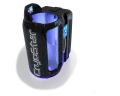
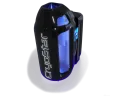
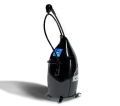
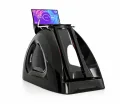
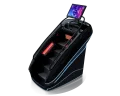
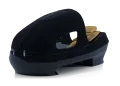
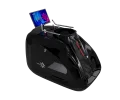
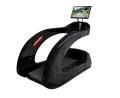
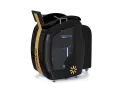
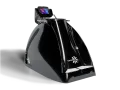
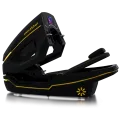
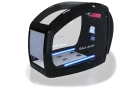
Vacuactivus manufactures specialized wellness equipment (commercial cryotherapy chambers, red light therapy panels and beds including the InfraCouch, vacuum infrared fitness in the BodyShape line including InfraStar and VacuStar, RollShaper wood-roller machines, and adjacent modalities) since 2009 (over 15 years) in Poland with EU-based production, with OEM and private-label partnerships active across 50+ countries. The category economics fit specialized wellness OEM at 10-50 unit MOQ for a given configuration, 14-24 week first-run lead time with certification workflow, and 6-12 week reorder lead time on established SKUs. Tooling investment for a full OEM configuration ranges illustratively $15,000-$75,000+ depending on product complexity.
For a brand evaluating a specialized wellness equipment OEM partnership, apply the same vetting workflow to us that this article recommends for any OEM partner: request current certification documents from us with issuing-body verification pointer (a legitimate OEM will provide, verify with issuing body); request a factory visit or third-party audit at your expense; run a sample order before pilot batch, and pilot batch before full production. For a formal engagement inquiry, the Vacuactivus OEM manufacturing service and private-label page walks the quote request pathway, and the Become a Vacuactivus distributor page covers the distributor / territorial partner pathway which some buyers prefer over pure OEM. For B2B context on how a category-specific OEM partnership differs from general fitness equipment manufacturing, see Fitness Equipment Manufacturer: Why Brands Choose Vacuactivus OEM and for wellness-center-side buyer perspective Best Red Light Therapy Equipment for Wellness Centers B2B Guide.
Frequently Asked Questions
Q1. What is an OEM (Original Equipment Manufacturer)?
An OEM is a factory that produces finished products to a buyer’s design specification, which the buyer then sells under the buyer’s own brand. The buyer owns the product design and the brand; the OEM contributes production capacity, tooling, quality control, certification workflow where applicable, and delivery logistics. The classic industry pattern is the OEM-VAR relationship (a Value-Added Reseller contracting with an OEM to produce equipment sold under the VAR brand), with the canonical example being Apple designing hardware and Foxconn manufacturing it at scale. OEM differs from ODM (factory-designed with buyer rebrand), contract manufacturing (build-to-print with no product ownership either side), and private label (rebadge of existing factory product without customization).
Q2. What is the difference between OEM and ODM?
The critical difference is who owns the product design. OEM: buyer owns the design, factory builds to buyer’s specification. ODM (Original Design Manufacturer): factory owns the design, buyer licenses and customizes for branding. OEM fits brands with proprietary product designs they want manufactured at scale under their own brand. ODM fits brands that want a factory-designed product rebranded with minimal customization, often at higher MOQ since the factory needs to amortize its design investment across multiple buyers. Contract terms differ: OEM contracts assign product IP to the buyer; ODM contracts typically license factory-owned IP to the buyer with restrictions on modification and territorial rights. Neither is better in the abstract; they fit different buyer contexts.
Q3. What is the difference between OEM and private label?
OEM builds a buyer-designed product to the buyer’s specification with buyer branding; private label rebadges an existing factory product under the buyer’s brand with no design customization. OEM requires the buyer to have a differentiated product design and MOQ commitment to justify tooling; private label works for buyers who want to launch a category quickly without a differentiated product design. Private-label MOQ is typically much lower (10-500 units), lead time is much shorter (4-8 weeks since the product already exists), and unit cost is often higher (no design ownership means less pricing leverage). For a brand testing a category, private label first is often the right sequence; for a brand with a proven design and volume commitment, OEM economics work better long-term.
Q4. What is contract manufacturing vs OEM?
Contract manufacturing is a build-to-print arrangement where the buyer provides full engineering drawings and specifications, and the factory manufactures strictly to those drawings without owning any product IP. OEM is a broader relationship where the buyer typically provides design intent and specification and the factory contributes production engineering, tooling design, and certification workflow. In practice the line blurs – many OEM relationships involve some contract-manufacturing components, and many contract manufacturers add production-engineering value over time. The contract terms are what actually distinguish them: contract manufacturing contracts specify build-to-print obligations without design contribution; OEM contracts define production capacity, quality standards, certification responsibility, and IP terms.
Q5. What is the minimum order quantity (MOQ) for OEM manufacturing?
It varies substantially by product category. High-volume consumer electronics OEM typically requires 1,000+ units per SKU per production run. Specialized wellness equipment OEM (where Vacuactivus operates) works at 10-50 unit MOQs for a specific configuration, since each unit is higher-value and the production line accommodates smaller batches. Private-label rebadging typically runs at 10-500 units. Contract manufacturing MOQ depends on product complexity but is often lower than OEM since design work is buyer-provided. The MOQ is a negotiation input, not a fixed rule – factories will sometimes accept lower MOQ against higher unit price or against a commitment to specified reorder volume within a defined timeframe.
Q6. Who owns the intellectual property in an OEM partnership?
It depends on the contract terms, and this is the single most important OEM contract provision. The default buyer assumption is that any product IP contributed to the design (drawings, specifications, brand elements, custom fixtures) transfers or is licensed exclusively to the buyer. The default factory assumption may be that residual improvements, tooling designs, and process innovations belong to the factory. A well-drafted OEM contract explicitly resolves who owns product design IP (typically the buyer), who owns tooling (variable – sometimes buyer, sometimes factory with buyer-exclusive use, sometimes shared), who owns process improvements developed during production (variable), and whether the factory is permitted to reuse learnings on other buyer accounts (typically restricted). Have an attorney with international manufacturing contract experience review these terms before signing.
Q7. How long does OEM manufacturing take?
Split the timeline into first-run and reorder windows. First-run lead time (from PO to first delivery) runs 14-24 weeks for specialized wellness equipment when the workflow includes CE marking, ISO 13485 medical device certification where applicable, FDA registration where applicable, or UL listing requirements. Reorder lead time on established SKUs runs 6-12 weeks since certification and tooling are already in place. Consumer electronics OEM lead time is often shorter (8-12 weeks first run) at the tradeoff of higher MOQ. Tooling investment is a separate one-time cost incurred before the first production run. Add certification lead time explicitly if the product requires new certifications – CE marking, ISO 13485, and FDA registration each add 4-12 weeks to first-run timeline depending on certification scope.
Q8. What are examples of OEM companies?
Foxconn is the canonical high-volume consumer electronics OEM, producing hardware for Apple, Sony, Dell, and others under those buyer brands. Flex Ltd (formerly Flextronics), Jabil, and Celestica operate similar contract-manufacturing/OEM hybrid models in electronics. In automotive OEM, Magna International produces vehicle systems for major automakers. In specialized wellness equipment, Vacuactivus operates as an OEM in commercial cryotherapy chambers, red light therapy panels and beds, vacuum infrared fitness (BodyShape line), and RollShaper wood-roller categories since 2009 (over 15 years) from EU/Poland-based production, with 50+ country OEM partnerships. Category-specialist OEMs typically outperform generalist manufacturers on the specific category’s certification workflow and production engineering; the tradeoff is that the buyer commits to that category rather than spreading OEM relationships across a generalist manufacturer.
Conclusion
OEM (Original Equipment Manufacturer) partnerships work when the buyer has a differentiated product design worth manufacturing, minimum viable order volume to justify tooling, brand and go-to-market capability to sell the manufactured product profitably, and operational capacity to manage a manufacturing relationship over 6-12 month cycles. When those preconditions align, OEM economics deliver better unit cost and stronger IP ownership than private-label alternatives; when they do not, private label or ODM often fit better for the buyer’s actual maturity level.
The vetting sequence that separates working partnerships from failed ones – certification verification with issuing bodies, factory audit, sample order, pilot batch, then full production commitment – is not optional; skipping steps to compress timeline typically costs more in remediation than the vetting would have. Certifications should be verified with the issuing body regardless of what the vendor’s marketing states – CE marking, ISO 9001, ISO 13485, FDA registration, and UL listing all have specific issuing bodies and current audit-report checks that are the reliable verification method. Apply the same standard to any manufacturer including Vacuactivus. For specific OEM engagement inquiry on specialized wellness equipment, the manufacturing service page walks the quote request; for territorial distributor partnerships as an alternative, the distributor onboarding page covers that pathway.


