
















Red Light Bed Therapy: Commercial Tanning-Style Beds for Spas
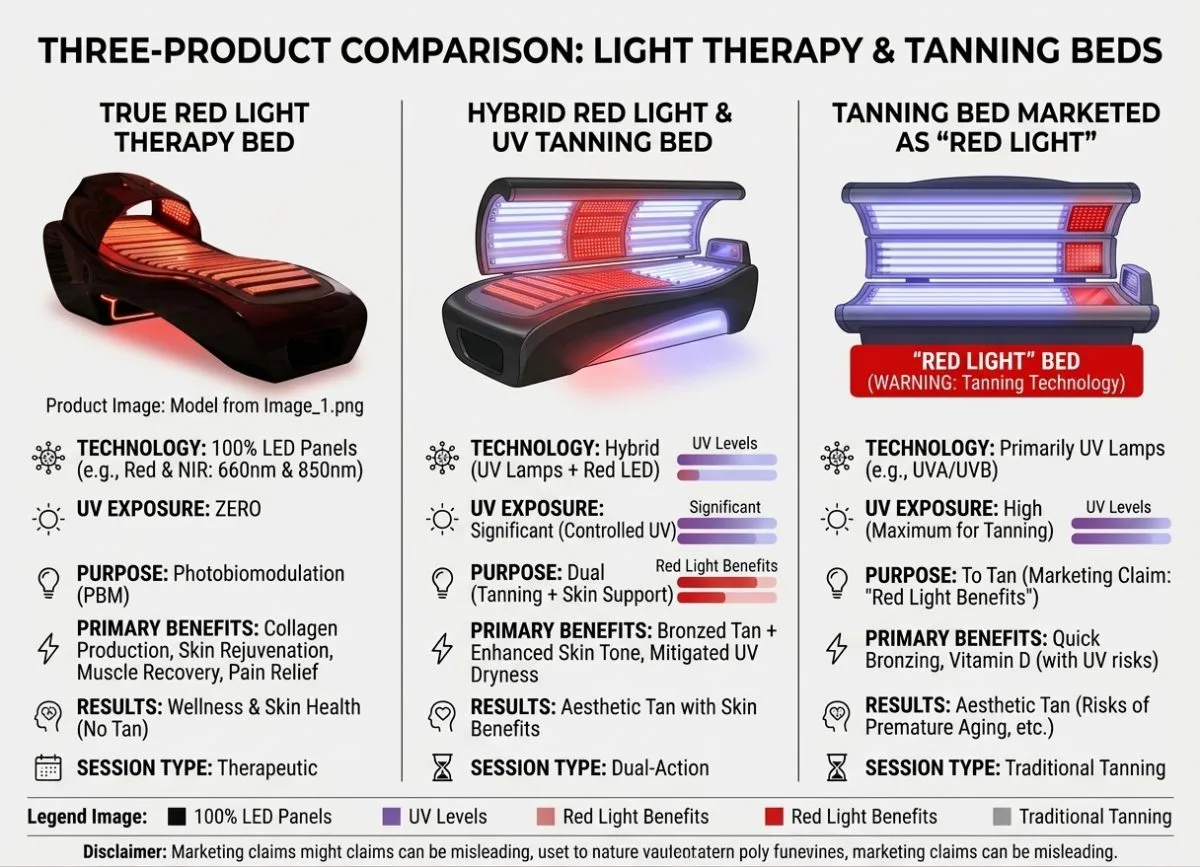
Three different products get sold as a red light bed, and the difference decides what a spa can legally tell its clients. A true red light therapy bed delivers red and near-infrared wavelengths in the 620-900nm range, contains no UV, and does not tan. A hybrid bed combines UV tanning lamps with red LEDs in one cabinet: it tans, because the UV is doing what UV does, and the red light rides along. And some salons market a standard tanning bed as a red light bed simply because the lamps glow red. For an operator the consequence is direct. Buy a dedicated red light bed and you can sell a non-UV wellness service. Buy a hybrid and you are selling UV exposure with a wellness label on it.
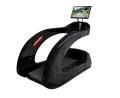
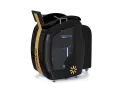
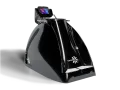
Vacuactivus manufactures the InfraCouch Red Light, a commercial red light bed in the dedicated (non-UV) category built for medical spas, chiropractic clinics, recovery studios, fitness centers, and wellness facilities since 2009 (over 15 years). This guide is written from the build side and from years of selling into salons and spas that ask the same three questions: which product am I actually looking at, what can I honestly say to my clients, and does the math work. We answer all three below.
The article is structured for the operator who is 60 seconds from a purchase decision. Skim the naming section to place any bed you are being pitched into one of three buckets. Read the claims section to know what you can say about each bucket. The demand and membership math sections cover the commercial case. The spec checklist gives you the questions to ask any supplier before signing. Nothing here is medical advice. Client-facing therapeutic claims and marketing copy should be reviewed with a qualified healthcare or regulatory professional before publication.
Three Products, One Name
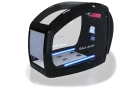
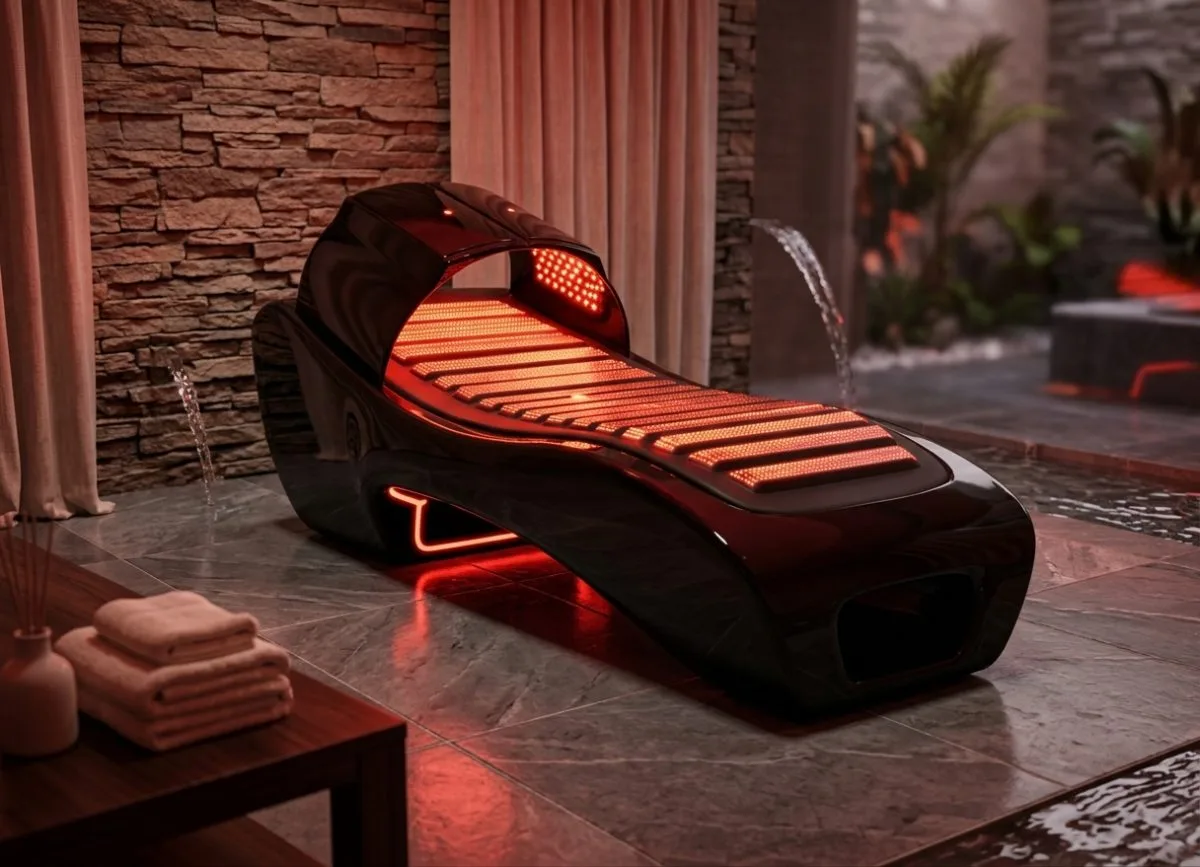
Walk into ten tanning salons advertising red light and you will find at least three different machines behind the same phrase. The first is a dedicated red light therapy bed: an enclosed cabinet, usually a lay-down format that looks like a tanning bed, lined with LEDs emitting visible red in the 620-700nm range and often near-infrared in the 780-900nm range. There is no UV in it. It does not tan, and the client leaves the same color they arrived. For a deeper look at what these wavelengths actually do at the cellular level, see Red Light Therapy Panel: How 660nm + 850nm Wavelengths Heal Tissue which covers the mechanism and dual-wavelength specification in depth.
The second is a hybrid: UV tanning lamps and red LEDs in one cabinet, sold under names like CollaTan. It tans, and it does so because the UV lamps are doing exactly what UV lamps do; the red LEDs run alongside as an add-on. Palm Beach Tan, the largest US tanning chain, lists hybrid systems next to horizontal beds and stand-up booths as separate categories, which is the honest way to present them. The third is not a product at all but a naming practice: some salons call a standard tanning bed a red light bed because the lamps glow red or deep orange. As SeekRedLight puts it, the name is misleading – a red glow is not red light therapy. Wavelength is a measured property, not a color you can see.
This matters commercially because your clients cannot tell the three apart by looking, and increasingly they are checking. It matters operationally because what sits in your room determines what you are allowed to say about it. The table below distills the three-product reality into a factor-by-factor comparison.
| Factor | True Red Light Therapy Bed | Hybrid (UV Lamps + Red LEDs) | Tanning Bed Marketed as Red Light |
|---|---|---|---|
| UV present | No | Yes (that is the point of the UV lamps) | Yes |
| Does it tan the client | No (client leaves the same color) | Yes (the UV does the tanning; red LEDs run alongside) | Yes |
| Wavelengths | 620-700nm visible red plus often 780-900nm near-infrared | UV plus red LED (often 620-700nm) | Standard UV lamps that glow red or deep orange (a color, not a therapeutic wavelength) |
| What you can honestly claim to clients | Non-UV wellness service; skin texture and collagen support over 4-6 to 8-12 weeks | A tan (because the UV tans), plus red light exposure as an add-on | A tan; do not describe as red light therapy |
| Indoor tanning tax filing obligation | No (no UV emitted) | Yes (UV service) | Yes (UV service) |
| Protective eyewear required | Recommended (LED brightness comfort) | Yes (UV exposure) | Yes (UV exposure) |
| Who it fits | Wellness-leaning salon, medical spa, chiropractic clinic, recovery studio, fitness center | Salon with membership base wanting UV + red light in one visit and honest UV disclosure | Does not fit as a red light offering – reclassify as standard UV |
What You Can Claim Depends on What You Bought
A dedicated red light bed produces no UV, which means the service you sell is a non-UV wellness session and you can describe it that way without a caveat. A hybrid produces UV, which means the session tans, and every honest description of it has to say so. The industry blur happens at exactly this seam: a hybrid marketed as red light therapy invites the client who came in specifically to avoid UV. Mito Red, whose FAQ on this topic is reviewed by its scientific advisory board, states the position plainly. Red light therapy does not make UV exposure safe and should not be treated as protection against tanning-related damage. The American Academy of Dermatology position on indoor tanning has not softened either: wrinkles, loss of skin firmness, and age spots.
None of this disqualifies hybrids. Clients who want a tan and want collagen support in the same visit are a real market, and Palm Beach Tan and Boca Tanning Club both run hybrid systems successfully alongside dedicated services. The rule is separation, not exclusion. Sell the tan as a tan and the red light as red light. Practically, that also affects paperwork – UV services carry indoor tanning tax filing obligations that a dedicated red light service does not, and misclassifying the service on the marketing menu does not exempt it from the tax classification of the equipment producing it.
The Demand Is Already Searching for You
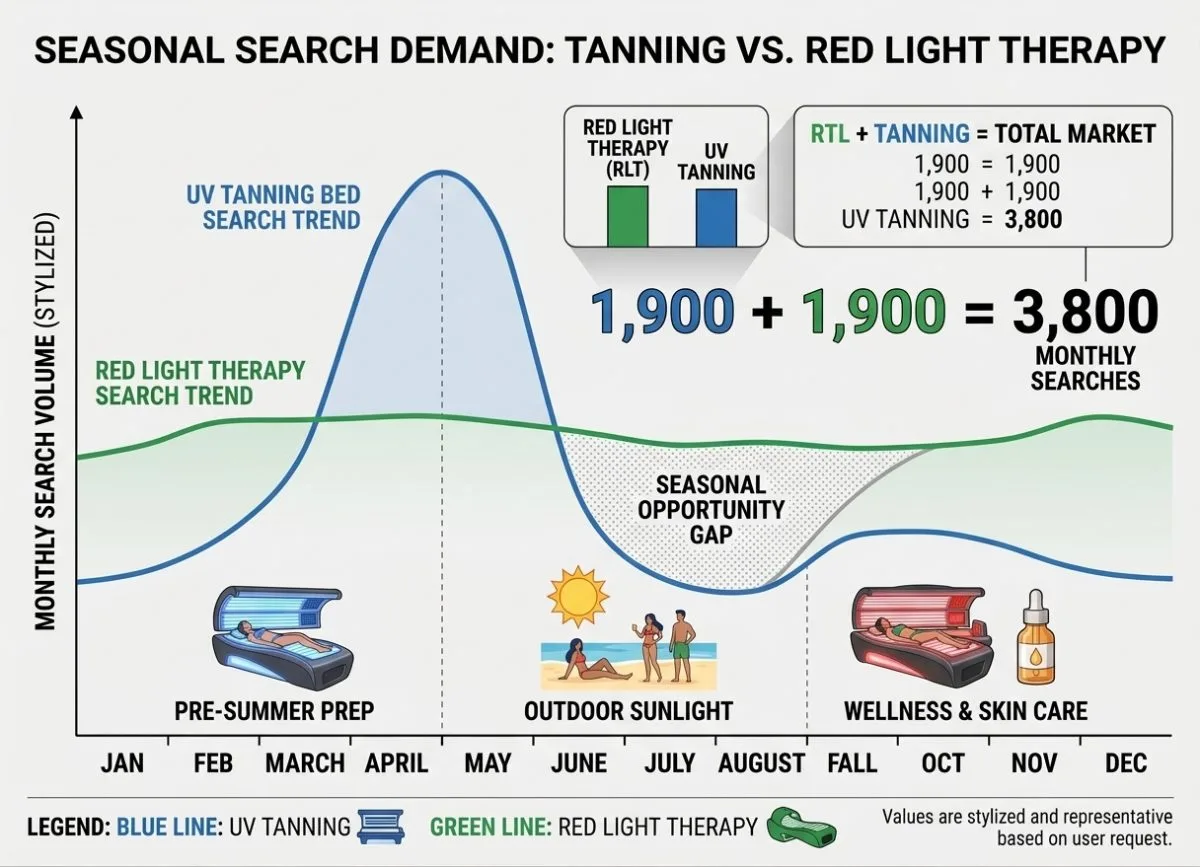
Two search terms make the business case without any argument from us. In the US, roughly 1,900 people a month search ‘red light therapy beds near me’, and another 1,900 search ‘tanning salons with red light therapy beds’. That is 3,800 monthly searches from people who have already decided they want the service and are hunting for a room that has one. If your salon does not, those searches resolve to the salon that does, and the Google Maps pack decides it in about four seconds.
The demand behind those numbers has a shape. Clients arriving through those searches are not seasonal tanners looking for the cheapest bed; they are wellness buyers, and Simple720 makes the point directly in its salon-upgrade analysis – the wellness market carries a higher budget and stays loyal longer than seasonal tanners. That difference shows up in the calendar. Tanning demand peaks in spring and collapses in the fall; red light demand does not follow the sun. A salon whose entire revenue rides on UV has a seasonal curve baked into it, and a red light bed is one of the few additions that fills the trough rather than deepening it. ProSun frames its lay-down beds around exactly this positioning, keeping clients engaged year-round rather than for six months of it.
The Membership Math
Red light beds pay through memberships, not walk-ins, and the published numbers are unusually specific for this industry. ProSun reports a salon running a $39.99 bi-weekly Premium Membership that includes unlimited red light plus a monthly body scan. In ProSun’s published case: 43% of new members chose the upgrade, the bed paid back in under three months, and attrition dropped more than five points over twelve months. That last number is the one operators should read twice, because a five-point attrition improvement compounds across the entire membership base, not just the red light users. These are ProSun’s reported operator numbers rather than a Vacuactivus result or an industry norm; use them as a benchmark, not a forecast.
Simple720 runs the per-session math on hybrids: a standard walk-in tanning session retails at $12-14 while a luxury hybrid session commands $30 at high-end salons, so moving ten clients a day onto the premium unit adds roughly $160 daily. That revenue covers the equipment maintenance line of about $500 a month within days of active operation. Simple720 also notes that LED technology cuts 30-40% of the energy draw versus older lamp units, which matters as electricity rates climb. For scale, a real listing at BizQuest for an established Ohio tanning and wellness salon shows what the mature version looks like: 2,400 square feet, fifteen tanning beds plus one red light unit and a spray tan room, running 95% recurring membership revenue at $115,911 annually. Note the ratio – one red light unit against fifteen tanning beds. It is there because it earns its floor space, not because it fills it. The BizQuest listing is a seller’s stated numbers rather than an audited P&L; treat it as a structural illustration.
The market context for pricing: UV sessions run $10-30, dedicated red light clinics charge $40-80 per session with monthly unlimited at $200-400, and Planet Fitness bundles Total Body Enhancement into a $24.99 Black Card tier. Any operator model should place its own bed against these market anchors before committing capital. The table below distills the pricing landscape.
Red Light Bed Revenue Models 2026 (Market Reference)
Published pricing points across the US market, distilled from named operator and market sources. Individual salon economics vary substantially by location, clientele, pricing tier, and operational execution; use this as a market landscape reference, not a financial forecast.
UV tanning session: $10-30 per session (market range across bed tiers and locations, per SeekRedLight). Hybrid premium session: approximately $30 per session at high-end salons (per Simple720). Dedicated red light therapy clinic session: $40-80 per session (per SeekRedLight market survey). Monthly unlimited red light package: $200-400 per month (per SeekRedLight). Gym-bundled tier: Planet Fitness Total Body Enhancement included in $24.99 Black Card (per SeekRedLight). ProSun bi-weekly Premium Membership: $39.99 for unlimited red light plus monthly body scan, with reported 43% new-member upgrade rate and payback under 3 months (per ProSun case study). Established salon annual recurring revenue: 95% recurring at $115,911 across 2,400 square feet with 15 tanning beds plus 1 red light unit plus spray tan (per BizQuest listing, seller-stated). For a deeper look at commercial red light equipment pricing and FDA-clearance verification, see Red Light Therapy Equipment for Sale: Commercial Buying Checklist.
What to Verify Before You Buy
The spec sheet is where the three products separate, and marketing copy will not do it for you. Wavelengths first: a therapeutic bed should publish actual figures, visible red in the 620-700nm band and near-infrared in the 780-900nm band, not a generic red light claim. Mito Red says this directly – verify the actual wavelengths and output data rather than relying on generic claims. Some beds run a single wavelength: ProSun builds around 633nm, which is a legitimate red light figure but covers skin rather than deeper tissue, so match the spec to what you are actually selling. If muscle and joint recovery is on your service menu, the near-infrared band matters; if the offer is skin work only, a red-only bed can be a defensible spec.
Irradiance next, and always with the distance it was measured at and the instrument used, because a number without those two facts is not a specification. Ask for the third-party test report rather than a bullet point on a brochure. Then LED lifespan, where 50,000 hours and up is the professional marker for commercial deployment. Then the warranty, specifically whether commercial use is covered rather than excluded – consumer warranties void the moment a paying client uses the device, and that clause has ended more red light investments than any component failure. Finally, documented absence of UV if you are buying a dedicated bed: ask for it in writing, because your entire service description depends on it being true. For a broader B2B equipment guide covering the full evaluation flow across wellness-center equipment categories, see Best Red Light Therapy Equipment for Wellness Centers: B2B Guide.
Expect the results conversation too. Red light is cumulative, not instant. Clients notice skin texture changes after 4-6 weeks at three to five sessions per week, and collagen changes take 8-12 weeks. Sell that timeline honestly at the counter, or the membership churns before it works. This is a commercial fact rather than a clinical footnote: a client sold on a visible week-one result cancels in week three, while a client who understood the eight-to-twelve-week arc renews.
Where a Red Light Bed Fits and Where It Does Not
A red light bed fits a salon or spa with a membership base to upsell, a wellness-leaning clientele, and a revenue curve that sags out of season. It fits medical spas and recovery studios where the service sits naturally alongside what is already on the menu. It fits an operator who has plateaued on membership growth and needs a premium tier rather than more of the same tier. For the difference between commercial-grade and consumer-grade red light equipment (which matters for the warranty question above), see Best At-Home Red Light Therapy: Why Pros Choose Pro Equipment which explains the specification gap professional buyers should not miss.
It does not fit everyone, and Simple720 is refreshingly blunt about the failure case: in a high-volume shop where clients want the cheapest tan available, a premium bed sits idle and the floor space would earn more as a basic UV unit. It does not fit an operator unwilling to sell the timeline honestly, because red light disappoints anyone expecting a visible result in week one. It does not fit a room with no plan for the electrical and freight requirements a commercial cabinet carries. And it does not fit as a UV replacement for clients who came for a tan – it is an addition to the menu, not a substitute on it. The operator question is not whether red light works. It is whether your specific membership base will pay a premium tier for it, and the honest way to find out is to ask them before you buy rather than after.
Where Vacuactivus Fits
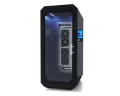
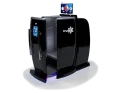
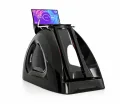
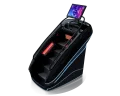
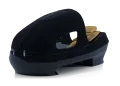
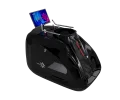
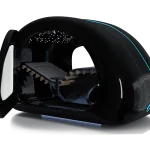
Vacuactivus manufactures the InfraCouch Red Light, a commercial red light bed built for medical spas, chiropractic clinics, recovery studios, fitness centers, and wellness facilities. The format is the tanning-bed silhouette without any UV: the client lies on a contoured surface, the canopy closes, and the session runs 15-20 minutes. It sits squarely in the dedicated category described above, which is the distinction that governs how you describe the service to a client.
Operators frequently pair InfraCouch Red Light with adjacent equipment in the same treatment flow, and we build for that as well. The De-Stress Lounge zero-gravity massage chair runs as a companion recovery station in wellness cabins, and the Revique HaloX longevity capsule combines red light, infrared, and PEMF into a single-cabinet multi-modality option for facilities where floor space is limited. Full specifications and configuration options are on the Vacuactivus red light therapy equipment page. Apply the checklist above to us the same way you would to any supplier: ask for the wavelengths, the irradiance methodology, the LED rating, and the commercial warranty clause in writing. A manufacturer who will not put those in writing is telling you something.
Frequently Asked Questions
Q1. What is the difference between a red light bed and a tanning bed?
A tanning bed uses ultraviolet radiation to stimulate melanin and darken skin. A red light therapy bed uses visible red light in the 620-700nm range and often near-infrared in the 780-900nm range, contains no UV, and does not change skin color. They look similar because both are enclosed cabinets you lie in, but the light is doing opposite work. UV damages skin to produce a tan, while red light supports cellular function through photobiomodulation. The complication is a third category. Some salons market a standard tanning bed as a red light bed because the lamps glow red or deep orange, and a red glow is not red light therapy – wavelength is a measured property, not a color you can see. Ask the salon for the actual wavelengths and whether the bed emits UV.
Q2. Do red light therapy beds tan you?
A dedicated red light therapy bed does not. It emits no UV, and UV is what produces a tan, so a client leaves the same color they arrived. A hybrid bed does tan, because it combines UV tanning lamps with red LEDs in one cabinet, and the UV lamps do exactly what UV lamps do regardless of what the red LEDs are doing alongside them. This is the distinction that gets blurred in marketing, and it matters for the client who specifically came in to avoid UV. Mito Red, whose guidance on this is reviewed by its scientific advisory board, states it directly: red light therapy does not make UV exposure safe and should not be treated as protection against tanning-related damage. If a bed tans you, it is emitting UV, whatever it is called on the price list.
Q3. Are hybrid red light tanning beds worth it for salons?
It depends entirely on your clientele, and the honest answer includes a failure case. Simple720 runs the math: a standard walk-in session retails at $12-14 while a luxury hybrid commands $30 at high-end salons, so moving ten clients a day onto the premium unit adds roughly $160 daily and covers the roughly $500 monthly maintenance line within days. LED technology also cuts 30-40% of energy draw versus older units. But the same analysis is blunt about when it fails: in a high-volume shop where clients want the cheapest tan available, a premium hybrid sits idle and the floor space would earn more as a basic unit. Hybrids fit salons with a membership base to upsell and a clientele that values anti-aging over getting dark fastest. One operational caveat: a hybrid emits UV, so the session must be described as a tanning service and carries indoor tanning tax obligations that a dedicated red light service does not.
Q4. How much do salons charge for red light therapy sessions?
Pricing splits by format. UV tanning sessions run $10-30 depending on bed tier and location, while luxury hybrid sessions reach $30 per visit at high-end salons. Dedicated red light therapy clinics charge $40-80 per session, with monthly unlimited packages at $200-400. Gyms bundle it into membership tiers instead: Planet Fitness includes Total Body Enhancement with its $24.99 Black Card. The most instructive number comes from ProSun, reporting a salon running a $39.99 bi-weekly Premium Membership that includes unlimited red light plus a monthly body scan, where 43% of new members chose the upgrade, the bed paid back in under three months, and attrition dropped more than five points over twelve months. The pattern across all of these is that red light earns through membership tiers and retention rather than per-session walk-ins.
Q5. How long does it take to see results from a red light bed?
Red light is cumulative, not instant, and selling it otherwise churns memberships before the service works. Clients typically notice skin texture changes after 4-6 weeks at three to five sessions per week. Collagen changes take 8-12 weeks. Sessions themselves run 10-20 minutes. For an operator this timeline is a commercial fact rather than a clinical footnote: a client sold on a visible week-one result cancels in week three, while a client who understood the eight-to-twelve-week arc renews. Build the timeline into the counter conversation and the membership terms. This is also why red light works better as a membership product than a walk-in one – the business model has to match the biology, and the biology needs repeat exposure over weeks.
Q6. What wavelengths should a red light therapy bed have?
A therapeutic bed should publish actual measured figures: visible red in the 620-700nm band and near-infrared in the 780-900nm band, rather than a generic red light claim. Mito Red states this directly – verify the actual wavelengths and output data instead of relying on generic claims. Red wavelengths reach skin and collagen; near-infrared reaches deeper tissue, so a bed running red only covers skin work but not muscle or joint recovery. ProSun, for example, builds around 633nm, a legitimate red figure that suits skin applications specifically. Match the spec to what you intend to sell. Alongside wavelengths, ask for irradiance with the distance it was measured at and the instrument used, since a number without those two facts is not a specification, and ask for the third-party test report rather than a bullet point on a brochure.
Q7. Can you use red light therapy and a tanning bed together?
Yes, and many salon clients do both in one visit. They work through completely different mechanisms: UV stimulates melanin to darken skin, while red and near-infrared wavelengths support cellular function without affecting skin color, so there is no conflict between the two services. Palm Beach Tan and other chains run both alongside each other, and rotation memberships covering UV tanning, red light, and spray tanning are a common structure. The caution is what the combination does not do. Red light does not neutralize UV damage and is not protection against it, and the American Academy of Dermatology position on indoor tanning risks – wrinkles, loss of firmness, age spots – is not changed by adding a red light session afterward. Sell them as two services with two different purposes rather than as one service that cancels the other.
Q8. How much does a commercial red light therapy bed cost?
Commercial red light beds span a wide range depending on tier, and pricing should always be confirmed with the supplier since it moves. What is more useful than a single number is the operating math around it. Equipment maintenance runs roughly $500 per month on a commercial unit according to Simple720, and LED technology cuts 30-40% of energy draw versus older lamp units. On the return side, ProSun reports a bed paying back in under three months inside a $39.99 bi-weekly membership with a 43% upgrade rate. For a sense of scale in a mature operation, a listing at BizQuest for an established Ohio salon shows 2,400 square feet running fifteen tanning beds plus one red light unit and a spray tan room, generating $115,911 annually at 95% recurring membership revenue. Budget beyond the cabinet for electrical requirements, freight and liftgate delivery, and floor space that could otherwise hold a UV unit.
Conclusion
Three different products get sold as a red light bed. What you buy decides what you can honestly tell your clients: a dedicated bed sells as a non-UV wellness service, a hybrid sells as a tan with red light alongside, and a red-glowing standard tanning bed sells as UV whatever the price list calls it. The demand is already there – 3,800 monthly US searches from people hunting for a salon that has one, and the Google Maps pack decides quickly. The economics work through memberships, not walk-ins: ProSun reports 43% new-member upgrades, payback under 3 months, and attrition down 5+ points on its published case; Simple720 shows +$160 daily on ten hybrid upgrades against $500 monthly maintenance. Verify wavelengths (620-700nm red plus 780-900nm near-infrared), irradiance with distance and instrument, LED lifespan 50,000+ hours, commercial warranty, and documented absence of UV if buying dedicated. Sell the 4-6 week texture and 8-12 week collagen timeline honestly at the counter, or the membership churns before it works. The operator question is not whether red light works. It is whether your specific membership base will pay a premium tier for it – and the answer to that is a conversation with them before signing the freight order.


