












Best At-Home Red Light Therapy in 2026: Why Pros Choose Pro Equipment
The best at-home red light therapy device is not the one with the loudest marketing or the most affiliate links. It is the one with the right specifications for your goal: adequate irradiance (power density), the correct wavelengths, and enough coverage. That framing is missing from most 2026 device roundups. This guide, written by the Vacuactivus engineering team that manufactures professional red light therapy equipment, teaches you how to read a spec sheet and match it to your treatment goal.
Here is the part most best-red-light-therapy device reviews skip: most clinical studies demonstrating red light therapy benefits used professional-grade devices with higher power densities than typical at-home versions. Weather.com’s May 2026 buyer guide made this point directly. The science of red light therapy is proven; the degree of effectiveness scales with the dose delivered. Lower-power consumer devices are not fake, but they require longer or more frequent sessions to reach the doses that produced published clinical outcomes.
This guide serves two audiences with different tolerance for equipment cost and different treatment goals. Home users researching best red light therapy for personal skin and recovery goals learn how to evaluate consumer devices honestly and identify when at-home coverage is sufficient. B2B wellness studio operators, spa owners, and clinic buyers evaluating red light therapy equipment for professional service offerings learn the specification differences that justify commercial-grade capital investment. The comparison sections and buying checklist below cover both use cases.
What Actually Makes a Red Light Device Effective
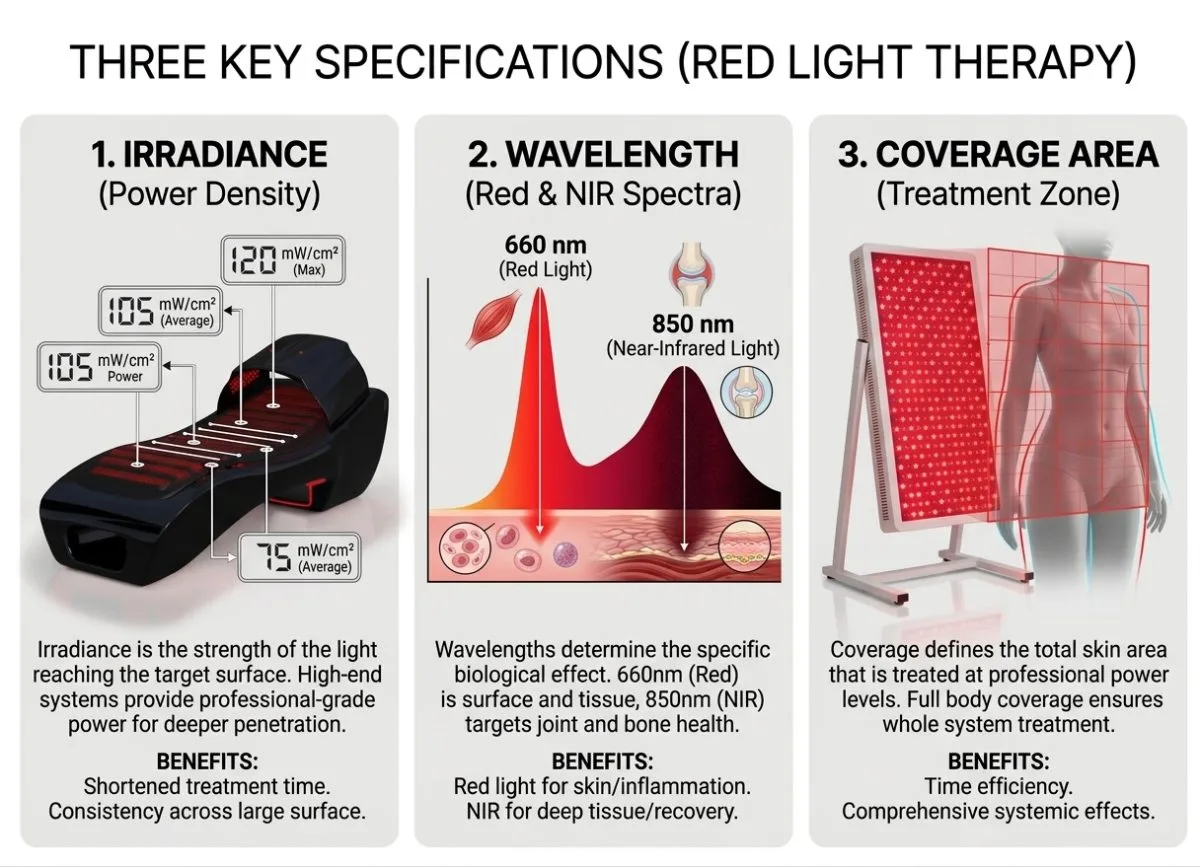
Three specifications determine whether a red light therapy device delivers meaningful results: irradiance (power density), wavelength, and coverage area. Everything else in marketing copy (design, color, brand story) is secondary at best. The three H3 sections below explain each spec in depth.
Irradiance (Power Density)
Irradiance, also called power density, measures how much light energy actually reaches your tissue per unit area. It is expressed in milliwatts per square centimeter (mW/cm2) at a stated treatment distance. This is the single most useful spec because it determines your dosing time. Consumer at-home devices typically deliver 10-30 mW/cm2 at the stated distance per Weather.com’s spec ranges. Professional equipment delivers higher power density, which translates to shorter sessions for equivalent dose. A device with the right wavelengths but very low irradiance simply needs much longer sessions to deliver a meaningful dose – which is not a scam, just a spec tradeoff. Devices that hide irradiance or only quote total LED wattage should be treated with caution: total wattage does not tell you what reaches your skin.
Wavelength (660nm and 850nm)
Two wavelength ranges dominate red light therapy research: 630-680nm (visible red, typically labeled 660nm) targets surface-level skin concerns like complexion, collagen, and superficial recovery. 810-850nm (near-infrared, or NIR, typically labeled 850nm) penetrates deeper for muscle tissue, joint targets, and full-body recovery applications. Consumer Health Digest’s May 2026 review confirms these two ranges as the researched standards. Dual-wavelength devices combining 660nm and 850nm are the most versatile because they cover both surface and deeper targets in one session. Single-wavelength devices can be excellent when matched precisely to a goal, but pay a versatility cost. For a deeper dive into the wavelength mechanism specifically, Red Light Therapy Panel: How 660nm + 850nm Wavelengths Heal Tissue covers the tissue-penetration physics. For the specific hair-follicle application of these wavelengths, see Red Light Therapy Panel which covers 630-670nm follicle targeting. For the musculoskeletal application at 810-850nm, see Red Light Therapy for Pain Relief which covers deeper-tissue pain applications.
Coverage Area
Coverage is often overlooked but matters enormously for practical use. Treating a face with a compact mask is different from treating a full body with a panel or a bed. A great mask for the face is a poor choice for whole-body recovery, and a large panel is overkill for spot skin treatment. Match coverage to goal. Fortune’s 2026 panel roundup notes that form factors range from flexible pads and compact high-output panels for targeted treatment through large multi-panel arrays for full-body coverage. Time investment is also a coverage decision: treating a full body with a small panel requires multiple positioning sessions, defeating the point of at-home convenience.
Why Clinical Results Use Professional-Grade Power Density
The single most important insight for a spec-literate buyer: most clinical studies demonstrating red light therapy benefits used professional-grade devices with higher power densities than typical at-home versions. Weather.com’s May 2026 buyer guide surfaced this observation, and Stanford Medicine’s February 2025 review reinforced the dose-dependence framing (device variation in potency, session time, and cost makes direct comparison hard). Understanding what this means changes how you shop.
Red light therapy works through photobiomodulation: mitochondria within cells absorb specific wavelengths (660nm and 850nm), which triggers increased ATP production, nitric oxide release, and downstream cellular signaling. This biological mechanism is not proprietary to any device tier – the physics operates identically at consumer and professional irradiance. However, the outcome you experience depends on cumulative dose (measured in joules per square centimeter), which is irradiance multiplied by exposure time. A 60 mW/cm2 professional device delivers a target dose roughly three times faster than a 20 mW/cm2 consumer device. That is why clinical study protocols specify device specs precisely: the same protocol on an under-powered device delivers a fraction of the intended dose in the same session time.
The practical implication is not that consumer devices fail. They work when used long enough and consistently enough to reach adequate cumulative dose. A consumer device at 20 mW/cm2 used for 20 minutes daily can approach dose targets reached by a professional device at 60 mW/cm2 in about 7 minutes. The tradeoff is time investment vs upfront capital cost. This is the core reason Red Light Therapy Equipment for Sale: Commercial Buying Checklist emphasizes power density metrics for operators optimizing throughput.
Pro vs Consumer Red Light Therapy: The Real Differences
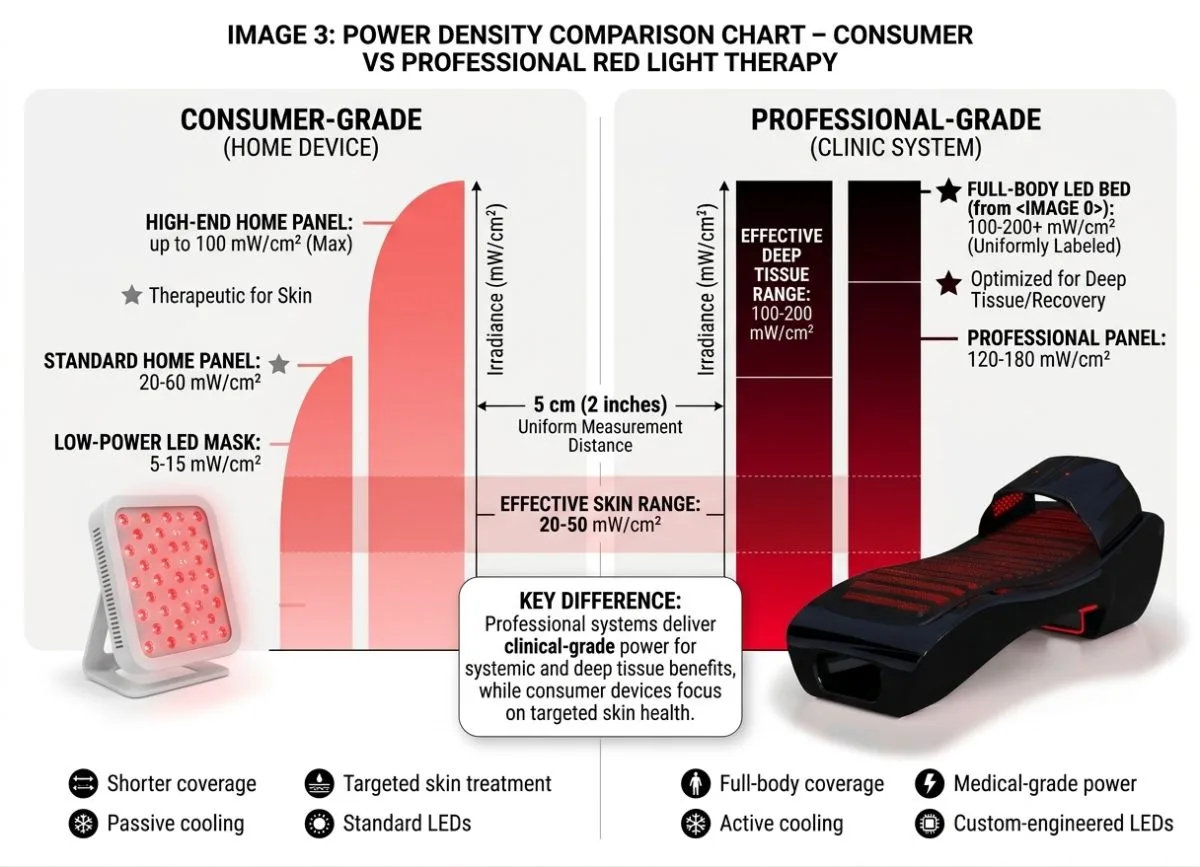
The comparison table below covers eight factors that separate consumer at-home devices from professional equipment. The framing is honest tiers, not one side better than the other. Consumer devices at every price point can be legitimate purchases when matched to their appropriate use case.
| Factor | Consumer At-Home | Professional Equipment |
|---|---|---|
| Irradiance (power density at treatment distance) | 10-30 mW/cm2 typical range at stated distance | Higher power density, delivering equivalent dose in shorter sessions |
| Wavelengths | Often single 660nm or dual 660nm + 850nm depending on tier | Dual 660nm + 850nm standard, precisely calibrated emission spectrum |
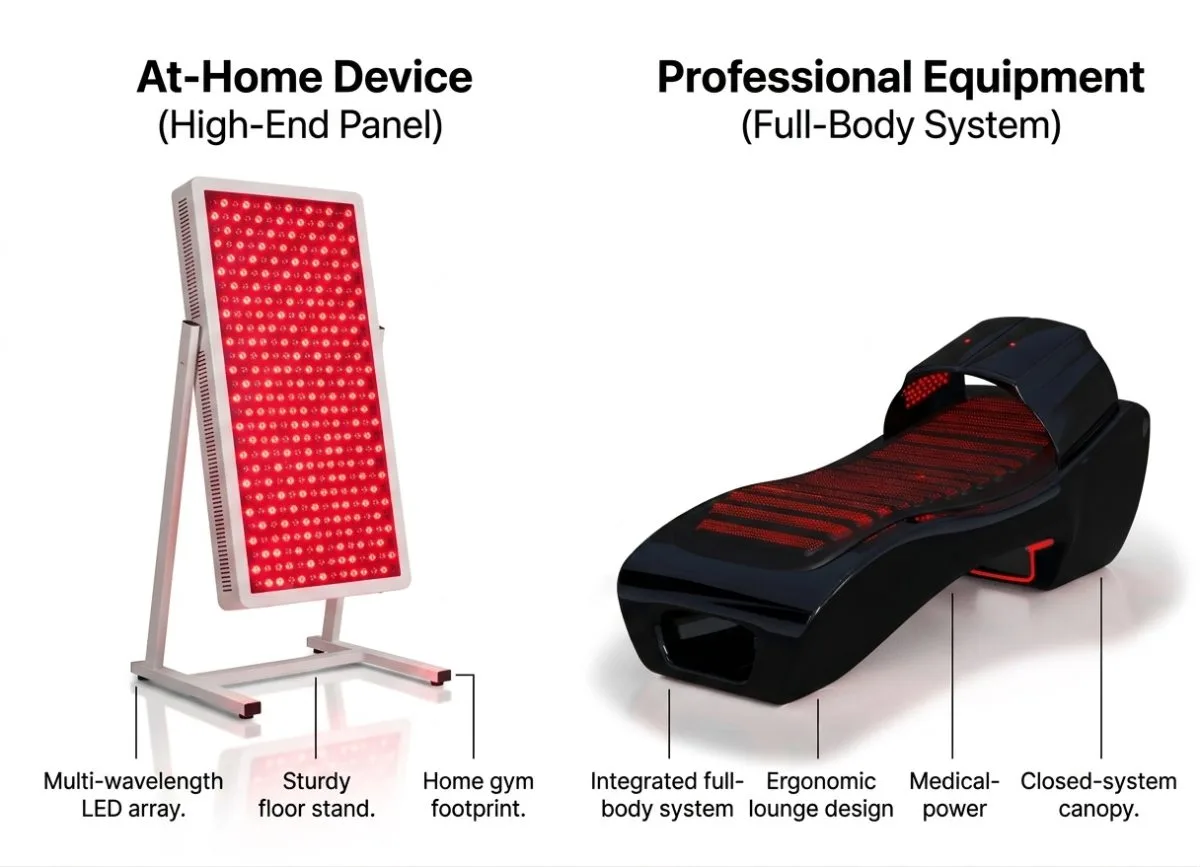
| Coverage area | Compact face masks to mid-size panels (roughly 12 x 24 inches typical panel) | Full-body panels, red light therapy beds, and multi-panel arrays for whole-body treatment |
| Dosing time per session | 10-20 minutes typical to reach target dose (longer at lower irradiance) | Shorter sessions at equivalent dose due to higher power density |
| LED rating and durability | Consumer LEDs typically rated for lower total hours; varies widely by brand | Medical-grade / clinical-grade LEDs rated 50,000+ hours for heavy daily use |
| Build quality and warranty | 1-2 year warranty typical; plastic housings common | 2-3 year warranty typical; metal frames and clinic-grade housings |
| Price range (2026 typical) | $50-$900 depending on form factor and coverage | Higher upfront cost matched to commercial use case and daily throughput |
| Ideal use case | Facial skin care, targeted small areas, daily maintenance, budget-conscious | Full-body treatment, deeper tissue recovery, clinic throughput, business ROI |
The Good Trade’s 2026 science-backed device coverage highlights clinical-grade and medical-grade LED framing for consumer devices in the upper tier (RLT Home and Vital as examples of consumer-tier products that approach medical-grade LED specifications; cited as third-party market examples for context). Peak Primal Wellness’s March 2026 review notes that dual 660nm+850nm devices with medical-grade LEDs rated 50,000+ hours represent a mid-tier consumer segment, with representative models like Hooga HG1500 around $899 in the full-body panel category (third-party product cited for market context). These upper-consumer devices genuinely narrow the gap with entry professional equipment, though the coverage and warranty categories still favor professional gear for daily heavy use.
When At-Home Is Enough (and When It Isn’t)
Honest goal-based segmentation matters because at-home devices are the right choice for many treatment goals. Buyers who overspend on professional equipment for exclusively facial skincare are as poorly served as buyers who underspend on consumer equipment for whole-body recovery. The framing below reflects real use cases.
At-home red light therapy is enough when: you are treating facial skin care goals (complexion, fine lines, texture); targeting small specific areas (a shoulder, a wrist, a spot injury); using red light therapy for daily maintenance rather than acute intervention; on a budget where a $200-$900 consumer device fits your priorities; okay with 10-20 minute sessions used consistently over months. A quality dual-wavelength consumer panel with 20+ mW/cm2 and honest spec disclosure delivers real results across these use cases.
Professional equipment matters more when: full-body coverage is the primary goal (a face mask cannot treat legs or back efficiently); deeper tissue targets (muscle recovery, joint applications) benefit from higher irradiance to deliver adequate dose in reasonable session time; time efficiency matters (fitting sessions into a busy schedule); you are operating a wellness business where multiple clients per day require durable equipment with warranty coverage; you need clinic-throughput sessions where a 7-minute pro session replaces a 20-minute consumer session per client. For a look at commercial full-body form factor specifically, Red Light Bed Therapy: Commercial Tanning-Style Beds for Spas covers the bed category used in spa and clinic settings.
Form Factors: Panels, Beds, Masks, and Handheld Wands
Form factor decisions follow coverage decisions. The four categories below cover 95%+ of red light therapy devices on the market in 2026. Each fits different goals.
Red Light Panels
The best red light therapy panel is the most versatile form factor. Panels scale from compact desktop units (roughly 12 x 8 inches for spot treatment) through large full-body panels and multi-panel arrays for commercial deployment. Power density can be very high in premium panels because thermal management is easier in a flat rigid form factor. Panels handle face, body, and targeted-area treatment with the same device. Consumer panels dominate the mid-market ($300-$900 range); professional panels serve clinic and business buyers where the best red light therapy device for home use crosses into commercial-grade specifications. Vacuactivus manufactures professional-grade panels used across wellness centers and clinical practices; explore professional red light panels for commercial-grade specifications.
Red Light Therapy Beds
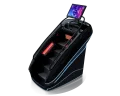
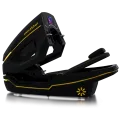
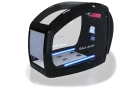
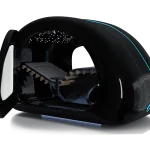
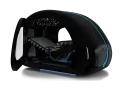
A red light therapy bed provides the highest whole-body coverage in a single session and is optimized for spa, wellness center, and clinic deployment. Users lie inside the bed (similar in silhouette to tanning beds but with red light and near-infrared LEDs). Session time is fast (10-20 minutes) because the whole body is exposed simultaneously. Red light therapy beds are almost exclusively professional equipment; consumer bed-form-factor units are rare because the capital cost and space requirement rarely fit home use. Best fit: high-volume commercial wellness settings where full-body sessions at high throughput justify the investment.
Masks and Handheld Wands
The best red light therapy mask targets facial skin care specifically. Coverage is naturally limited to the face and neck area; irradiance varies by brand from entry-level (near-decorative) to legitimate treatment tiers. Fortune’s 2026 mask coverage highlights clinic-grade specs for the upper tier of consumer masks, with gradual results over weeks to months. Handheld wands offer even more targeted spot treatment (small areas, wrinkles, specific muscle points), typically for personal detail work. Both mask and wand categories serve real use cases; neither is a good choice for full-body work. For a deeper look at the mask category specifically, Best Red Light Therapy Mask: Pro vs Consumer Devices Compared covers the mask-specific spec tiers.
How to Choose: A Buying Checklist
The buying checklist below distills eight criteria drawn from Weather.com, Consumer Health Digest, The Good Trade, and Peak Primal Wellness 2026 device review coverage plus manufacturer specifications from professional equipment. Any consumer device meeting most of these criteria at its price point is a legitimate purchase. A device failing multiple criteria (especially undisclosed irradiance) is a red flag.
- Verified irradiance specification disclosed at a stated treatment distance (not just total LED wattage). This is the most important criterion; the rest matter less if irradiance is undisclosed.
- Dual 660nm + 850nm wavelengths for versatility, unless you have a specific single-wavelength use case (facial-skin-only masks can be 660nm-only legitimately).
- Coverage area matching your treatment goal (mask or wand for facial, panel for body, bed for whole-body clinical throughput).
- FDA-cleared status for the specific device model (not just the category). FDA-cleared applies to specific devices demonstrating reasonable safety and effectiveness for stated use; verify directly with the manufacturer for the model in question.
- LED rating of 50,000 hours or higher (medical-grade / clinical-grade LEDs). Peak Primal Wellness March 2026 uses this threshold for the mid-tier consumer segment as an approximation of medical-grade durability.
- Manufacturer warranty of 2-3 years on the device (consumer standard is 1-2 years, professional is 2-3 years or more).
- Third-party tested specifications, ideally with a testing report accessible from the manufacturer’s site. Reputable brands publish independent measurement data rather than only manufacturer-attested numbers.
- Realistic dosing time for your goal: at your device’s irradiance, calculate what session length actually delivers the target dose. A very-low-irradiance device may require sessions longer than practical for daily home use.
For Wellness Businesses: Why Professional Red Light Therapy Equipment Pays Off
For B2B wellness studio operators, spa owners, recovery centers, and clinic buyers, the specification math shifts. Professional red light therapy equipment delivers higher power density (shorter sessions per client = higher daily throughput at the same session price), longer LED life (50,000+ hour ratings for heavy daily use), full-body coverage that a mask or small panel cannot match, and warranty coverage sized for commercial-grade duty cycles. The ROI calculation compares upfront capital investment against the labor time saved per session and the throughput increase per operating day.
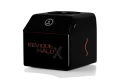
A concrete example: a business running 30 red light therapy sessions per day at 15 minutes per session (using a 30 mW/cm2 consumer-tier panel to reach a target dose) allocates 7.5 hours of session time. The same 30 clients on a professional 90 mW/cm2 panel need 5 minutes per session, freeing 5 hours of daily equipment availability and increasing effective throughput. Over a year, that difference sums to 1,500+ additional session slots. Explore the commercial red light equipment category page for the full commercial red light range, or the Revique HaloX longevity capsule for a multi-modality unit combining red light with infrared and aromatherapy. Wellness businesses positioning red light services within a broader biohacking-oriented offering can review the What Is Biohacking? Complete Guide to Performance Optimization pillar for category framing, and the Red Light Therapy and Cryotherapy Stack guide for multi-modality clinic recovery service configurations.
Frequently Asked Questions
Q1. What makes a red light therapy device effective?
Three specs determine effectiveness: irradiance (power density, measured in mW/cm2), wavelength (660nm red and 850nm near-infrared are the researched ranges), and coverage area for your target. Irradiance matters most because it sets how much light energy actually reaches your tissue, which determines your dosing time. A device with the right wavelengths but very low power density simply needs much longer sessions to deliver a meaningful dose.
Q2. What irradiance do I need for red light therapy?
Consumer at-home devices typically deliver 10-30 mW/cm2 at the treatment distance, while professional-grade equipment delivers higher power density. Higher irradiance means shorter effective sessions to reach the same dose. There is no single required number; what matters is that the manufacturer discloses verified irradiance at a stated distance. Devices that hide this spec or quote only total LED wattage should be treated with caution.
Q3. Are at-home red light therapy devices as good as professional ones?
For many goals, at-home devices are genuinely effective, especially for facial skin care, targeted areas, and daily maintenance. The honest difference is power density and coverage. Most clinical studies demonstrating red light therapy benefits used professional-grade devices with higher power densities than typical at-home versions. The science is proven; the degree of effectiveness scales with the dose delivered, so lower-power home devices generally need longer or more frequent sessions.
Q4. What wavelength is best for red light therapy?
The two researched ranges are roughly 630-680nm (red) for skin-surface concerns like complexion and collagen, and 810-850nm (near-infrared) for deeper tissue, muscle recovery, and joints. Dual-wavelength devices that combine 660nm and 850nm are the most versatile because they cover both surface and deeper targets. Single-wavelength devices can work well if matched to a specific goal.
Q5. Is a red light panel better than a mask?
It depends on your target. A mask is convenient and well-suited to facial skin care, but its coverage and power are limited to the face. A panel offers larger coverage, can treat the face and body, and usually delivers higher, scalable power density, making it more versatile for recovery and larger areas. For whole-body treatment, a panel or bed is far more practical than a mask.
Q6. How much should I spend on a red light therapy device?
Quality at-home devices range from a few hundred dollars for compact panels and masks to around $900 for larger full-body home panels. Professional equipment costs more because of higher power density, larger coverage, medical-grade LEDs rated for 50,000+ hours, and durability for heavy use. Rather than anchoring on price, match the spec (irradiance, wavelength, coverage) to your goal; an underpowered cheap device can cost more in wasted time.
Q7. Do cheap red light therapy devices work?
Some do, within limits. An inexpensive device with honest specs and the correct wavelengths can deliver real benefit for surface skin goals, provided you use it consistently and long enough to reach an adequate dose. The risk with the cheapest devices is undisclosed or very low irradiance, weak LED quality, and poor durability. A low-power device is not useless; it just requires more patience to reach the dose a higher-power device delivers faster.
Q8. What is power density in red light therapy?
Power density, or irradiance, is the amount of light energy delivered per unit area, measured in milliwatts per square centimeter (mW/cm2). It is the single most useful spec because it determines how quickly you accumulate your target dose. Two devices with identical wavelengths but different power densities will require very different session times; the higher-density device reaches an effective dose faster, which is a major reason professional equipment is built around higher power density.
Conclusion
The best at-home red light therapy device is the one with specifications matched to your goal, not the one topping affiliate roundups. Read the spec sheet: verified irradiance at a stated distance, dual 660nm + 850nm wavelengths for versatility, coverage area that matches what you want to treat, FDA-cleared status for the specific model, 50,000 hour LED rating, and 2-3 year warranty. Match consumer-tier devices to facial skin care and targeted use; consider professional equipment for full-body coverage, deeper tissue work, and time-efficient dosing. The best red light therapy is the one delivering adequate dose at your target – which is a math problem answered by the specifications, not by marketing.
For at-home users satisfied with consumer-tier specifications and facial or targeted goals, the checklist above finds legitimate devices at multiple price points. For serious full-body users, high-frequency users, and wellness businesses, professional equipment is a better long-run fit. Vacuactivus manufactures commercial-grade red light therapy panels and beds used across wellness centers, spas, and recovery clinics; for the full evidence-based background on red light therapy applications generally, see Red Light Therapy Benefits Backed by Studies, Not Hype


