







facebook Cryotherapy Equipment Cost: Hidden Operating Expenses Most Buyers Miss
Home - News - Cryotherapy Equipment Cost: Hidden Operating Expenses Most Buyers Miss

Cryotherapy Equipment Cost: Hidden Operating Expenses Most Buyers Miss

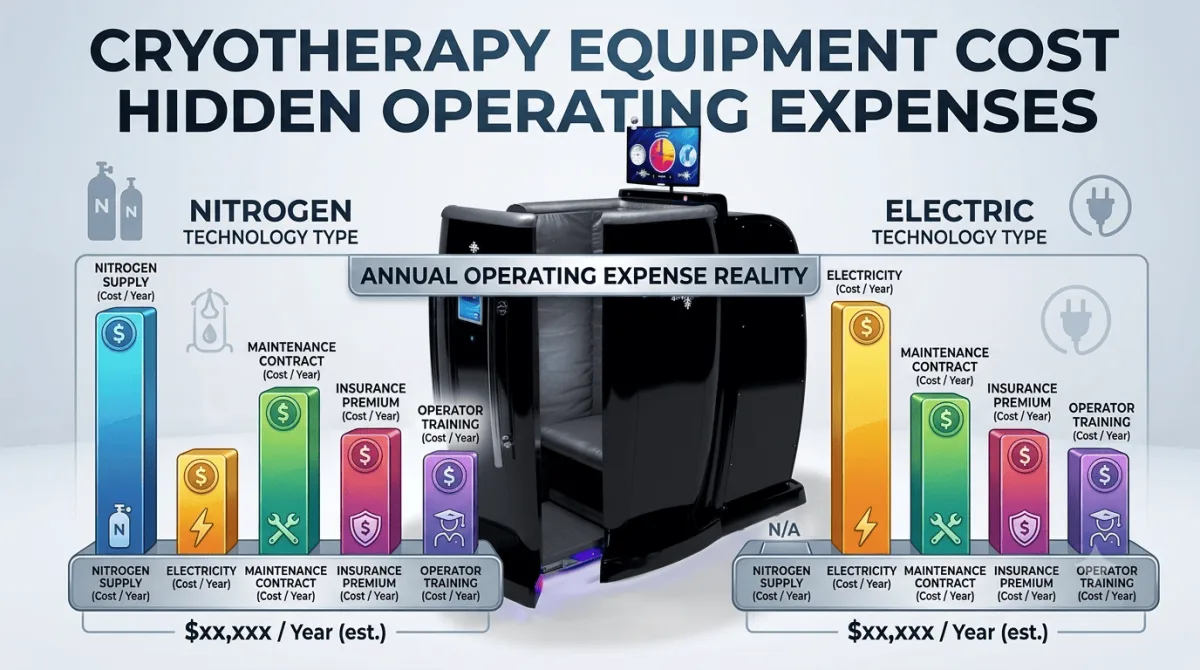
The hidden operating expenses most cryotherapy buyers miss are nitrogen supply ($5,000-$12,000/year for moderate volume, up to $36,000-$60,000/year at busy nitrogen facilities), electricity ($2,000-$5,000/year), maintenance contracts ($2,000-$6,000/year), insurance ($1,500-$3,500/year), and operator training ($1,000-$2,500). The biggest gap is between electric and nitrogen cryo machine running cost: electric chambers cost about $1,100/year to operate while nitrogen chambers cost $36,000-$60,000/year in gas alone per Articasystems April 2026 real operator data. Buyers who budget only for the machine sticker price often underestimate true annual cryotherapy equipment cost by tens of thousands of dollars. Vacuactivus manufactures both electric and nitrogen cryotherapy chambers, so here is the honest operating cost reality, not a sales pitch that pretends operating costs do not exist.

This guide focuses on HIDDEN OPERATING expenses that follow the equipment purchase – the ongoing costs that compound over years of ownership. It complements our companion Article #29 (upfront cryotherapy machine pricing 4-tier taxonomy) rather than duplicating it. The cryotherapy equipment cost conversation typically stops at the machine price, but the machine sticker price is only half the story. The related cryotherapy equipment price question also typically covers only the machine, missing the ongoing cryotherapy equipment price of operation over years. Over a five-year ownership period, operating expenses often exceed the original equipment cost, especially for nitrogen systems where gas alone can total $180,000-$300,000 per Articasystems 2026 electric vs nitrogen breakdown. The ‘cryotherapy equipment cost’ search category drives 390 monthly US searches per Serpstat 2026 data, along with ‘cryotherapy equipment price’ at 390/mo, ‘cryotherapy cost machine’ at 70/mo, and adjacent ‘cryo machine running cost’ and ‘total cost cryotherapy’ queries – all commercial intent signals from business buyers modeling their financial plans. Whether you searched for ‘cryotherapy cost machine’ or ‘cryo machine running cost’ or ‘total cost cryotherapy’, this hidden-operating-expenses guide addresses the total cost cryotherapy question that goes beyond sticker price. A serious cryotherapy chamber cost analysis must include liquid nitrogen cost projections for nitrogen chambers and electric vs nitrogen cryotherapy operating comparisons for any long-term cryotherapy business cost model.

The audience for this cryotherapy equipment cost hidden operating expenses guide is prospective cryotherapy business owners underestimating ongoing costs during their initial financial modeling, existing operators evaluating their true annual cost after 1-2 years of operation, buyers comparing electric versus nitrogen on operating basis for a multi-year business plan, franchise buyers building projected cash flow models, and CFOs at wellness businesses budgeting for a cryotherapy service addition. Vacuactivus does not have zero operating costs – all commercial cryotherapy equipment has ongoing operating expenses, and this guide details them honestly with real 2026 numbers cited from Life Force Medbeds, Articasystems Impact BodyWorx Florida operator data, Luxury Wellness Store, CryoChambers, Financial Models Lab, and Cryo Service Repair sources.

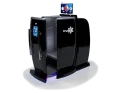
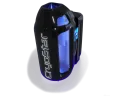
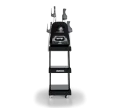
Cryotherapy Equipment Cost: Hidden Operating Expenses Most Buyers Miss| image_1


Why the Sticker Price Is Only Half the Story

When buyers evaluate cryotherapy equipment cost, most focus on the upfront machine price and stop there. The machine sticker price is only half the story. Over a five-year ownership period, cryotherapy operating cost often exceeds the original equipment cost, especially for nitrogen systems. A nitrogen chamber that costs $28,500 upfront can consume $180,000-$300,000 in liquid nitrogen alone over five years per Articasystems April 2026 electric vs nitrogen cost breakdown – an operating total that dwarfs the original cryotherapy equipment price. The Financial Models Lab December 2025 cryotherapy center financial model estimates liquid nitrogen at 40% of first-year revenue as cost of goods sold, which is the largest single line item in most nitrogen operator budgets.

The hidden operating expenses fall into predictable categories that this guide details: consumables (nitrogen or electricity depending on chamber type), maintenance contracts and service, insurance premiums, staff training and recertification, safety infrastructure (oxygen monitoring, ventilation for nitrogen systems), and scheduled downtime. Understanding these before you purchase prevents the budget shock that catches many first-year operators. The cryotherapy business cost reality is that ongoing operating expenses accumulate steadily whether the chamber runs at full utilization or partial capacity, so operating cost planning matters more than sticker-price shopping. This guide breaks down each hidden expense with real 2026 numbers, then shows the electric versus nitrogen operating gap that drives long-term profitability for cryotherapy operators.

The 8 Hidden Operating Expenses

The full hidden operating expense taxonomy that every cryotherapy buyer should model before purchasing equipment. (1) Consumables – nitrogen gas or electricity, the single largest recurring cryotherapy operating cost (detailed in dedicated sections below). (2) Maintenance contracts – $2,000-$6,000/year covering parts and labor to keep the chamber running per Life Force Medbeds cryotherapy equipment cost breakdown. (3) Insurance – $1,500-$3,500/year premium to cover cryotherapy operations and liability, a non-negotiable cryotherapy insurance expense. (4) Operator training – $1,000-$2,500 upfront for certified staff and safety protocols, plus periodic operator training cryotherapy recertification. (5) Oxygen monitoring and ventilation – for nitrogen systems, mandatory O2 sensors, exhaust fans, and safety monitoring add ongoing calibration and replacement costs beyond the initial installation. Each of these first five expenses is well-documented in the Life Force Medbeds guide and confirmed by Luxury Wellness Store 2026 hidden costs framework.

(6) Consumable parts – filters, seals, pressure regulators, valves that wear and require replacement over the chamber’s operating life. (7) Scheduled downtime – nitrogen systems typically need 2-3 maintenance shutdowns per year per Articasystems 2026, each meaning lost revenue during the outage on top of the maintenance service cost itself. (8) Utility overhead – refrigeration and HVAC load runs continuously (Financial Models Lab December 2025 business model budgets $1,500/month in fixed utilities regardless of session volume, and CryoChambers.com April 2026 notes multi-room electric installations can consume $12,200/year in cooling alone at larger facilities). Most cryotherapy buyers budget for one or two of these categories and are surprised by the rest during the first year of ownership. The Hidden Operating Expenses annual breakdown table below shows the low-end and high-end range per category so buyers can build realistic financial models before purchasing.

Expense CategoryLow End (Annual)High End (Annual)Applies To
Nitrogen supply (gas refills)$5,000/year (moderate volume)$60,000/year (busy 15-20/day)Nitrogen chambers only
Electricity$1,100/year (single-user electric)$5,000/year (multi-room electric)Electric chambers primary + nitrogen chambers small
Maintenance contract$2,000/year$6,000/yearAll chambers
Insurance premium$1,500/year$3,500/yearAll chambers
Operator training (upfront + recert)$1,000/year amortized$2,500/yearAll chambers
Oxygen monitoring + ventilation$500/year (calibration)$1,500/yearNitrogen chambers only
Consumable parts (filters, seals, valves)$300/year$1,200/yearAll chambers
Downtime + lost revenue (shutdowns)$500/year (electric 0-1 shutdown)$8,000/year (nitrogen 2-3 shutdowns)All chambers, nitrogen more
TOTAL (Annual Hidden Operating)~$10,900/year (electric moderate)~$81,700/year (nitrogen busy)Range depends on technology + volume


Nitrogen Supply: The Biggest Recurring Cost

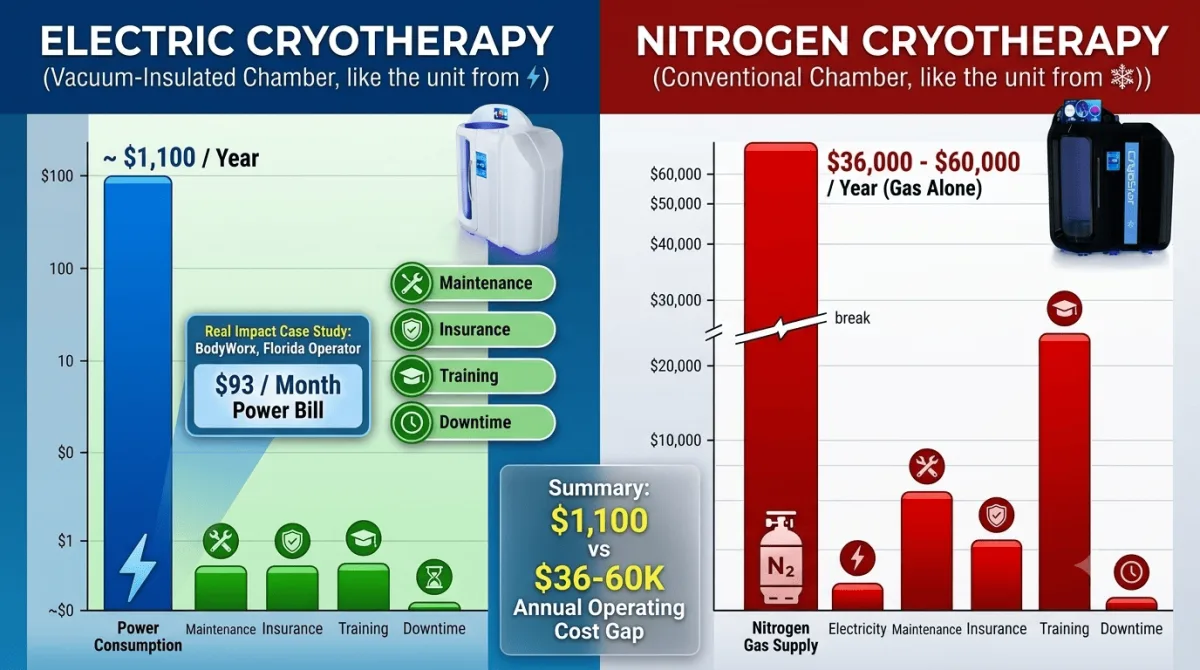
For nitrogen cryotherapy chambers, liquid nitrogen supply is the biggest recurring operating expense and the one buyers most underestimate during financial modeling. Real 2026 numbers: nitrogen refills run $5,000-$12,000/year for a moderate-volume facility per Life Force Medbeds cryotherapy equipment cost guide with Dr. Louis Hilliard expert framing, while busy centers running 15-20 sessions per day report $3,000-$5,000/month, or $36,000-$60,000/year in gas alone per Articasystems April 2026 electric vs nitrogen breakdown. Consumption is 3-7 kg of liquid nitrogen per session including precooling – CryoStar consumes 3-5 kg per session and Antarctica models consume 4-7 kg per session per Luxury Wellness Store April 2026 cost breakdown. Regional liquid nitrogen cost pricing runs $0.30-$2.00 per liter per Cryo Service Repair benchmarks, with roughly $1.30/liter as a common working assumption. The first cooldown of the day consumes the most nitrogen because the chamber must reach operating temperature from ambient – subsequent sessions consume less.

Additional nitrogen supply cost items buyers forget when budgeting cryotherapy chamber cost: tank rental (typically $200/month), delivery scheduling on supplier fixed routes (you pay whether the tank is at full or empty capacity when the truck arrives), dewar storage vessels, pressure regulators and valves, and supplier delivery delays that can interrupt service if not managed against a buffer inventory. Any realistic cryotherapy chamber cost analysis for a nitrogen configuration must include full liquid nitrogen cost projections across the ownership horizon, not just the first quarter’s liquid nitrogen cost estimate. One business financial model at Financial Models Lab December 2025 estimates liquid nitrogen at 40% of first-year revenue as cost of goods sold – a significant COGS drag that determines whether the nitrogen business is profitable. For nitrogen operators, the liquid nitrogen cost supply line item often determines whether the whole cryotherapy business cost model works. The nitrogen supply liquid nitrogen cost is not a small variable expense; it is the largest cryotherapy equipment cost operators face year after year, and the biggest single driver of cryotherapy operating cost projections. Any cryotherapy chamber cost model without a robust liquid nitrogen cost line item will underestimate the true cryotherapy business cost by tens of thousands of dollars per year.

Electricity: The Overlooked Small Number

For electric cryotherapy chambers, electricity is the primary operating consumable, and it is dramatically lower than nitrogen gas by roughly 30x per session. Real 2026 numbers: electric chambers cost $5-8/day to operate, or about $1,100/year per Articasystems April 2026 operating cost analysis. One Florida operator (Impact BodyWorx, running 4 years) pays $93/month on the power bill to run the chamber full-time per Articasystems real operator data. At a rate of roughly 16.21 cents per kWh (US average electricity rate), single-user electric cryotherapy chamber electricity cost stays in the $1,100-$2,500/year range per CryoChambers April 2026 detail. Multi-room electric installations consume more – up to $12,200/year in cooling for larger facilities running multiple chambers simultaneously. Drying mode is a continuous power draw approximately 3,800W per hour of drying operation.

Electric chambers also carry no liquid nitrogen delivery logistics, no nitrogen storage requirements, no per-session dedicated technician requirement with self-service systems, and no oxygen monitoring compliance overhead. The cryotherapy chamber electricity cost number surprises buyers coming from nitrogen because it is so much lower per session – the tradeoff is a higher upfront machine cost that recovers via lower ongoing cryotherapy operating cost after year 2-3 for most commercial operators. Any cryotherapy chamber electricity cost analysis should factor in both single-user and multi-user configuration – the cryotherapy chamber electricity cost per unit stays modest but scales with configuration count. This electric vs nitrogen cryotherapy operating gap is the single biggest factor in long-term cryotherapy profitability. The electric vs nitrogen cryotherapy operating cost math changes the whole business plan. An electric vs nitrogen cryotherapy decision framed only on upfront pricing misses the long-term cryotherapy operating cost story where electric vs nitrogen cryotherapy separates by orders of magnitude. The Electric vs Nitrogen annual operating cost comparison table below shows the side-by-side reality across all major expense categories, with real operator numbers cited from Articasystems and CryoChambers 2026 data.

Cost CategoryElectric Chamber (single-user)Nitrogen Chamber (busy 15-20 sessions/day)Difference
Consumable (electricity or gas)$1,100/year ($5-8/day)$36,000-$60,000/year gas aloneNitrogen 30-55x higher
Real operator exampleFlorida operator $93/month (Articasystems)$3,000-$5,000/month at 15-20 sessions/daySame order of magnitude difference
Maintenance$1,000-$3,000/year (single-user)~$1,000/year (nitrogen simpler mechanically)Roughly comparable
Multi-user repair spike$8,000-$20,000 per major repair eventn/a in single-chamber setupMulti-user electric more
Oxygen monitoring calibration$0 (not needed)$500-$1,500/yearNitrogen adds this
Scheduled downtime shutdowns0-1/year typical2-3/year (Articasystems)Nitrogen more
Approximate annual total (all expenses)$6,000-$15,000/year$45,000-$75,000/year (busy nitrogen)Nitrogen 3-8x higher operating total
Annual savings if switch to electricn/a$63,000+ (Articasystems real operator)Substantial multi-year impact

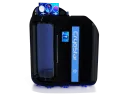
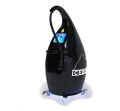
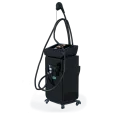
Cryotherapy Equipment Cost: Hidden Operating Expenses Most Buyers Miss| image_2


Maintenance, Insurance, and Training: The Small Expenses Buyers Forget Entirely

The expenses buyers forget entirely when planning cryotherapy equipment cost budgets are the smaller but meaningful line items. Cryotherapy maintenance cost detail per CryoChambers.com April 2026: nitrogen chambers average around $1,000/year in cryotherapy maintenance cost because the mechanism is comparatively simple, single-user electric chambers run $1,000-$3,000/year in cryotherapy chamber maintenance, and multi-user electric repairs can range $8,000-$20,000 per major repair event often requiring onsite manufacturer intervention. A comprehensive cryotherapy maintenance cost contract covering parts and labor typically runs $2,000-$6,000/year per Life Force Medbeds guide. Any cryotherapy chamber maintenance analysis should also account for parts that wear over multi-year operation. Some electric systems require occasional refrigerant recharge ($600-$1,200), though hermetically sealed chambers avoid this expense entirely. Nitrogen systems add pressure regulator and valve inspection, ventilation system upkeep, and O2 sensor calibration to the annual cryotherapy chamber maintenance envelope. Modeling cryotherapy maintenance cost realistically in year-1 projections prevents the mid-year cash flow shock that catches operators who underestimated cryotherapy chamber maintenance in their initial cryotherapy operating cost planning.

Cryotherapy insurance: expect $1,500-$3,500/year to cover cryotherapy operations and liability per Life Force Medbeds framework – a non-negotiable cost that scales with session volume and facility size. Nitrogen operators face additional insurance considerations because liquid nitrogen storage and handling carry state-specific regulatory requirements that affect insurability. Operator training cryotherapy: certified operator training costs $1,000-$2,500 upfront, with periodic recertification adding recurring cost. Liquid nitrogen storage and handling carries state-specific regulatory requirements that add compliance and training cost specific to nitrogen operators. Downtime: nitrogen systems typically need 2-3 scheduled maintenance shutdowns per year per Articasystems, each meaning lost revenue on top of the service cost itself – a busy nitrogen operator can lose $5,000-$8,000 in annual revenue to scheduled shutdowns alone. These expenses are small individually but add $5,000-$15,000/year combined that buyers routinely omit from cryotherapy equipment cost projections when planning only for the equipment purchase.

5-Year Operating Cost: The True Total

The five-year cryotherapy TCO picture is where operating expenses compound over time and often exceed the original equipment cost. Nitrogen chamber 5-year operating total: gas $36,000-$60,000/year × 5 = $180,000-$300,000, plus maintenance ~$5,000 over 5 years, plus insurance $10,000-$17,500 over 5 years, plus training and recertification $3,000, plus tank rental $12,000 over 5 years, plus oxygen monitoring calibration $3,000-$7,500. Total 5-year nitrogen operating cost: roughly $213,000-$345,000 on top of the machine sticker price. Electric chamber 5-year operating total: electricity $1,100-$2,500/year × 5 = $5,500-$12,500, plus maintenance $5,000-$15,000 over 5 years, plus insurance $10,000-$17,500 over 5 years, plus occasional refrigerant recharge $600-$1,200, plus training $3,000, plus minimal downtime cost. Total 5-year electric operating cost: roughly $24,000-$49,000 on top of the machine sticker price.

The cryotherapy TCO operating gap between electric and nitrogen over five years can exceed $200,000 in total operating cost of ownership. This is why the machine sticker price is only half the story, and why electric operating economics increasingly win for facilities with a multi-year horizon despite the higher upfront cost. A nitrogen operator can pay 4-7x the total operating cost of an electric operator over the same 5-year window, which changes the business valuation profile dramatically. For franchise buyers building projected cash flow models over 5-10 years, the operating cost difference often justifies the higher upfront electric investment within year 2-3 of operation. The cryotherapy TCO framing matters more than any single-year operating snapshot because ongoing operating expenses accumulate steadily whether volume is high or moderate. For deeper upfront machine pricing context that pairs with this operating cost guide, see the How Much Does a Cryotherapy Machine Cost Real 2026 Numbers companion article covering the 4-tier upfront pricing taxonomy.


How to Budget for Cryotherapy Operating Costs

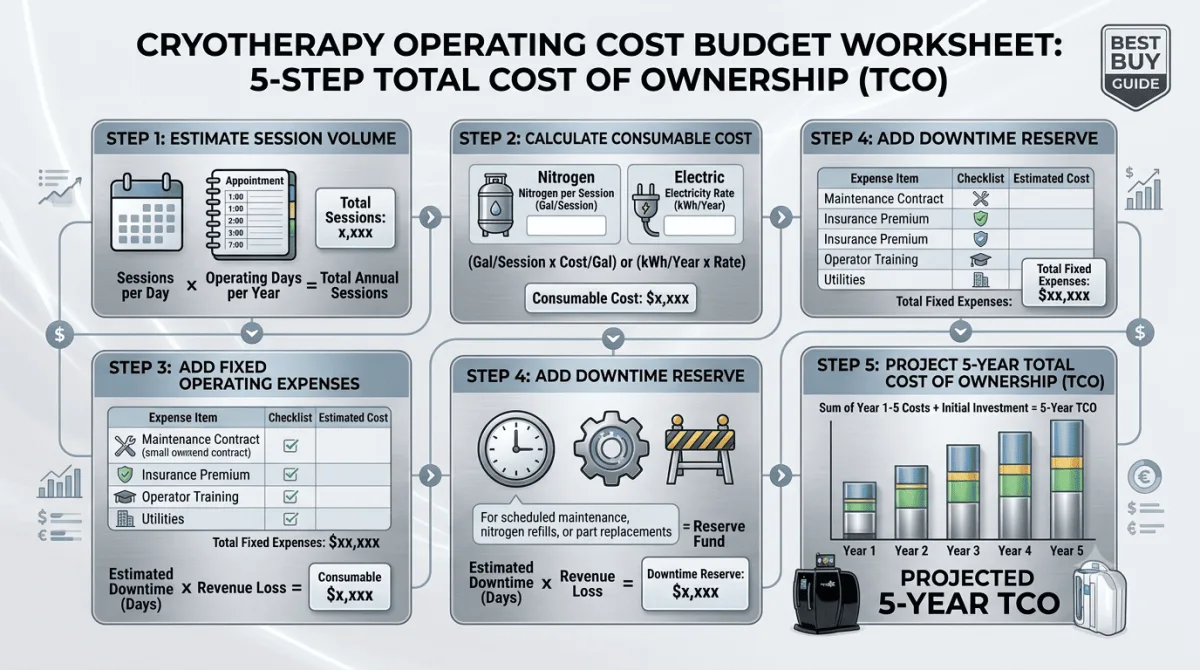
Practical budgeting guidance for building a realistic cryotherapy business cost projection. Build your cryotherapy operating budget from the consumable up in a five-step workflow. Step 1: estimate session volume (sessions per day multiplied by operating days per year – most commercial operators plan 250-300 operating days). Step 2: calculate consumable cost – for nitrogen, sessions per year × 3-7 kg per session × nitrogen price per kg (typically $1.30/liter as working assumption); for electric, roughly $1,100-$2,500/year flat regardless of session count. Step 3: add fixed operating expenses – maintenance ($2,000-$6,000), insurance ($1,500-$3,500), training and recertification ($1,000-$2,500), utilities overhead ($1,500/month per Financial Models Lab benchmark). Step 4: add a downtime reserve for scheduled shutdowns and unexpected repairs (nitrogen operators should reserve $5,000-$8,000/year for lost revenue during 2-3 shutdowns; electric operators can reserve $2,000-$3,000/year for occasional service events). Step 5: project all operating costs over 5 years to see true cryotherapy TCO alongside the equipment purchase.

For financing and cash flow planning, remember that both cryotherapy chamber lease payments and operating expenses are typically tax-deductible business costs, which can improve after-tax economics for both technology choices. Vacuactivus offers cryotherapy chamber lease and cryotherapy financing options  through partner financing programs, plus operating cost modeling assistance for specific configurations across electric and nitrogen technology types. For operators starting from scratch, Vacuactivus also provides cryotherapy business opportunity and startup framework guidance  for building the initial business plan around realistic operating cost projections. Realistic budgeting from the consumable up prevents the first-year cash flow shock that catches operators who planned only for the machine sticker price and forgot the ongoing operating expenses covered throughout this cryotherapy equipment cost guide.

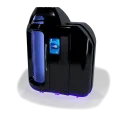
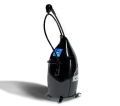
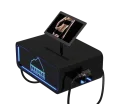
Cryotherapy Equipment Cost: Hidden Operating Expenses Most Buyers Miss| image_3

Frequently Asked Questions

Q1. What are the hidden costs of cryotherapy equipment?

The hidden operating costs of cryotherapy equipment that most buyers miss are: nitrogen supply ($5,000-$12,000/year for moderate volume, up to $36,000-$60,000/year for busy nitrogen facilities), electricity ($1,100-$5,000/year depending on system), maintenance contracts ($2,000-$6,000/year), insurance ($1,500-$3,500/year), operator training ($1,000-$2,500 upfront), oxygen monitoring and ventilation for nitrogen systems, consumable parts like filters and seals, and scheduled downtime for maintenance shutdowns. Buyers who budget only for the machine sticker price underestimate true annual cryotherapy equipment cost by tens of thousands of dollars, especially for nitrogen chambers where gas alone can exceed the original equipment price over five years.

Q2. How much does it cost to run a cryotherapy machine?

Cryo machine running cost depends heavily on the technology. An electric cryotherapy chamber costs about $5-8 per day, or roughly $1,100/year in electricity – one Florida operator pays $93/month to run the chamber full-time per Articasystems 2026 real operator data. A nitrogen cryotherapy chamber costs $3,000-$5,000/month in liquid nitrogen at a busy facility, which is $36,000-$60,000/year in gas alone. On top of the consumable, add maintenance ($2,000-$6,000/year), insurance ($1,500-$3,500/year), and operator training costs. The total annual cryo machine running cost for an electric chamber is often under $10,000/year, while a nitrogen chamber can exceed $50,000/year once all operating expenses are counted. This gap is the single biggest factor in long-term cryotherapy profitability and total cost cryotherapy planning.

Q3. What is the monthly cost of liquid nitrogen for cryotherapy?

Liquid nitrogen cost for a nitrogen cryotherapy chamber typically runs $3,000-$5,000 per month at a busy facility running 15-20 sessions per day per Articasystems 2026, which works out to $36,000-$60,000 per year in gas alone. Consumption is 3-7 kg of liquid nitrogen per session including precooling (CryoStar 3-5 kg, Antarctica 4-7 kg per Luxury Wellness Store 2026), at roughly $1.30 per liter, though regional pricing ranges from $0.30 to $2.00 per liter per Cryo Service Repair benchmarks. The first cooldown of each day consumes the most nitrogen because the chamber reaches operating temperature from ambient. Beyond the gas itself, monthly liquid nitrogen cost includes tank rental (approximately $200/month) and scheduled deliveries (you pay whether the tank is full or empty). For lower-volume facilities, nitrogen refills run closer to $5,000-$12,000 per year. This is the biggest recurring cost buyers underestimate.

Q4. Is electric or nitrogen cryotherapy cheaper to operate?

Electric cryotherapy is dramatically cheaper to operate than nitrogen. An electric chamber costs about $1,100/year in electricity ($5-8/day), while a nitrogen chamber costs $36,000-$60,000/year in gas alone per Articasystems 2026 electric vs nitrogen breakdown. Over five years, electric cryotherapy operating cost totals roughly $24,000-$49,000 (including maintenance, insurance, and training), while nitrogen cryotherapy operating cost totals roughly $213,000-$345,000. That is a cryotherapy TCO operating gap that can exceed $200,000 over five years. Electric also eliminates gas delivery logistics, nitrogen storage, oxygen monitoring compliance, and per-session staffing with self-service systems. The tradeoff is that electric chambers cost more upfront. For facilities with a multi-year horizon and steady session volume, electric operating economics increasingly win despite the higher purchase price.

Q5. What maintenance does a cryotherapy chamber need?

Cryotherapy chamber maintenance varies by type. Nitrogen chambers need pressure regulator and valve inspection, ventilation system upkeep, O2 sensor calibration, and typically 2-3 scheduled maintenance shutdowns per year per Articasystems 2026 (each meaning lost revenue during the outage). Nitrogen cryotherapy chamber maintenance averages around $1,000/year in cost. Electric chambers have fewer failure points but still need periodic service: single-user electric maintenance runs $1,000-$3,000/year per CryoChambers 2026, while multi-user electric repairs can range $8,000-$20,000 per major repair event and often require onsite manufacturer intervention. A comprehensive maintenance contract covering parts and labor typically runs $2,000-$6,000/year per Life Force Medbeds framework. Some electric manufacturers offer occasional refrigerant recharge ($600-$1,200), though hermetically sealed chambers avoid this. Budget for both scheduled maintenance and unexpected repairs, plus the revenue lost during any downtime.

Q6. How much should I budget for cryotherapy operating costs?

Budget from the consumable up. For an electric chamber, plan roughly $1,100-$2,500/year electricity plus $2,000-$6,000 maintenance, $1,500-$3,500 insurance, and $1,000-$2,500 training – a total of about $6,000-$15,000/year in cryotherapy operating cost. For a nitrogen chamber, plan $36,000-$60,000/year gas plus the same fixed expenses – a total that can exceed $50,000/year in cryotherapy business cost. Calculate consumable cost from your session volume (sessions per day times nitrogen consumption or flat electricity), then add fixed expenses and a downtime reserve. Project over five years to see true total cost cryotherapy of ownership, since operating expenses often exceed the original machine cost. The Financial Models Lab 2025 cryotherapy center financial model provides one benchmark structure for building this projection. Realistic budgeting prevents the first-year cash flow shock that catches operators who planned only for the equipment purchase.

Q7. Why do most cryotherapy buyers underestimate the true cost?

Most cryotherapy buyers underestimate true cryotherapy equipment cost because they focus on the machine sticker price and stop there, missing the hidden operating expenses that compound over time. The machine price is only half the story – over five years, operating expenses often exceed the original equipment cost, especially for nitrogen systems where gas alone can total $180,000-$300,000. Buyers commonly budget for the consumable but forget cryotherapy maintenance cost contracts, cryotherapy insurance, operator training cryotherapy, oxygen monitoring compliance, consumable parts, and downtime. Nitrogen buyers in particular underestimate gas consumption (3-7 kg per session per Luxury Wellness Store 2026) and the cost of scheduled shutdowns. The fix is to model all eight hidden operating expenses over a five-year horizon before purchasing, rather than budgeting only for the equipment.

Q8. What insurance do you need for a cryotherapy business?

A cryotherapy business typically needs liability insurance covering cryotherapy operations, which runs $1,500-$3,500/year in premium depending on session volume, facility size, and location per Life Force Medbeds cryotherapy equipment cost framework. This cryotherapy insurance coverage protects against client injury claims and equipment-related incidents. Nitrogen operators face additional considerations because liquid nitrogen storage and handling carry state-specific regulatory and safety requirements that can affect insurability and premiums. Beyond liability, operators generally carry standard business insurance (property, general liability, workers compensation where applicable). Cryotherapy insurance is a non-negotiable operating expense that scales with your business, and it is one of the hidden costs buyers routinely omit when budgeting from the machine price alone. Confirm requirements with a broker familiar with wellness and cryotherapy operations in your state.

Conclusion

The cryotherapy equipment cost reality goes far beyond the machine sticker price. Hidden operating expenses that most buyers miss include nitrogen supply ($5,000-$60,000/year depending on volume), electricity ($1,100-$5,000/year), maintenance contracts ($2,000-$6,000/year), insurance premiums ($1,500-$3,500/year), operator training ($1,000-$2,500), oxygen monitoring for nitrogen systems, consumable parts, and scheduled downtime. Whether searchers phrase it as cryotherapy equipment cost, cryotherapy equipment price, cryotherapy cost machine, or cryo machine running cost, the answer is the same – real cryotherapy chamber cost planning requires modeling all operating expenses over 5 years. A cryo machine running cost analysis that omits the cryotherapy chamber cost of consumables underestimates true annual burn by tens of thousands. The cryotherapy business cost impact of these hidden operating expenses often makes or breaks first-year profitability. The cryotherapy chamber electricity cost stays modest for electric configurations at $1,100-$2,500/year, but the cryotherapy chamber electricity cost scales with multi-unit installations. The cryotherapy maintenance cost line item ($2,000-$6,000/year contract, plus $8,000-$20,000 for multi-user electric repair events) is one of the most-omitted categories in first-year cryotherapy business cost projections. Over five years, cryotherapy operating cost often exceeds the original machine cost, especially for nitrogen chambers where gas alone totals $180,000-$300,000 per Articasystems 2026 data. The 5-year operating cost gap between electric ($24,000-$49,000) and nitrogen ($213,000-$345,000) can exceed $200,000, which drives long-term profitability decisions for cryotherapy operators. Buyers who budget only for the machine sticker price often face first-year cash flow shocks when the true ongoing operating expenses (cryotherapy maintenance cost + cryotherapy chamber electricity + insurance + training + consumables) accumulate.

Vacuactivus manufactures both electric and nitrogen cryotherapy chambers since 2009 across 50+ countries, and this guide honestly details operating cost reality rather than pretending ongoing cryotherapy operating cost does not exist. Vacuactivus does not claim zero-operating-cost economics for its cryotherapy chambers – all commercial cryotherapy equipment carries the ongoing expenses detailed throughout this guide. Vacuactivus offers cryotherapy chamber financing options and operating cost modeling assistance for specific configurations. Build your operating budget from the consumable up (5-step process detailed above), project over 5 years for true cryotherapy TCO, and factor in the electric versus nitrogen operating gap when choosing technology. Explore the Vacuactivus cryotherapy chambers commercial equipment catalog for the full electric and nitrogen chamber range, or the Vacuactivus cryotherapy and weight-loss equipment product line  for the specialized fat-loss vertical. For adjacent B2B context, see the Cryotherapy Machine for Sale Complete 2026 B2B Buyer Guide complete buyer guide covering both upfront and operating cost considerations.

Contact us