










Red Light Therapy for Weight Loss: The Real Mechanism (Honest Review)
Does red light therapy actually cause weight loss? Some peer-reviewed studies report modest circumference reduction (measured as inch loss in the tape-measure sense) in treated areas such as the waist, arms and thighs – and select clinic-grade LLLT devices like the Erchonia Zerona-class laser hold FDA clearance for temporary circumference reduction in specific anatomical zones under specific supervised protocols. But those effects are typically appearance changes localized to the treated area, they are transitory unless supported by concurrent caloric management and physical activity, and no consumer red light therapy device is FDA-cleared for the treatment of obesity.
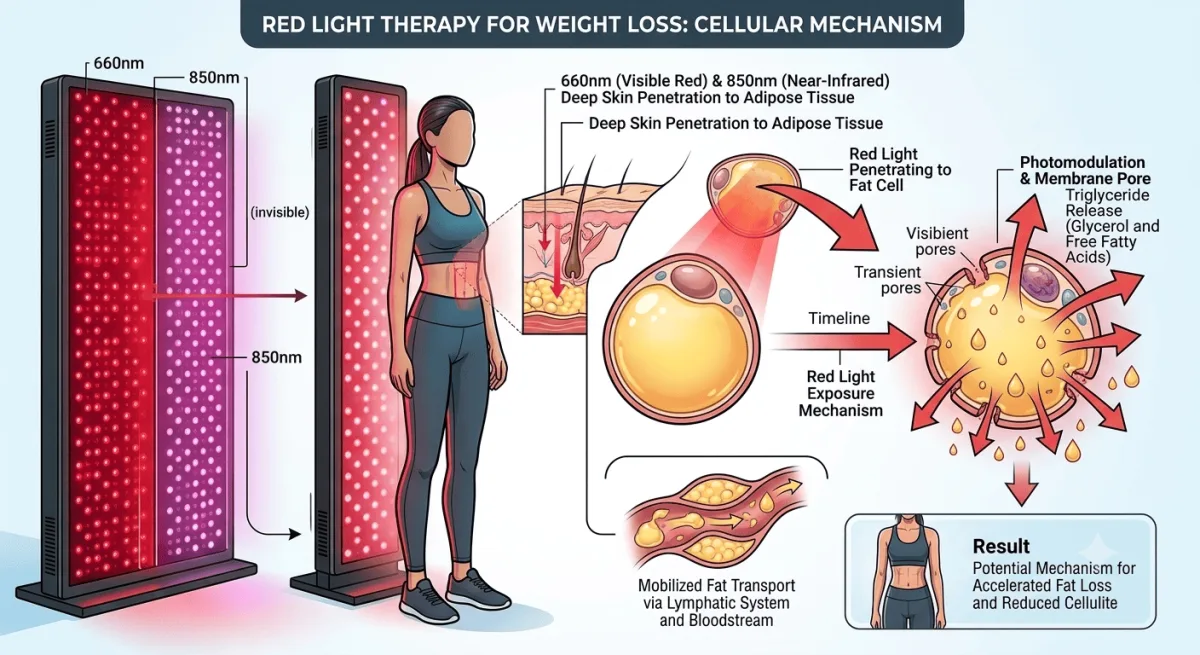
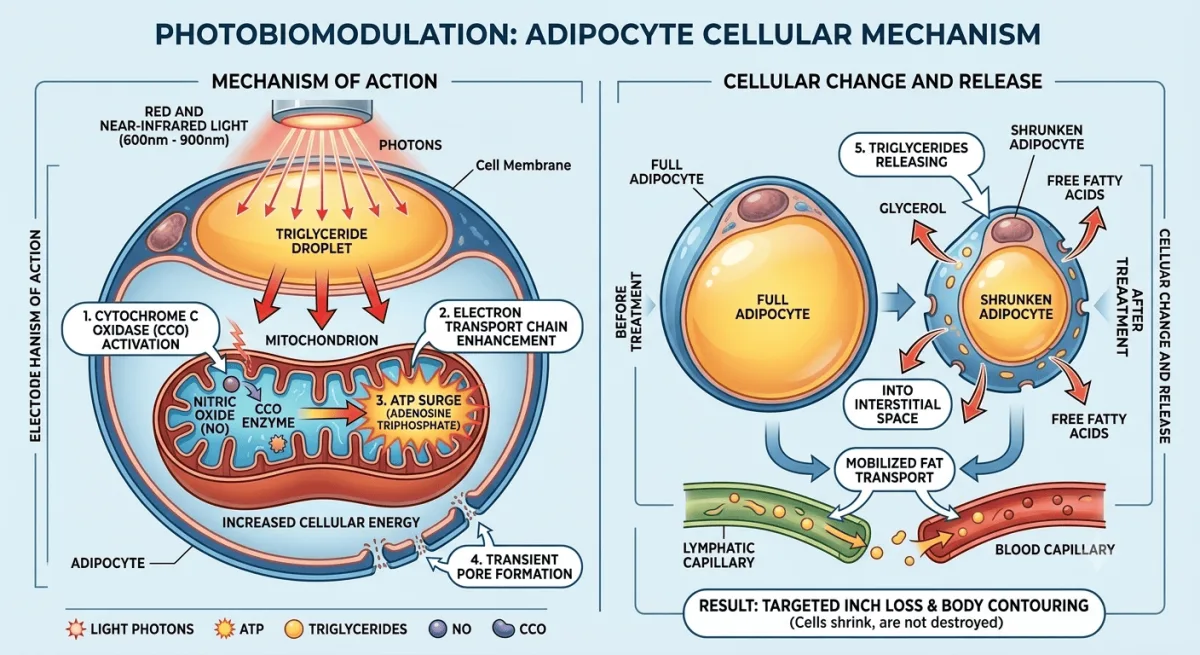
The mechanism is real physiology, not magic. Red and near-infrared photons at 660nm and 850nm are absorbed by cytochrome c oxidase in mitochondria, briefly stimulating ATP production and triggering a transitory pore formation in the adipocyte membrane through which intracellular triglycerides pass into the interstitial space. Whether those released fatty acids get utilized (via activity or a caloric deficit) or get re-stored back into fat cells over the following hours to days is the difference between a maintained inch-loss result and a temporary appearance change. That is the honest core of the modality, and it is the framing this article stays inside.
Vacuactivus manufactures commercial red light therapy panels and beds since 2009 (over 15 years), and this article summarizes what the peer-reviewed research reports about the actual mechanism and its realistic weight-loss ceiling. Cryotherapy has a parallel evidence base for weight-loss claims (spoiler: also modest and non-standalone) covered in depth in Cryotherapy for Weight Loss: How Cold Activates Brown Fat which walks the parallel debunking of studio marketing claims. Nothing here is medical advice; consult a qualified physician or registered dietitian before starting any red light therapy weight-loss protocol.
What Red Light Therapy Actually Does at the Cellular Level
Red light therapy (also called low-level laser therapy or LLLT and photobiomodulation) works through a defined photobiological pathway. Red photons at approximately 660nm and near-infrared photons at approximately 850nm are absorbed by cytochrome c oxidase, the terminal enzyme of the mitochondrial electron transport chain. This absorption briefly increases ATP production and modulates cellular reactive oxygen species signaling, effects documented across dozens of peer-reviewed studies on wound healing, skin, muscle recovery, and adipocyte behavior.
For adipocytes specifically, the observed effect is a transitory pore formation in the cell membrane. When this pore opens, some of the intracellular triglyceride content moves into the interstitial fluid outside the cell. That intracellular-to-interstitial lipid movement is the mechanistic basis for the circumference-reduction observations reported in some peer-reviewed studies of body-area red light therapy. Critically, the released fatty acids do not automatically leave the body. They are metabolic fuel awaiting utilization – and whether they are burned or re-stored is determined by the metabolic context around the treatment, not by the light itself. This mechanism is why FDA-cleared clinic-grade LLLT devices demonstrate temporary circumference reduction under specific supervised protocols, while consumer belts marketed with the same-sounding language rarely produce comparable results.
Does Red Light Therapy Actually Cause Weight Loss? Here Is the Honest Answer
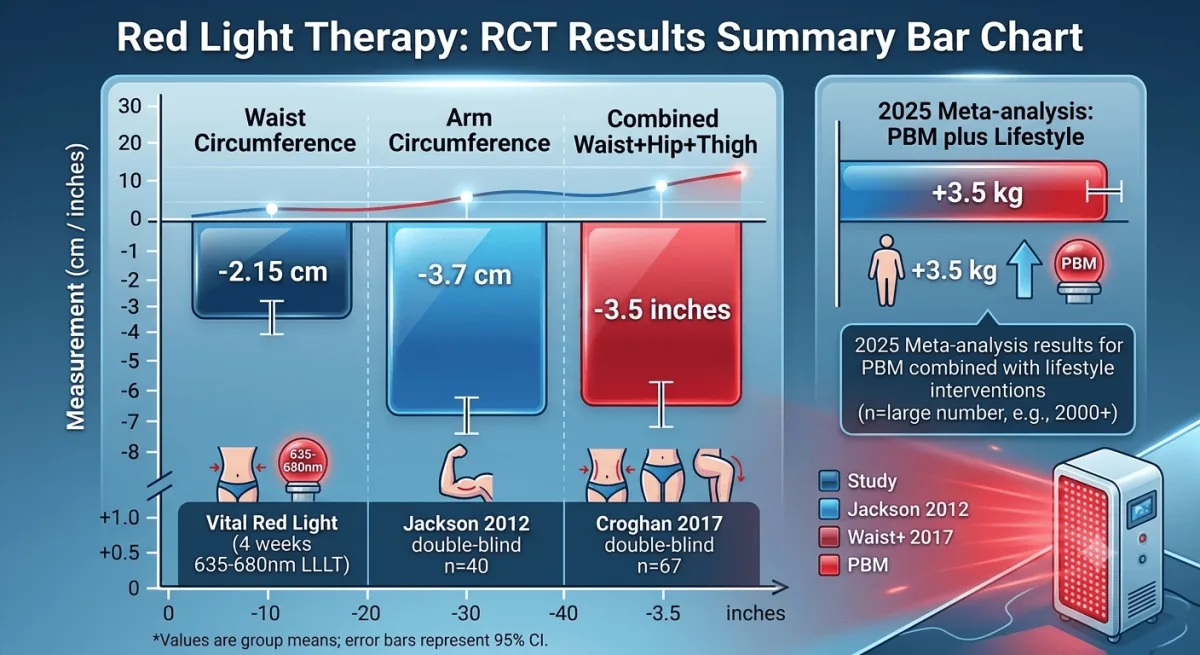
It does not, as a standalone intervention, produce reliable scale-weight loss or BMI reduction in the peer-reviewed literature. What some peer-reviewed studies do report is modest circumference reduction (inch loss measured by tape at the waist, arms, hips or thighs) in the treated area under specific device and protocol conditions. That distinction between scale weight and localized circumference matters because the two are different physiological outcomes with different implications for a client’s expectations.
The FDA has cleared the Erchonia Zerona-class LLLT laser system for temporary circumference reduction in specific anatomical zones (waist, hips, thighs) under specific supervised protocols. That clearance is the regulatory reference point: FDA has verified this narrow claim under this specific device class, protocol and use context. Consumer LED belts and even mid-range panel devices marketed with similar-sounding claims are not covered by that clearance and their marketing frequently overreaches the evidence. If a red light device or clinic is quoting scale-weight or BMI loss as an expected outcome, the claim is not supported by the FDA clearance nor by the mainstream peer-reviewed literature.
LED Belts vs Laser Devices: Why It Matters
Not all red light devices are the same, and the marketing frequently blurs three tiers that behave very differently in practice. The comparison table below distills them.
| Device Class | Typical Price | Irradiance / Dosing | FDA / Regulatory Status | Realistic Weight-Loss Effect |
|---|---|---|---|---|
| Consumer LED belt / wrap (Amazon-style) | $30 – $200 | Often sub-therapeutic; irradiance rarely published in mW/cm2 | General consumer wellness product (no medical clearance) | Marketing overreach common; no reliable evidence-based inch-loss effect at this tier |
| Commercial LED panel (medical-grade dosing) | $1,500 – $15,000 | Medical-grade dose typically 50-200 mW/cm2 at 660nm and 850nm, IEC 60601-2-57 safety standard for medical light emitters | Wellness equipment (not weight-loss cleared) | Some peer-reviewed studies report modest circumference reduction in treated zones as an appearance change; results maintained only with concurrent lifestyle changes |
| Clinic-grade LLLT laser (Erchonia Zerona-class) | $30,000 – $100,000+ | 635nm laser diode array, specific FDA-approved dosing protocol | FDA-cleared for temporary circumference reduction in specific anatomical zones under specific protocols | The regulatory reference point: FDA has cleared for temporary circumference reduction, not weight loss, under specific supervised protocols |
The pattern this table reflects: real circumference-reduction results in published clinical work overwhelmingly come from clinic-grade LLLT laser devices under supervised protocols, with commercial LED panels delivering medical-grade dosing (adherent to the IEC 60601-2-57 safety standard for medical light emitters) approximating clinic laser results more closely than budget consumer belts. A consumer belt in the $30-$200 range typically cannot deliver the irradiance or wavelength consistency required to produce the mechanism, whatever the marketing states. For the underlying wavelength science that separates these tiers, see Red Light Therapy Panel: How 660nm + 850nm Wavelengths Heal Tissue which walks the canonical wavelength pair in depth.
What Wavelengths Actually Work for Fat Cell Response
The canonical wavelength pair for adipocyte-relevant photobiomodulation is 660nm (red visible light) and 850nm (near-infrared). 660nm reaches surface-layer adipocytes at approximately 2-3 mm skin and dermis penetration; 850nm reaches deeper subcutaneous adipose tissue at approximately 4-5 mm penetration. Together they cover the tissue depth range where subcutaneous fat sits in most anatomical regions targeted by body-contouring protocols.
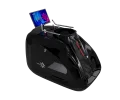
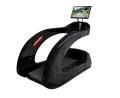
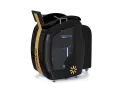
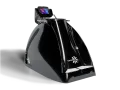
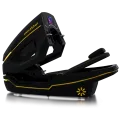
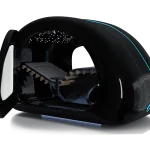
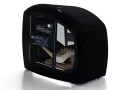
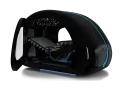
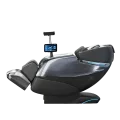
Wavelengths shorter than approximately 630nm (visible red) have insufficient penetration for adipose targeting; wavelengths longer than approximately 900nm penetrate deeper but move away from the peak cytochrome c oxidase absorption spectrum, reducing the mitochondrial ATP effect. Vacuactivus commercial panels and the InfraCouch red light bed use the 660nm + 850nm canonical pair consistent with the peer-reviewed literature and matching the wavelength standard across our red light product range.
Realistic Protocol: How Often and For How Long
The protocols used in published clinical work typically run 2 to 3 sessions per week over a 6 to 12 week program, with session durations of 10 to 30 minutes at appropriate irradiance for the treated area size. Progress is tracked by tape measure at baseline and weekly at the treated zones (not by scale weight), because scale weight and circumference are different outcomes and the modality does not reliably move the scale.
Concurrent lifestyle context is decisive. A protocol combined with mild caloric restriction and regular physical activity supports utilization of the released fatty acids and produces measurable-and-maintained circumference reduction more often than the same protocol done in isolation. A protocol done in isolation, with no concurrent caloric management or physical activity, will show transitory circumference changes that reverse as the fatty acids are re-stored. This is not a marketing framing; it is the physiology. For a stacked protocol pairing red light therapy with cryotherapy for compound recovery-plus-appearance benefits, see Red Light Therapy Combined with Cryotherapy: Stacked Protocol Benefits which walks the combined-modality approach.
What Red Light Therapy Cannot Do (Honest Limits)
Red light therapy does not remove fat cells (as cryolipolysis-class devices do through selective apoptosis), does not reliably reduce scale weight or BMI as a standalone treatment, does not target visceral fat (only subcutaneous adipose in the treated area), and does not produce permanent fat loss – the fatty acids released through the transitory pore either get utilized via activity and deficit or get re-stored back into the same or adjacent fat cells over hours to days. These are not marketing failures on the manufacturer side; they are physiological limits of the modality that responsible operators should communicate to clients at consultation.
Presented accurately, red light therapy is a legitimate service for appearance-support inch loss, skin quality, recovery, and adjunctive body contouring alongside a supervised weight-management plan. Presented as spot-reduction magic or a standalone weight-loss treatment, it sets up disappointment and refund requests. The honest framing sells more series bookings over time than the overreach, because clients who see the appearance change they were promised come back and refer, while clients who were promised scale-weight loss stop coming when the scale does not move.
Combined Approach: When Red Light Therapy Actually Delivers
The strongest results in published clinical work and in operator experience come from combining red light therapy with adjunctive body-contouring modalities and lifestyle context. For studios building a body-contouring service menu, pairing red light with CoolSculpting-class body-contouring equipment adds cryolipolysis (selective fat cell apoptosis through controlled cooling, a different mechanism producing localized fat cell reduction) as a compound service – two mechanisms addressing different aspects of the same client goal. Adding BodyShape vacuum fitness equipment to the same menu provides the low-impact cardio and vacuum-infrared circulation that support metabolic utilization of the released fatty acids. And for the commercial context on operator ROI from a red light therapy service line specifically, see Whole Body Red Light Therapy: ROI for Recovery Studios and Wellness Centers which walks the business case.
For a wellness studio, medspa or body-contouring clinic evaluating red light therapy as a service line, position the modality around what it actually delivers (appearance-support inch loss, recovery, skin quality, adjunctive body contouring within a broader supervised plan) rather than around scale-weight or BMI claims that the evidence base and FDA position do not support. Explore the Vacuactivus red light therapy panels for the full commercial equipment range including the InfraCouch Red Light bed for full-body coverage.
Frequently Asked Questions
Q1. Does red light therapy really work for weight loss?
Not as a standalone intervention for scale weight or BMI reduction. Some peer-reviewed studies report modest circumference reduction (inch loss in the tape-measure sense) in treated areas such as waist, arms and thighs, and the FDA has cleared the Erchonia Zerona-class LLLT laser system for temporary circumference reduction in specific anatomical zones under specific supervised protocols. But scale weight and localized circumference are different outcomes. The mechanism is a transitory pore in the adipocyte membrane releasing intracellular lipids into the interstitial space; whether those fatty acids get utilized or re-stored depends entirely on concurrent caloric management and physical activity. Present it as appearance-support inch loss with a lifestyle-context requirement rather than as scale-weight loss, and it holds up under evidence scrutiny.
Q2. How does red light therapy actually cause fat loss?
Through a defined photobiological mechanism. Red photons at 660nm and near-infrared photons at 850nm are absorbed by cytochrome c oxidase in adipocyte mitochondria, briefly stimulating ATP production. This triggers a transitory pore formation in the adipocyte cell membrane through which some intracellular triglyceride content moves into the interstitial fluid outside the cell. That is the mechanistic basis for the localized circumference reduction observed in some peer-reviewed studies. The released fatty acids are metabolic fuel awaiting utilization – if the client is on caloric restriction or performing physical activity, they get burned; without concurrent activity or deficit, they get re-stored back into fat cells over hours to days. That is why lifestyle context is decisive for maintained results.
Q3. How much inch loss can you actually expect from red light therapy?
Some peer-reviewed studies report modest circumference reduction in treated areas measured by tape at the waist, arms, hips or thighs. The specific reported ranges vary by protocol, device tier, treatment duration and how strictly baseline was standardized. FDA-cleared clinic-grade LLLT (Erchonia Zerona-class) has demonstrated temporary circumference reduction in specific anatomical zones under specific supervised protocols; consumer LED belt marketing frequently claims results the device tier cannot deliver at the irradiance it produces. Track by tape measure at baseline and weekly rather than by scale weight, since scale weight is not the outcome the mechanism produces. Set expectations around modest, localized, and requiring concurrent lifestyle context to be maintained.
Q4. Do red light therapy belts actually work?
Most consumer LED belts in the $30 to $200 range do not deliver the wavelength consistency or irradiance required to produce the mechanism at a therapeutically meaningful level, whatever their marketing claims. The photobiological mechanism requires specific wavelengths (660nm red and 850nm near-infrared canonical pair) at specific irradiance (typically 50-200 mW/cm2 at the skin surface) for a sufficient session duration. Consumer belts often fail on one or more of these dimensions. Commercial LED panels with medical-grade dosing (adherent to IEC 60601-2-57 safety standard for medical light emitters) approximate clinic laser results more reliably than budget belts. Clinic-grade LLLT laser devices like the Erchonia Zerona hold FDA clearance for temporary circumference reduction under specific supervised protocols. If a belt is at consumer price, the honest expectation is minimal to no therapeutic effect at the adipose level.
Q5. What is the difference between LED and laser red light therapy?
The core distinction is coherence and dosing precision. Lasers produce coherent monochromatic light at a very narrow wavelength band with tightly-controlled irradiance; LED devices produce narrow-band but non-coherent light typically clustered around the target wavelength with somewhat broader spectral distribution and irradiance that varies with distance from the panel. Both can produce the photobiological mechanism when properly dosed. FDA-cleared body-contouring LLLT devices (Erchonia Zerona-class) are laser systems; commercial LED panels with medical-grade dosing (50-200 mW/cm2 at 660nm and 850nm, IEC 60601-2-57 safety standard) can produce comparable results at a lower price point when used per protocol. Consumer LED belts frequently fail on dosing rather than on the LED-vs-laser question specifically. Match the device tier to the service model rather than assuming either LED or laser is inherently superior.
Q6. How often should I do red light therapy for weight loss?
Published clinical protocols typically run 2 to 3 sessions per week over a 6 to 12 week program, with session durations of 10 to 30 minutes at appropriate irradiance for the treated area. Track progress by tape measure at baseline and weekly at the treated zones rather than by scale weight, since the modality produces localized circumference change rather than scale-weight loss. Combine the protocol with mild caloric restriction and regular physical activity to support utilization of the released fatty acids and produce maintained results; without concurrent lifestyle context, expect transitory changes only. Consult a qualified healthcare provider before starting any red light therapy weight-loss protocol, particularly if you take photosensitizing medications, have active skin conditions at the treatment area, are pregnant, or have thyroid dysfunction.
Q7. Can red light therapy burn belly fat specifically?
Red light therapy targets subcutaneous adipose tissue in the specific area treated, so panel or bed exposure of the abdominal area can produce localized circumference reduction there in the same way it can at waist, arms, thighs or hips. What red light therapy does not target is visceral fat (the fat around internal organs) – the wavelengths do not penetrate to that depth, and visceral fat responds to systemic energy balance rather than local light exposure. For belly-specific circumference reduction (subcutaneous, cosmetic), red light therapy can contribute alongside supervised weight management. For visceral fat reduction (the metabolically-relevant abdominal fat), evidence-based approaches (caloric management, physical activity, and where clinically appropriate, medical intervention) remain the reliable path. The distinction between subcutaneous and visceral abdominal fat is the clinically-relevant framing.
Q8. How much does a red light therapy weight loss program cost?
Client-facing session pricing at wellness studios and medspas typically runs $50 to $150 per session in the US, with packages of 10 sessions at 15-20% discount and monthly unlimited memberships $99 to $249 depending on device tier. Clinic-grade LLLT laser protocols (Erchonia Zerona-class) at medical clinics run higher, often $200 to $500 per session in a supervised 6-session package format. For operators evaluating red light therapy as a service line, commercial LED panels run $1,500 to $15,000 at the medical-grade dosing tier, and clinic-grade LLLT lasers run $30,000 to $100,000+; the full B2B ROI walk-through for wellness studios is at Whole Body Red Light Therapy: ROI for Recovery Studios. Client cost varies by market; equipment cost varies by tier and configuration.
Conclusion
Red light therapy does not produce reliable scale-weight loss or BMI reduction as a standalone intervention. What it does produce, in the peer-reviewed literature and under FDA-cleared clinic-grade protocol conditions, is modest localized circumference reduction (inch loss measured by tape at treated areas) through a defined photobiological mechanism – transitory pore formation in adipocytes releasing intracellular lipids into the interstitial space. Whether those fatty acids get utilized or re-stored depends entirely on concurrent caloric management and physical activity, which makes the modality an adjunctive appearance-support tool rather than a standalone weight-loss treatment.
The FDA has cleared the Erchonia Zerona-class LLLT laser for temporary circumference reduction under specific supervised protocols; consumer LED belts frequently overreach the evidence at their tier; commercial LED panels with medical-grade dosing (IEC 60601-2-57 safety standard) sit between the two. Match the device to the service model, set client expectations around inch loss (not scale weight) with concurrent lifestyle context, and the modality holds up as a legitimate wellness service. Positioned as spot-reduction magic or a standalone weight-loss treatment, it sets up disappointment. Consult a qualified healthcare provider or registered dietitian before starting any red light therapy weight-loss protocol, and prioritize evidence-based approaches for weight management overall.


