














Cryotherapy for Weight Loss: How Cold Activates Brown Fat
Cryotherapy does not produce meaningful weight loss according to a 2025 randomized controlled trial by Karppinen and colleagues, published in the peer-reviewed journal Obesity (Wiley). However, cold exposure does modestly activate brown adipose tissue (BAT) in principle and may support small improvements in glucose control and LDL cholesterol – meaning cryotherapy has some real metabolic effects, just not the ones cryotherapy studios usually promise. This guide from the Vacuactivus editorial team walks through what the newest peer-reviewed research actually shows about cryotherapy weight loss, brown fat activation, and calories burned per session, versus the marketing claims widely repeated across the industry.
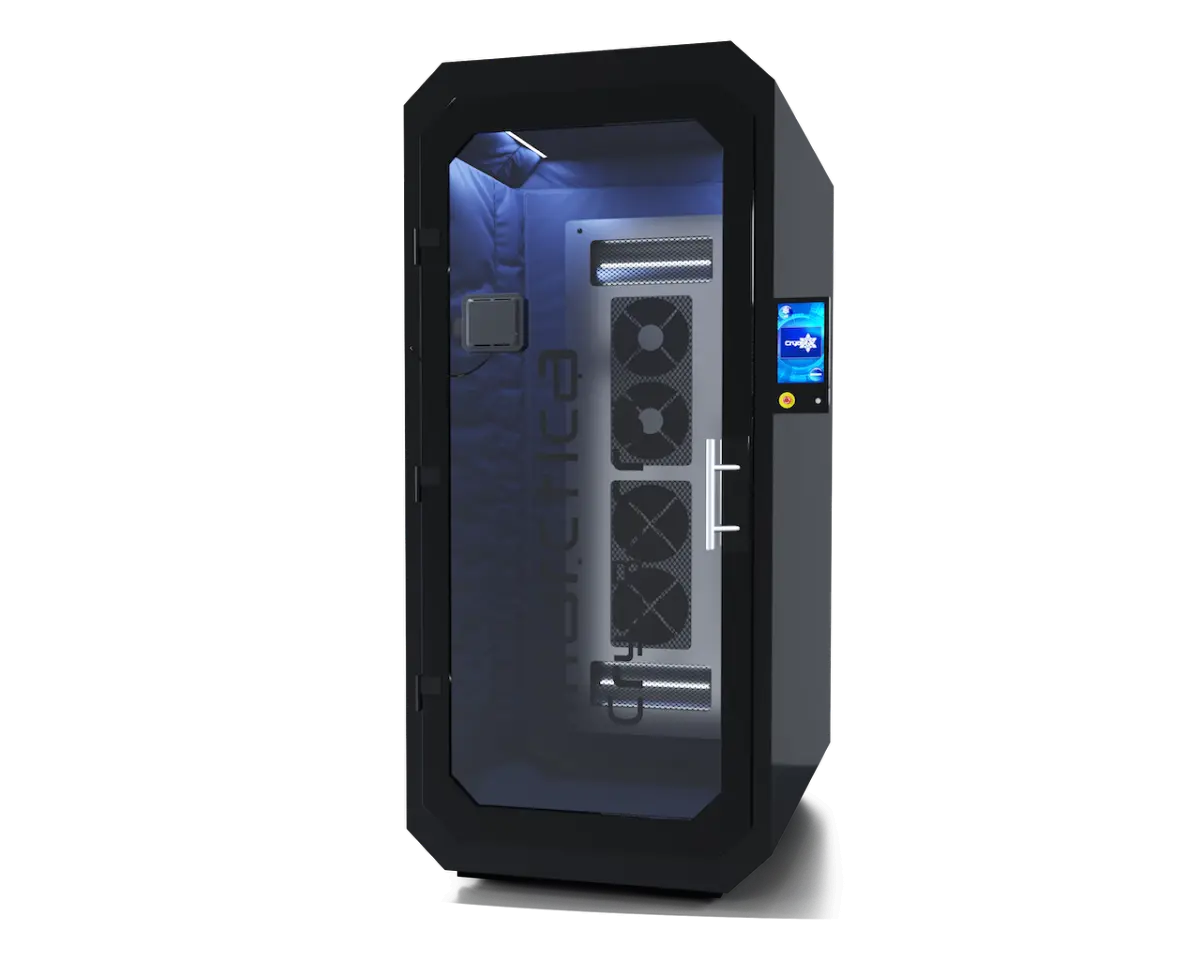
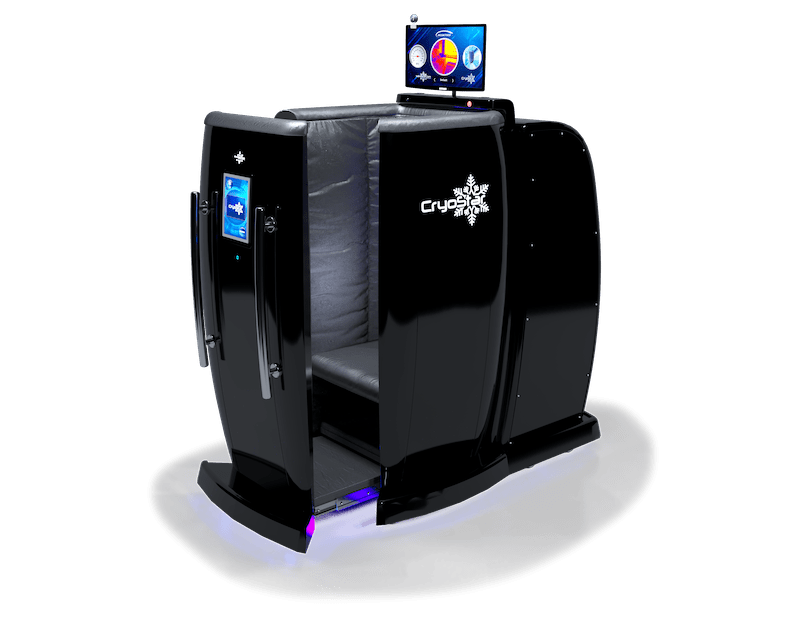
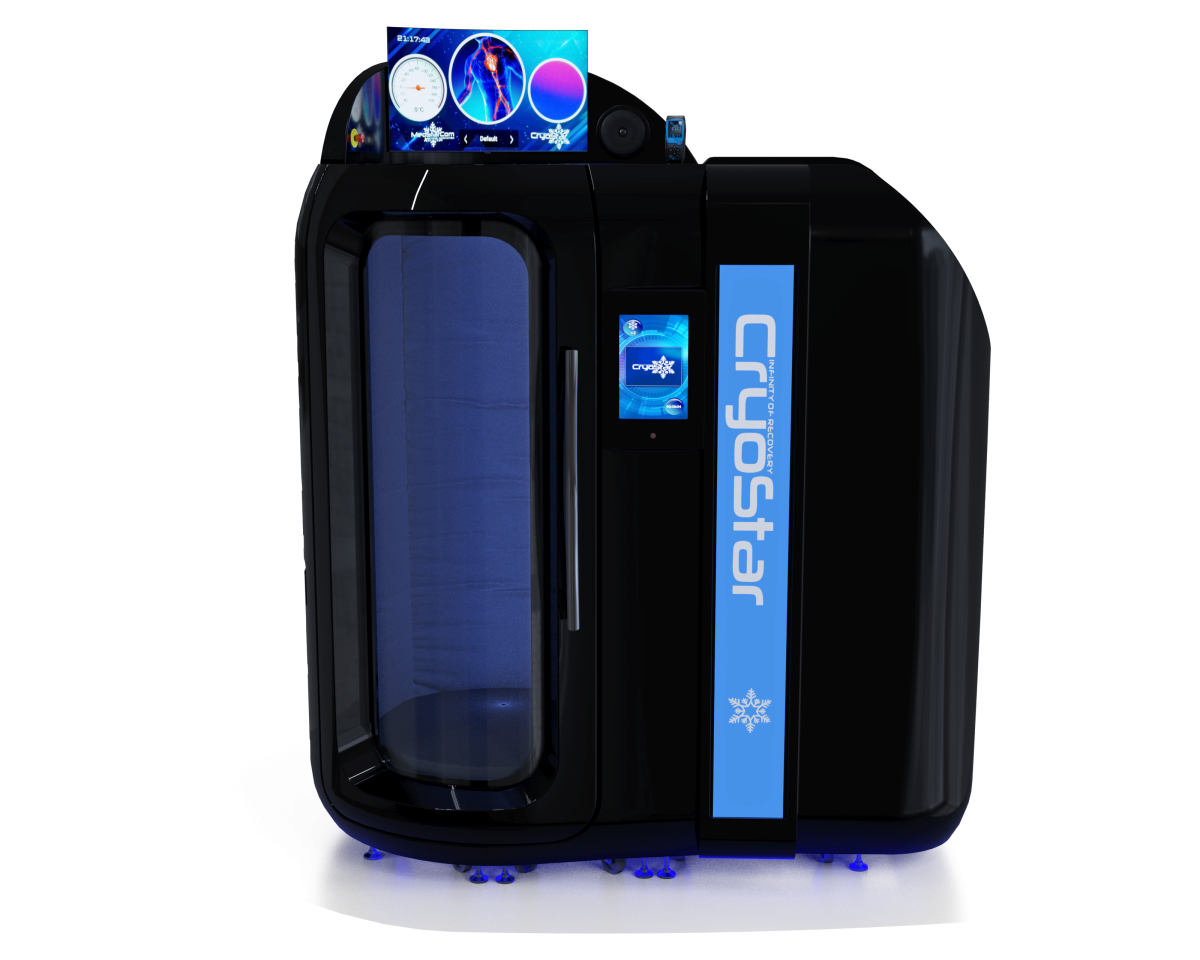
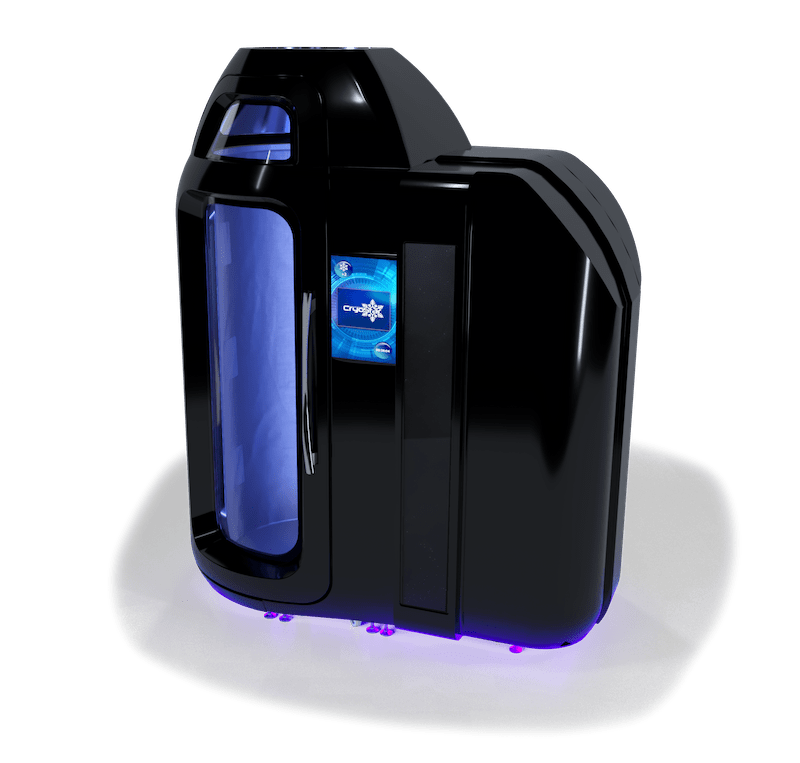
Vacuactivus manufactures cryotherapy chambers used across recovery studios, wellness centers, and clinical practices. That gives us an insider view of how the modality is often sold to consumers – and where those sales messages diverge from what the science supports. This article is written as science journalism rather than as a product pitch. The evidence-based verdict on cryotherapy for weight loss is honest but nuanced: no meaningful weight loss on the scale, some real physiological effects on BAT and metabolic markers, and a legitimate role for cryotherapy in recovery and inflammation protocols where the evidence base is stronger.
The audience for this guide is a health-curious consumer searching for a straight answer to ‘does cryotherapy work for weight loss.’ The three most-searched claims we hear from clients (‘800 calories per session’, ‘boosts metabolism 350%’, ‘burns fat’) are all addressed head-on. Where the evidence is weak we say so. Where real benefits exist (glucose, LDL, recovery, mood) we note them without overselling. The tone is intentionally not marketing; it is a manufacturer being honest about what its own equipment actually does.
What Cryotherapy Actually Does to Your Body (2-4 Minutes at -110C)
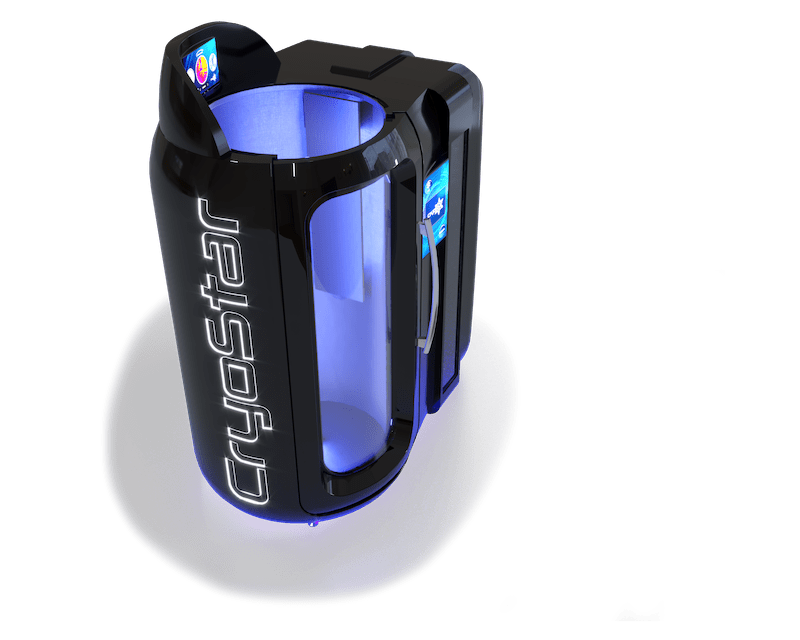
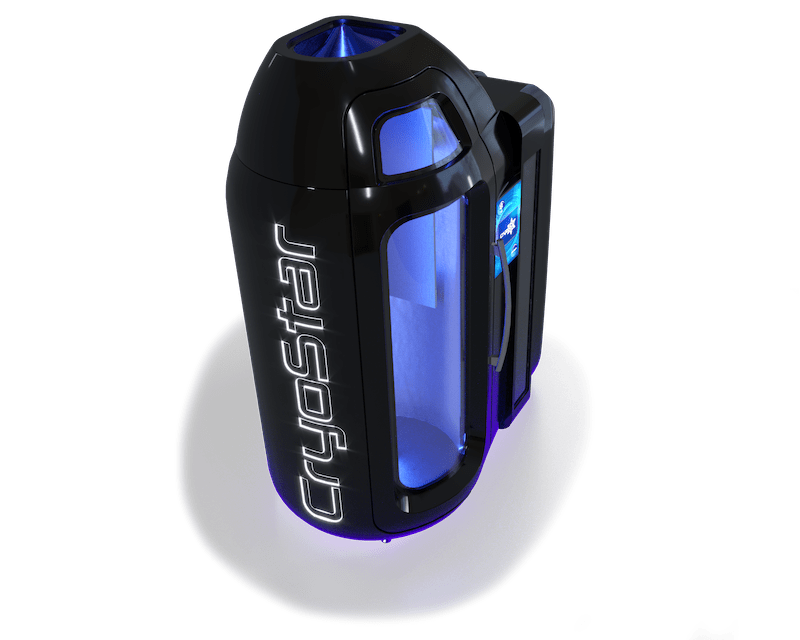
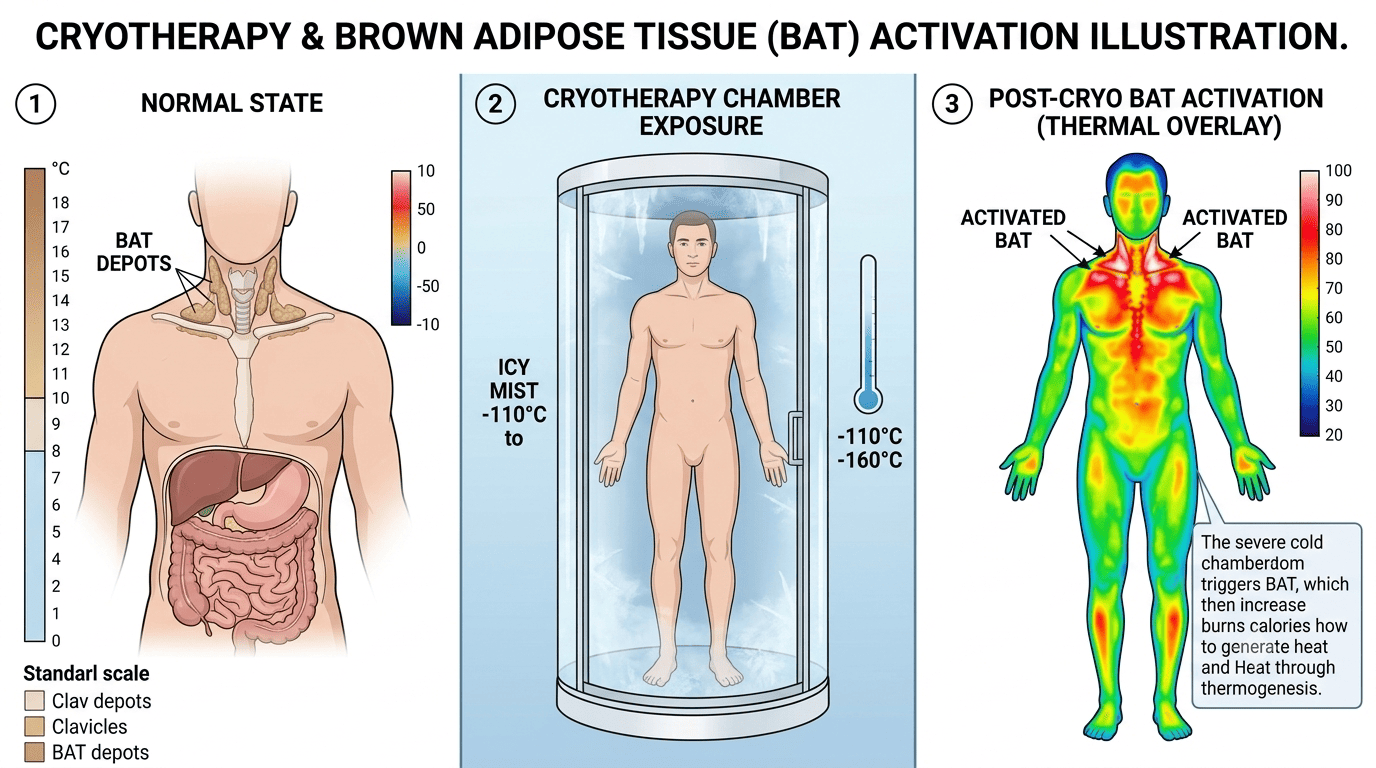
A whole body cryotherapy (WBC) session runs 2-4 minutes at air temperatures of -110C to -140C. The physiological response is well characterized. Your skin temperature drops rapidly from about 32C down toward 5-10C within the first minute of exposure while your core body temperature stays largely stable. The sympathetic nervous system activates, releasing a surge of norepinephrine. Blood vessels near the skin surface constrict sharply, pulling blood toward the core to protect internal organs. Your body responds to this thermal emergency through non-shivering thermogenesis – a form of heat production that recruits brown adipose tissue and burns fatty acids to generate warmth via UCP1 (the uncoupling protein in BAT mitochondria). This brown adipose tissue response is the physiological hook that studios often invoke when marketing cryotherapy for cold therapy weight loss.
This is real physiology. The question is not whether cold exposure activates BAT in principle – it does, and brown fat activation via UCP1 is well documented in the peer-reviewed literature. The question is how much energy the WBC session actually burns, whether that translates into measurable weight loss on the scale, and whether the whole body cryotherapy protocol used in studios (2-3 sessions per week, 2-4 minutes each) is sufficient to drive meaningful cryotherapy metabolism changes. Cryotherapy metabolism effects are real at the mechanism level but their magnitude and duration are the crux of the honest evidence discussion. The next sections walk through what the newest evidence actually shows on cryo weight loss, cryo fat loss protocols, and cryotherapy calories burned per session.
Does Cryotherapy Actually Burn Calories? Here Is the Honest Math
Does cryotherapy burn calories at all? Yes, in the sense that any thermogenic response has a caloric cost. But how many calories does cryotherapy burn per session? The widely marketed number is ‘500-800 kcal per session’ (US Cryotherapy blog, Restore Hyper Wellness franchise content, and many studio websites). The American Council on Science and Health’s February 2026 review specifically traced this claim, reviewed the underlying evidence, and classified it as unsubstantiated – meaning no peer-reviewed source supports 500-800 kcal of measurable energy expenditure from a single 2-4 minute WBC session. The claim appears to originate from studio marketing rather than from published research. When consumers ask does cryotherapy work for weight loss based on cryotherapy calories burned math, this is the first honest data point they need.
What does the science actually show for cryotherapy calories burned per session? Van der Lans et al 2013 (published in the Journal of Clinical Investigation) studied adults who underwent 10 days of cold acclimation at 15C ambient temperature. That sustained cold exposure increased BAT activity measured via PET-CT and contributed an estimated 90-190 kcal per day of additional non-shivering thermogenesis. Yoneshiro et al 2013 (same journal) found that 6 weeks of cold exposure at 17C for 2 hours per day drove BAT recruitment with approximately 180 kcal per day increase in cold-induced thermogenesis. Both studies measured sustained cold exposure over weeks – not brief 3-minute cryotherapy sessions. So how many calories does cryotherapy burn in a session-based protocol matters most for consumers who want to know does cryotherapy burn calories in commercial studio settings.
A realistic estimate for the actual thermogenic caloric cost of one 2-4 minute WBC session, extrapolating from these physiology studies, sits in the 50-150 kcal range – substantially less than the 500-800 kcal marketing figure. For context, 50-150 kcal is roughly the caloric equivalent of a 5-10 minute jog or a small apple. It is not zero, but it is not the metabolic firestorm that studio marketing suggests. Session-based cryo weight loss protocols therefore struggle to move the scale meaningfully because the caloric delta per session is small and the protocol frequency (2-3 sessions per week) is insufficient to compound into weekly caloric deficits that produce weight loss. This is the honest answer to does cryotherapy work for weight loss on session-based metrics.
| Marketing Claim | Where the Claim Originates | What the Evidence Actually Shows | Verdict |
| ‘800 calories per session’ | US Cryotherapy blog and general studio marketing | American Council on Science and Health February 2026 review found no peer-reviewed source. Traced to studio marketing content | Unsubstantiated |
| ‘500-800 calories per session’ | Restore Hyper Wellness franchise content | No published RCT has measured 500-800 kcal energy expenditure from a single 2-4 minute WBC session | Unsubstantiated |
| ‘Boosts metabolism by 350%’ | Various cryotherapy studio blogs | Non-shivering thermogenesis briefly raises sympathetic tone during and shortly after exposure; no evidence of sustained 350% metabolic elevation | Misleading |
| ‘Measurable weight loss from WBC’ | General studio marketing and franchise content | Karppinen 2025 RCT (19 adults, 28 sessions over 5 months): WBC group -11.9% vs control -11.5%, both on caloric restriction. Cryotherapy added no measurable weight loss | Not supported |
| ‘Improves glucose control and lipid profile’ | Some peer-reviewed reviews and studio content | Karppinen 2025 RCT: modest but real improvements in glucose control and LDL cholesterol in WBC group vs control | Partially supported |
What the Newest Research Shows: 2025 RCT Findings
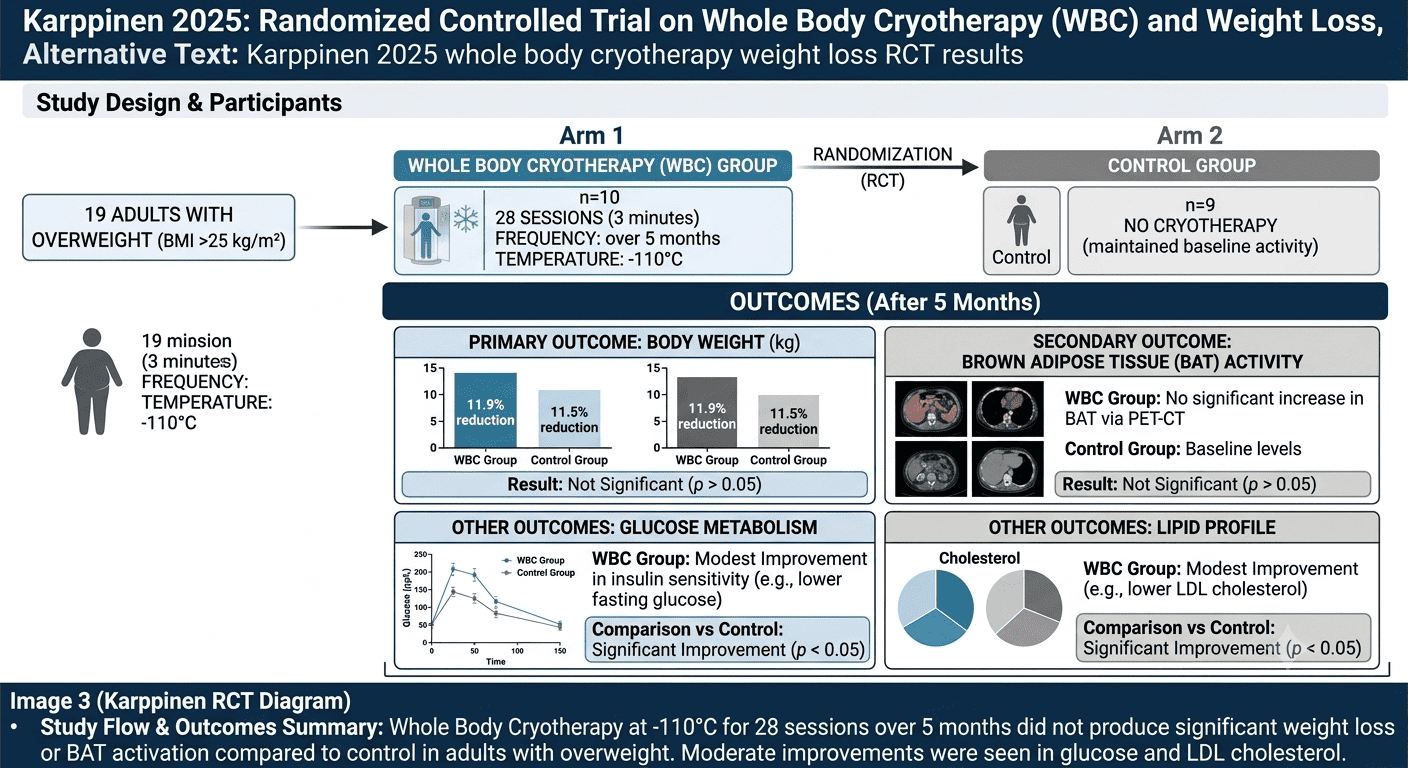
The single most rigorous piece of evidence on WBC and whole body cryotherapy weight loss to date is Karppinen et al 2025, published June 2025 in the peer-reviewed journal Obesity (Wiley). It is the study that everyone writing about cryotherapy weight loss needs to know about, and the one most studio marketing content does not cite. The study design was a randomized controlled trial with 19 adults with overweight or obesity. Participants were randomized to a whole body cryotherapy group (28 sessions of 3 minutes at -110C, 2-3 sessions per week over 5 months) versus a control group. Both groups were on caloric restriction. Measurements taken included body weight change, brown adipose tissue activation via PET-CT imaging, glucose control, lipid profile including LDL cholesterol, and resting metabolic rate.
The results were revealing. First, no significant difference in weight loss between groups: the whole body cryotherapy weight loss group averaged -11.9% body weight change versus -11.5% in the control group. That difference is statistically negligible. Cryotherapy added essentially nothing to weight loss beyond what the caloric restriction alone produced. Second, and unexpectedly, no significant brown adipose tissue activation was detected via PET-CT imaging in the WBC group over the 5-month protocol. This contradicts the mechanistic assumption that regular WBC would recruit and drive brown fat activation. Third, modest but statistically real improvements in glucose control and LDL cholesterol were observed in the WBC group versus control. This is a genuine finding worth taking seriously alongside the ACSH February 2026 debunking of inflated per-session calorie claims.
Karppinen 2025 RCT is the most authoritative recent verdict on does cryotherapy work for weight loss: it does not, at least not at the population level and not from the WBC protocol used in most studios. But the modest metabolic health marker improvements are a real, evidence-based benefit that operators and consumers can honestly discuss. The Karppinen 2025 finding of no PET-CT-detected brown adipose tissue activation also revises the standard mechanistic explanation for cryotherapy weight loss claims, since brown fat activation was the physiological pathway most often invoked. When both ACSH 2026 (debunking the calorie claim) and Karppinen 2025 (debunking the whole body cryotherapy weight loss claim via PET-CT-verified BAT non-activation) are combined, the evidence base for weight loss is thin. For a broader look at what the evidence base actually supports for cryotherapy in recovery and wellness contexts, see Benefits of Cryotherapy Chamber Sessions: What Science Says .
Brown Fat Explained: The Real Story
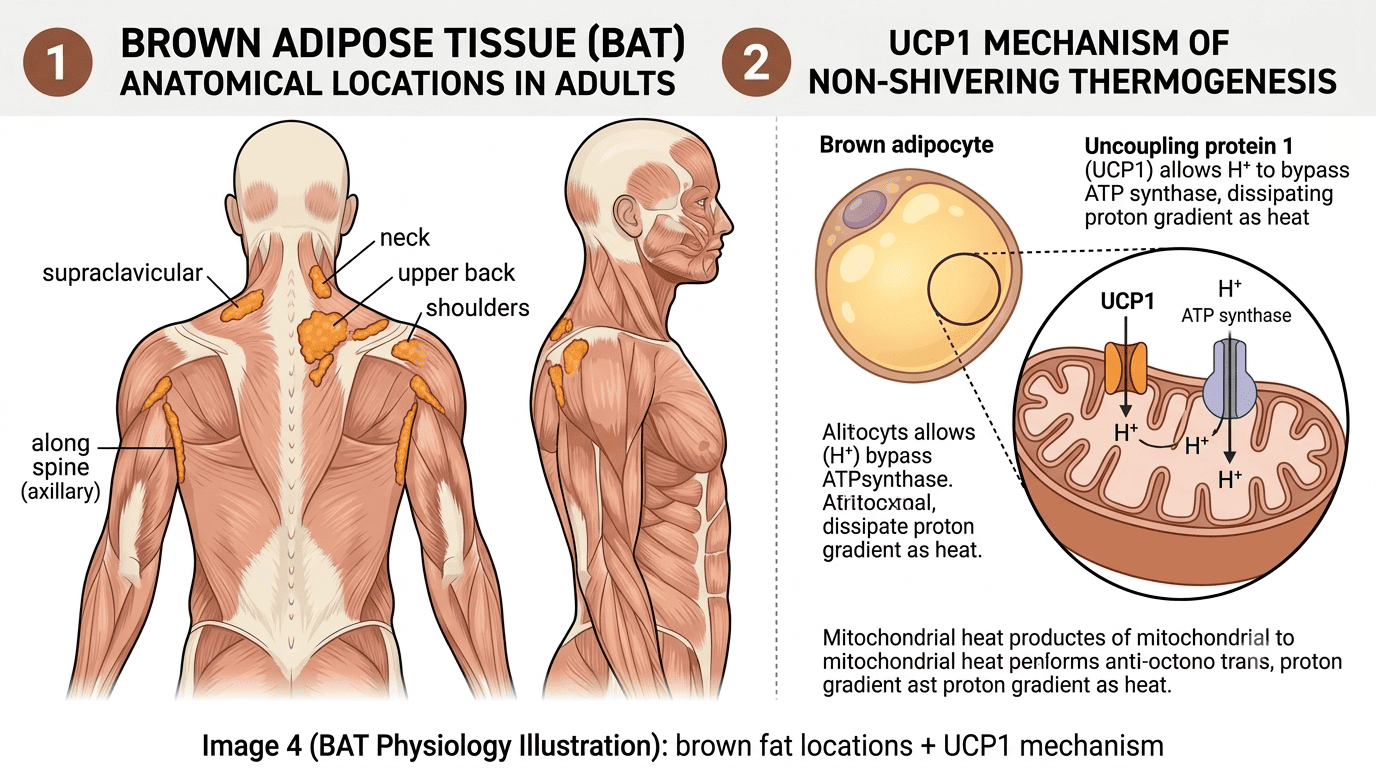
Brown adipose tissue (BAT), unlike white adipose tissue which stores energy, actually burns fatty acids to produce heat via UCP1 (uncoupling protein), a mitochondrial protein unique to brown fat. Adult humans retain functional BAT in specific locations: the supraclavicular region (around the neck), the upper back and shoulders, along the spine, and in smaller pockets around major blood vessels. Brown fat activation via non-shivering thermogenesis is a real physiological process, and cold exposure is the primary natural trigger. This is the mechanism cryotherapy studios reference when they discuss cryo fat loss.
The important nuance is duration. Cold acclimation studies (Van der Lans 2013, Yoneshiro 2013) show that adults can recruit more BAT through repeated cold exposure over weeks – either sustained mild cold (15-17C ambient temperature for hours per day) or repeated cold plunges. This BAT recruitment contributes roughly 90-190 kcal per day of additional thermogenesis at sustained cold exposure. But that daily contribution is spread across 24 hours of cool ambient conditions, not compressed into a single 3-minute high-intensity session. The Karppinen 2025 RCT specifically tested whether 5 months of 2-3 WBC sessions per week would produce measurable BAT recruitment; PET-CT imaging did not detect it.
This is the honest brown fat activation story: BAT is real, cold exposure activates it in principle, sustained cold protocols recruit more BAT over weeks, and cryotherapy protocols are shorter and less frequent than what appears to reliably recruit BAT in humans. Non-shivering thermogenesis at 90-190 kcal per day at sustained cold is real, but it’s not the same as burning 800 kcal in a single 3-minute session. Both facts can be true at once. For a deeper anatomical breakdown of what happens inside a cryotherapy chamber during a session, see What Is a Cryotherapy Chamber? Anatomy of a Modern Cryosauna .
Cryotherapy vs Cold Plunge vs Cold Shower: What Actually Works?
Different cold exposure methods differ meaningfully in physiological impact, and understanding those differences matters for anyone comparing cold plunge vs cryotherapy for cold therapy weight loss goals. The cold plunge vs cryotherapy question comes up frequently because the two modalities look superficially similar but produce different physiological signatures. Whole body cryotherapy (WBC) at -110C to -140C for 2-4 minutes produces the most intense skin cooling and the fastest sympathetic norepinephrine surge, but the total exposure time is very short and core body temperature stays largely stable. Cold plunge or ice bath at 10-15C water for 2-10 minutes produces moderate skin cooling plus meaningful core cooling because water transfers heat approximately 25 times faster than air. Cold shower at 12-16C for 1-5 minutes is the mildest but most accessible daily practice.
For brown adipose tissue recruitment specifically, the pattern in Van der Lans 2013 and Yoneshiro 2013 is consistent: sustained cold exposure repeated over weeks produces the most reliable brown fat activation adaptation. A daily cold shower routine or 2-3 cold plunges per week over 6-10 weeks aligns more closely with the protocols that have measurably recruited brown adipose tissue in human trials than an occasional 3-minute WBC session. In the cold plunge vs cryotherapy comparison, cold plunge tends to produce more sustained cold stimulus which favors brown fat activation adaptation over weeks. This does not mean WBC is useless – the whole body cryotherapy weight loss discussion is separate from WBC’s stronger evidence base in recovery and inflammation contexts (Bettoni 2013, Lombardi 2017 on IL-6 and CRP reduction). It means that for cryo fat loss expectations specifically, consistency and duration matter more than the intensity of any single session, and cryo fat loss protocols will look different from what studios often market.
So Should You Try Cryotherapy for Weight Loss? A Realistic Guide
The honest answer, based on Karppinen 2025 and the broader evidence, is that cryotherapy weight loss is not a reliable outcome to expect from WBC as a standalone intervention. Consumers asking does cryotherapy burn calories at meaningful rates should read the previous H2 (50-150 kcal per session), and consumers asking how many calories does cryotherapy burn over a full weekly protocol should recognize that even 2-3 sessions per week compound to at most a few hundred calories weekly – well below the caloric deficit needed for measurable weight loss. If you are trying WBC specifically for the scale or as a cold therapy weight loss shortcut, the evidence does not support that goal. If you are considering cryotherapy for adjacent benefits (recovery from training, inflammation reduction, mood support, small metabolic health marker improvements), those evidence bases are separately stronger. Cryotherapy metabolism effects are real at the mechanism level but their session-based magnitude is modest, so cryotherapy metabolism should be discussed honestly.
A realistic trial protocol looks like this: 2-3 WBC sessions per week for 4-8 weeks (matching the frequencies used in study protocols); track how you feel across energy, sleep quality, muscle recovery, and mood rather than obsessing over the weight scale; maintain diet and exercise as the primary weight management levers (the caloric-restriction control arm in Karppinen 2025 lost 11.5% body weight, essentially the same as the cryotherapy arm); and set the honest expectation that any weight change you see comes from diet and exercise, with cryotherapy as a supportive modality for adjacent recovery and metabolic benefits. This framing is more honest than ‘cryo will burn 500-800 calories per session’ – and it aligns better with what actually happens in real user experience. If you want an honest cold therapy weight loss context comparison, the sustained cold plunge routine may support brown fat activation over weeks more reliably than session-based WBC, though neither is a reliable standalone weight loss tool.
Are There Real Benefits Beyond Weight Loss? Yes
The Karppinen 2025 RCT found modest but real improvements in glucose control and LDL cholesterol in the WBC group versus the control. This is a legitimate metabolic health finding worth taking seriously – insulin sensitivity and lipid profile improvements matter over a lifetime even if they don’t move the scale. Earlier peer-reviewed research supports additional legitimate cold exposure benefits beyond weight loss. Bettoni 2013 and Lombardi 2017 (Frontiers in Physiology) documented modest reductions in systemic inflammation markers including IL-6 and CRP with regular WBC exposure – relevant for chronic inflammation, autoimmune conditions, and recovery from intensive training.
Costello et al 2015 (Cochrane Database Systematic Review) reviewed WBC for post-exercise muscle recovery and rated the evidence quality as very low – which is a real limitation to acknowledge honestly. Subjective recovery improvements were reported but rigorous evidence for improved objective outcomes is limited. Short-term mood improvements from the norepinephrine and endorphin surge post-session are well-documented and often the strongest immediate subjective benefit users report. The honest positioning of cryotherapy is that it is a supportive modality for recovery, inflammation management, mood, and some metabolic health markers – not a weight loss tool. That framing aligns with the evidence and delivers real value without overpromising. For operators serving recovery-focused clients honestly, explore Vacuactivus cryotherapy chambers and for the broader B2B buyer perspective on cryotherapy equipment, Cryotherapy Machine for Sale: Complete B2B Buyer’s Guide covers the operator perspective.
Frequently Asked Questions
Q1. Does cryotherapy actually work for weight loss?
Not meaningfully, according to the most recent research. A June 2025 randomized controlled trial by Karppinen and colleagues, published in Obesity, tracked 19 adults through 28 whole body cryotherapy sessions over 5 months. The cryotherapy group lost 11.9% body weight versus 11.5% in the control – a difference too small to be statistically meaningful. Both groups were on caloric restriction. Cryotherapy added no measurable weight loss beyond diet. It did, however, produce modest improvements in glucose control and LDL cholesterol.
Q2. How many calories does one cryotherapy session actually burn?
Realistic estimates put a single 3-minute whole body cryotherapy session at roughly 50-150 kcal of actual thermogenic energy expenditure. The widely marketed ‘500-800 calories per session’ figure has been classified as unsubstantiated by ACSH in February 2026 and has no peer-reviewed source. For context, jogging for 20 minutes burns roughly 200-250 kcal, so cryotherapy calories burned per session is substantially less than a modest cardio workout.
Q3. Does whole body cryotherapy activate brown fat?
Cold exposure does activate brown adipose tissue (BAT) in principle, through non-shivering thermogenesis and UCP1-mediated fatty acid oxidation. However, the 2025 Karppinen RCT specifically measured BAT activation via PET-CT imaging in cryotherapy participants and found no significant activation over 5 months of 2-3 sessions per week. Sustained cold exposure protocols (weeks of consistent cool ambient temperature) produce more reliable BAT recruitment than brief high-intensity cryotherapy sessions.
Q4. Is the ‘800 calories per cryotherapy session’ claim true?
No. The American Council on Science and Health traced this claim in a February 2026 review and classified it as unsubstantiated. It appears to originate from cryotherapy studio marketing rather than peer-reviewed research. No RCT has demonstrated 800 kcal of measured energy expenditure from a single WBC session. Realistic estimates sit in the 50-150 kcal range per session.
Q5. How often should I do cryotherapy for weight loss?
Given the 2025 RCT evidence showing no meaningful weight loss from WBC, no frequency is going to reliably produce weight loss on its own. If you are trying cryotherapy for recovery, inflammation, or metabolic health markers, most study protocols use 2-3 sessions per week for 4-8 weeks. Track how you feel across energy, sleep, and recovery rather than expecting scale changes.
Q6. What is the difference between cryotherapy and cryolipolysis for fat loss?
They are different techniques. Whole body cryotherapy (WBC) uses -110C to -140C air for 2-4 minutes as a systemic cold exposure and does not target fat cells directly. Cryolipolysis (also known as CoolSculpting) applies controlled cooling directly to specific fat pockets to trigger apoptosis in fat cells and is a body contouring procedure, not a general weight loss treatment. Cryolipolysis has FDA clearance for spot fat reduction; WBC does not have FDA weight loss claims.
Q7. Are there any real proven benefits of cryotherapy?
Yes, but not weight loss. The 2025 Karppinen RCT showed modest improvements in glucose control and LDL cholesterol. Earlier research supports reduced systemic inflammation markers (Bettoni 2013, Lombardi 2017), improved subjective recovery after exercise (though Cochrane 2015 rated evidence quality low), and short-term mood improvements from the norepinephrine surge. Cryotherapy is a legitimate adjunct for recovery and metabolic health markers, just not for weight loss specifically.
Q8. Cold plunge vs cryotherapy – which is better for burning fat?
Neither is a reliable fat-burning tool as a standalone. That said, sustained mild cold exposure (weeks of cool ambient temperature or regular cold plunges around 10-15C) produces more consistent brown fat adaptation than occasional 3-minute WBC sessions, based on studies like Van der Lans 2013 and Yoneshiro 2013. Cold plunge involves longer duration and core cooling. WBC is faster and more intense but shorter. For BAT recruitment, consistency matters more than intensity of any single session.
Conclusion
The honest verdict on cryotherapy weight loss: the newest and most rigorous evidence, Karppinen et al 2025 published in the peer-reviewed journal Obesity, shows no meaningful weight loss from 28 whole body cryotherapy sessions over 5 months versus a control group. On the related question of does cryotherapy burn calories at commercially useful rates, the widely marketed ‘800 calories per session’ figure has been classified as unsubstantiated by the American Council on Science and Health’s February 2026 review. Realistic per-session thermogenic energy expenditure sits in the 50-150 kcal range, and BAT recruitment via cryotherapy protocols has not been reliably demonstrated in RCT settings. Cold exposure does activate BAT in principle; sustained cold protocols recruit BAT more reliably than 2-3 minute high-intensity sessions.
That said, real benefits exist. Karppinen 2025 found modest improvements in glucose control and LDL cholesterol. Earlier research supports systemic inflammation reduction and subjective recovery and mood improvements. Cryotherapy is a legitimate supportive modality for recovery, inflammation management, and some metabolic health markers – just not a weight loss intervention. Vacuactivus manufactures cryotherapy chambers used across recovery studios and wellness centers globally, positioned for operators serving evidence-informed clients. For the full commercial equipment range, explore our cryotherapy and weight-loss equipment category and adjacent BodyShape vacuum fitness equipment for weight-management-adjacent modalities.


